Photo via The Guardian

What is Trump’s third-country deportation policy and who does it target?

Read the original at The Guardian ↗
Cite

Speri, A., & Loveluck, L. (2026, September 21). What is Trump’s third-country deportation policy and who does it target? The Guardian. https://www.theguardian.com/us-news/2026/sep/21/what-is-trump-third-country-deportation-policy

Dated when The Aporia collected the article, usually within hours of publication. Check the original for its exact date and byline.

The Guardian · collected 2026-09-21 · by Alice Speri, Louisa Loveluck

Quick Summary

Donald Trump’s administration has deported over 25,000 migrants, refugees, and asylum seekers since returning to office in 2025, using third-country agreements to send individuals to nations they may not have ties with. This policy involves striking deals with 35 countries, largely coordinated by the White House deputy chief of staff Stephen Miller, who has pledged at least $410 million for these arrangements. The Guardian participated in a joint investigation called the Deportation Project, which revealed that many individuals deported are sent to Mexico or other distant countries despite the U.S. claiming its focus is on deporting criminals.
Written by AI on 2026-09-21, from this article's own text only (the story summary below draws on all the coverage).
See how they differ ↓

AI analysis

Story summary

Since Donald Trump took office in January 2025, the US has secretly entered into agreements with 35 countries to deport more than 25,447 migrants, refugees, and asylum seekers who lack ties to those nations. The majority of these individuals were sent to Mexico, but others were dispersed across Latin America, Africa, and the Pacific region. These deals often involve payments from the US government—$410 million has been earmarked for this purpose—to help facilitate returns or directly to receiving countries. Human rights advocates criticize the policy as a "show of force," while the UNHCR supports states' responsibilities to protect refugees, stating that funds are used within their mandate to strengthen asylum systems globally.

Written for “US Third Country Deportations” on 2026-11-18, grounded in this article and the 3 other(s) covering the same event.

How they differ

4 outlets covered “US Third Country Deportations”.

What each outlet says

One AI summary per outlet of its latest article on this story, written from that article alone and checked against it. Open the article for the outlet's own words.

The GuardianThis outlet21 Sep

Donald Trump’s administration has deported over 25,000 migrants, refugees, and asylum seekers since returning to office in 2025, using third-country agreements to send individuals to nations they may not have ties with. This policy involves striking deals with 35 countries, largely coordinated by the White House deputy chief of staff Stephen Miller, who has pledged at least $410 million for these arrangements. The…

What is Trump’s third-country deportation policy and who does it target? (this article)
Euronews21 Sep

Since President Trump took office in January 2025, the US has been signing deals with developing countries to deport migrants who cannot legally be sent home. According to a report by Forbidden Stories, over 25,000 people have been deported to third countries under these agreements, primarily to Mexico but also to 27 other countries across Latin America, Africa, and the Pacific. The US has allocated $410 million for…

US has deported 25,000 people to third countries under secretive deals, report shows →
The Straits Times21 Sep

A report by Forbidden Stories reveals that since January 2025, the United States has deported over 25,000 people to third countries through secretive deals involving 35 nations and a $410 million budget. The investigation highlights that most deportees have been sent to Mexico, but others have gone to various Latin American, African, and Pacific countries. These agreements often involve direct payments or aid…

US has deported 25,000 to third countries under secretive deals: Report →
Dawn22 Sep

Forbidden Stories reports that since January 2025, the United States has secretly deported over 25,000 migrants to third countries under deals with 35 nations, spending $410 million in agreements and assistance. Most deportees were sent to Mexico, but others went to 27 other countries across Latin America, Africa, and the Pacific. The secretive negotiations are handled by a little-known State Department division…

US has secretly deported 25,000 migrants, says report →

Where they agree and split

Framing

How the first headlines put it

Attributed to a source2
Stated as fact1
The headlines (3)

US has deported 25,000 people to third countries under secretive deals, report shows Euronews · attributed to a source

US has deported 25,000 to third countries under secretive deals: Report The Straits Times · attributed to a source

What is Trump’s third-country deportation policy and who does it target? The Guardian · stated as fact

The full story: what happened, how it changed, and all 4 articles →

Compared with similar articles

This article reads leans left and hedges 14% of its claims. Each row says how that neighbour differs.
Dawn
Hedges 3 of 25 claims Outlet record 67/100
The Bulwark
Leans strongly left further left than this Hedges 2 of 20 claims
“The articles discuss different aspects of immigration and deportation policies under Trump's administration but do not describe the same specific incident or time period.”
The Straits Times
Leans left Hedges 3 of 17 claims Outlet record 64/100
“Article A describes the rejection of Trump's policy by an appeals court on September 18, while Article B explains what the third-country deportation policy is and its impacts since 2025.”
The Guardian
Leans right further right than this Hedges 10 of 95 claims Outlet record 64/100
“The articles describe different aspects of broader immigration policies under Trump's administration rather than a single specific incident.”
Times of India
Leans left Hedges 1 of 16 claims Outlet record 59/100
“Article A discusses a specific court ruling on third-country deportation policies, while Article B provides an overview and background of Trump's administration's third-country deportation policy.”
Euronews
Leans left Hedges 3 of 26 claims Outlet record 60/100
The Straits Times
Leans left Hedges 3 of 26 claims Outlet record 64/100
ABC News (US)
Leans left Hedges 2 of 10 claims Outlet record 67/100
“Article A discusses Trump's third-country deportation policy in general, while Article B reports on a specific legal case where a judge found the administration in contempt for twice deporting an asylum-seeker to El Salvador.”
ABC News (US)
Hedges 1 of 12 claims Outlet record 67/100
“Article A reports on a court decision rejecting a deportation policy, while Article B discusses Trump's third-country deportation policy and its effects.”
The Straits Times
Leans strongly right further right than this Hedges 4 of 23 claims Outlet record 64/100
“The articles describe different aspects of Trump's deportation policy: one discusses the overall implementation and numbers, while the other focuses on a legal action to allow continuation of the policy.”

Story

US Third Country Deportations
Politics · 4 article(s) covering the same event. Compare every outlet's account →
How this article was measured signals, leaning charts, publisher record, byline, topics and claims

Signals How these are calculated →

Claims extracted
35
sentences that state something as happening or true
Uncertain
14%
5 of 35 hedged ("reportedly", "may", "according to")
Leaning
Leans left
of the writing, not the subject · beta estimate
Publisher signals
64/100
The Guardian's corrections and hedging, across everything collected from it. Not a measure of accuracy.
Outlets on this story
4
Politics
Same framing elsewhere
1
articles that frame the event the way this one does
Analyzed 2026-09-21 · how these are computed

How this is being covered How these are calculated →

Article leaning vs. publisher reliability
Source leaning vs. consistency

Publisher

The Guardian · 2534 article(s) · 8 correction(s) detected
Running correction rate · 8 correction(s)

Who wrote this

Alice Speri
11 article(s) here · 1 carrying a prediction
Two other young DSA members, David Morales and Yousef Rabhi, were elected mayors of Providence, Rhode Island, and Ann Arbor, Michigan.
Trump’s 11th-hour suggestion, on election morning, that he would cut military aid to Israel at the end of the year because, as he put it, “they don’t need it”, was condemned across the board – with pro-Palestinian advocates dismissing it as “desperate” and pro-Israel ones as “unserious”.
He was released after a federal judge found he had probably been detained in retaliation of his advocacy for Palestinian rights, which the federal judge said would render his detention unlawful.
Official motorcades heading to the UN were diverted as protesters sat down in the middle of the street for more than an hour, unfurling banners that called to “end the genocide” and flying a kite reading “Free Palestine” – a reference to Israel’s threat earlier this year that it would target Palestinian children flying kites, organizers said.
The month-long trial ended with a hung jury but Jeff Rosen, the Santa Clara county district attorney, immediately announced his intention to retry the case before a judge ordered his recusal in May over a conflict of interest that, the judge said during court proceedings, would “render it unlikely that the defendants will receive fair treatment”.
Immigration judges had also ruled the people should be allowed to stay in the US because of credible fears they may face harm if sent home.
“If you come to our country and break our laws, we will arrest you and you will NEVER return,” the spokesperson said.
Nonetheless he ordered and participated in the torture of his victims because he had the power to do so and because he thought he would never be held accountable.”
Erakat told the Guardian that she and other critics of the county’s investment in Israeli bonds had planned to make statements at the hearing but that when they arrived there, the county’s mayor, Sara Baxter, told those present they could only speak for one minute as opposed to the slotted three.
Khalil, who missed the birth of his first son while in detention, was released in June 2025 but is continuing to fight the administration’s efforts to deport him – a protracted legal battle that is expected to ultimately be decided by the US supreme court.
Also by Alice Speri
Nothing else under this byline is closely related to this article, so these are simply their most recent.
All 11 articles by Alice Speri →
Louisa Loveluck
5 article(s) here · 1 carrying a prediction
The USAF added that its military prosecutors could take Mooty to a court martial based on the testimony of witnesses and what it called “indicators of impairment”.
The real documentary, directed by Oscar-winning film-makers Yuval Abraham and Rachel Szor, and produced by the Guardian, is in cinemas and will be shown in more than 50 countries.
2026-10-08 · assertive framing · Israel promotes film that mimics NAZA documentary
Immigration judges had also ruled the people should be allowed to stay in the US because of credible fears they may face harm if sent home.
No one would tell the shackled detainees onboard the US immigration plane where they were going.
Also by Louisa Loveluck
Nothing else under this byline is closely related to this article, so these are simply their most recent.

Topics

Forbidden Stories Guardian Paris the Department of Homeland Security the Deportation Project

Subjects

Trump PERSON · 4× Guardian ORG · 3× the Deportation Project ORG · 2× the Washington Post ORG · 2× Donald Trump’s PERSON · 1× Forbidden Stories ORG · 1× Paris GPE · 1× Stephen Miller PERSON · 1× White House ORG · 1× the Department of Homeland Security ORG · 1×

Narrative

A spokesperson for the UN agency that receives these funds, the UNHCR, said it supported “states in fulfilling their primary responsibility to protect refugees and asylum seekers on their territory by helping ensure that, irrespective of the circumstances of their arrival, they have access to asylum procedures and are not returned to places where they face a risk of harm”.
framing: assertive · carried by 1 article(s) · first seen 2026-09-21
Immigration judges had also ruled the people should be allowed to stay in the US because of credible fears they may face harm if sent home.
2026-09-21 · The Guardian
What is Trump’s third-country deportation policy and who does it target? · assertive framing

Claims (35 extracted, 5 hedged)

Since returning to office in 2025, Donald Trump’s administration has deported more than 25,000 migrants, refugees and asylum seekers to countries that are not their own. asserted
that → return → countries
Human rights lawyers describe these so-called third-country national arrangements as a “show of force”, intended to make people fear the consequences of entering the US without permission. asserted
people → describe → permission
To compile the most comprehensive account of a policy that has mostly operated behind closed doors, the Guardian joined 23 other media organisations in the Deportation Project, a joint investigation coordinated by Paris-based Forbidden Stories. asserted
Guardian → compile → Stories
The consortium interviewed more than 100 people affected by, or involved in, the US drive to extinguish unauthorised immigration, and reviewed documents outlining details of the agreements made by US officials with governments around the world. asserted
consortium → interview → world
The Trump administration has struck 35 deals allowing it to deport migrants and asylum seekers to countries that are not their own and where they often have no connections. asserted
they → strike → connections
Human rights lawyers say the administration is using a loophole: under US law it is illegal to send people back to countries where they are likely to be persecuted, and so the Department of Homeland Security is deporting migrants and asylum seekers to third countries instead. asserted
Department → say → countries
In many cases, however, the receiving countries then deport them onwards to the very place they fled. asserted
they → receive → place
Is this a new policy introduced by the Trump administration? asserted
this → introduce → administration
While the Trump administration trialled the policy during its first term, most of the deals with foreign countries have been struck since 2025. asserted
most → trialle → 2025
The US has pledged at least $410m (£307m) to secure such agreements with 35 countries, almost a third of them in Africa, according to internal records reviewed by the Washington Post as part of the Deportation Project. uncertain
US → pledge → Project
The drive is being led by the White House deputy chief of staff Stephen Miller, a fervent opponent of most migration to the US. asserted
drive → lead → US
It is being run out of the newly created Office of Remigration, a new section within the Department of State’s Bureau of Population, Refugees and Migration. asserted
It → run → Population
The name of the office incorporates a term adopted by the far right to describe the forcible expulsion of minority ethnic immigrants. asserted
name → incorporate → immigrants
Who is being deported? asserted
Who → deport → ?
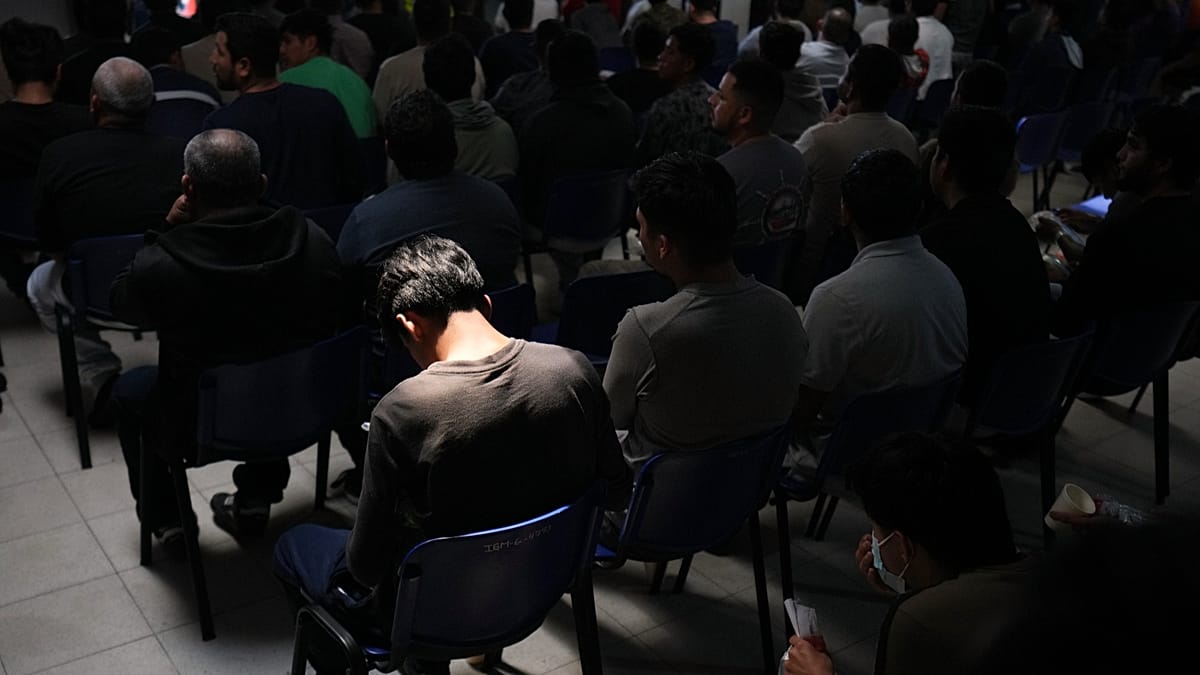
About 20,000 people have been bussed to Mexico, while at least 5,000 more have been put on planes to countries in Latin America, Africa, central Asia and the Caribbean. asserted
5,000 → buss → America
The Trump administration says its deportation drive is focusing on removing criminals from the US. asserted
drive → say → US
People interviewed by the Guardian for this project include a nurse, originally from Sierra Leone, who was her parents’ main carer in the US; an anti-government protester who fled the Iranian regime; and a gay man who fled Ghana after he was outed, and then hunted, by members of his family. asserted
he → interview → family
The state department claims that its priority is to deport people with criminal histories, but people interviewed by the Guardian said they had none. uncertain
they → claim → none
Immigration judges had also ruled the people should be allowed to stay in the US because of credible fears they may face harm if sent home. uncertain
they → rule → harm
And state department documents indicate that a majority of the 35 countries to have signed deals with the US have specified that they will not accept migrants with violent criminal records. asserted
they → indicate → records
Why would third countries agree to participate? asserted
countries → agree → ?
While the fine print of most deals remains opaque, the Trump administration is paying millions of dollars to the 35 countries that have agreed to accept foreign migrants, either temporarily or long term. asserted
that → remain → migrants
The state department is also using its foreign aid budget to sweeten the deals, allocating funds to UN agencies that support migrants in some of the third countries. asserted
that → use → countries
The internal state department records, reviewed by the Washington Post, indicate $30m was earmarked for Cameroon, in order to support UN operations in the country, in return for accepting 1,000 migrants. asserted
m → review → migrants
The US has so far sent only 44. The Democratic Republic of the Congo was promised $50m towards UN operations there in return for accepting 2,000 migrants. asserted
Republic → send → migrants
It has only received 15, and flights to Kinshasa are on hold because of the country’s Ebola outbreak. asserted
flights → receive → outbreak
A spokesperson for the UN agency that receives these funds, the UNHCR, said it supported “states in fulfilling their primary responsibility to protect refugees and asylum seekers on their territory by helping ensure that, irrespective of the circumstances of their arrival, they have access to asylum procedures and are not returned to places where they face a risk of harm”. asserted
they → receive → harm
chart showing Central African Republic has received the largest sum of payments from the US in deportation agreements Are third-country deportations legal? asserted
deportations → show → agreements
A US federal appeals court ruled on Friday that the Trump administration’s third-country removals policy was unlawful. asserted
policy → rule → Friday
A three-judge panel unanimously agreed that the policy violated due process by failing to give people enough notice of the decision to deport them, or the chance to legally contest it. asserted
policy → agree → it
Human rights lawyers said that meant third-country deportation flights should be grounded immediately. asserted
flights → say → ?
But the government has 90 days to appeal against the court’s decision, and is expected to do so. asserted
government → have → decision
“The third country deportation policy continues,” James Percival, the Department of Homeland Security’s general counsel, said in a statement. asserted
Percival → continue → statement
The ruling relates to a March 2025 lawsuit arguing that the US was sending people to places where they could be hurt or killed. uncertain
they → relate → places
While a US district judge issued a preliminary injunction in April 2025, resulting in a pause on deportation flights, the supreme court decided two months later that the policy could resume while the legal case played out, and the administration then ramped up the flights. uncertain
administration → issue → flights
Give feedback · no sign-in needed

No sign-in needed for now. Your note is sent without a name, so it cannot be answered.

History Support