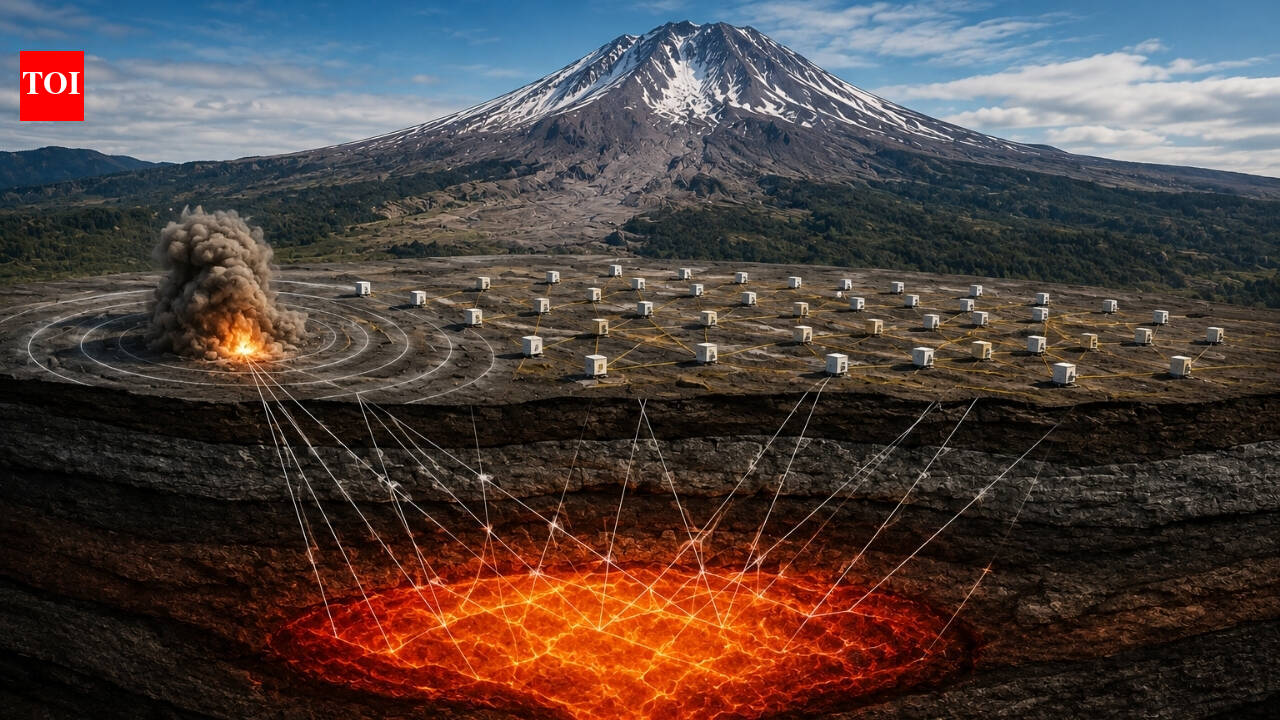
In 2014, scientists set off 23 blasts to uncover magma hidden beneath Mount St Helens

World News, Today World News, Latest International News, World Breaking News, Trending News of World - Times of India · collected 2026-08-25 · by TOI Science Desk
Read the original at World News, Today World News, Latest International News, World Breaking News, Trending News of World - Times of India ↗

Summary

Scientists at the Imaging Magma Under St. Helens (iMUSH) project used 23 controlled explosions in 2014 to map the magma hidden beneath Mount St. Helens. The experiment involved over 5,500 instruments that recorded seismic waves generated by the explosions, allowing researchers to identify an upper-crustal magma-storage zone roughly 4-15 kilometers beneath the volcano. This complex system of magma and rock is difficult to study using conventional methods, but the iMUSH project's approach provided a detailed image of the volcano's interior. The experiment was part of an interdisciplinary effort to investigate the magmatic plumbing system beneath Mount St. Helens.
Written by the local model on 2026-08-25, using this article's own text rather than the other coverage of the same event (that is the story summary below).

Signals How these are calculated →

Claims extracted
47
claim-shaped sentences
Uncertain
4%
2 of 47 hedged
Leaning
not political
takes no side on a contested political question
Publisher trust
94.0
red-flag proxy, not a credibility rating
Outlets on this story
1
Science
Narrative spread
1
articles carrying this framing
Analyzed 2026-08-25 · how these are computed

AI analysis (generated at analysis time, not now)

Story summary

In 2014, scientists conducted an experiment to map the magma beneath Mount St. Helens, one of the most studied volcanoes in the United States. Led by the Imaging Magma Under St. Helens (iMUSH) project, a team of researchers used 23 controlled explosions and a network of 800-1,000 Reftek seismic recorders to send waves through the ground and create a detailed image of the magma system beneath the volcano. The experiment was conducted over two weeks in late July and early August 2014, with a field crew of about 70 people involved. The results helped identify an upper-crustal magma-storage zone, which is estimated to contain 10-12% partial melt, roughly 4-15 kilometers beneath the volcano. This breakthrough was significant because it allowed scientists to visualize and understand the complex system of magma and rock hidden beneath Mount St. Helens.

Written for “Mount St Helens Eruption Experiment” on 2026-08-31, grounded in this article and the 0 other(s) covering the same event.
Why this leaning score
This article does not take a side on a contested political question, so it has no leaning score. That is an answer rather than a gap: a match report or a rescue can be warmly or critically written without being left or right, and scoring it anyway is how approval of a subject gets recorded as a political position.
No political leaning scored for article 2350 · logged 2026-08-27

Story

📰 Mount St Helens Eruption Experiment
Science · 1 article(s) covering the same event. This is the one the site leads with.

How this is being covered How these are calculated →

Article leaning vs. publisher reliability
Source leaning vs. consistency

Compared with similar articles

Nothing to compare against. No article is close enough to this one for the pipeline to have linked or judged the pair.

Publisher

World News, Today World News, Latest International News, World Breaking News, Trending News of World - Times of India · 97 article(s) · 0 correction(s) detected
SignalValueWeight
Correction rate 0.000 0.4
Uncertainty density 0.121 0.25
Assertive mismatch rate 0.000 0.35
No corrections detected for this publisher. That may mean careful reporting, or simply that nothing has been checked.

Who wrote this

TOI Science Desk
19 article(s) here · 1 carrying a prediction
🔮 A surface may be able to radiate heat towards the sky, but if it absorbs too much sunlight during the day, the solar heating can cancel much of that benefit.
🔮 High above the ice in Antarctica, a group of enormous balloons was quietly tracking a phenomenon that could not be seen from the ground.
🔮 If the current phase works as expected, the scale will change rapidly.
🔮 What if the rocks beneath our feet could one day be turned into a giant hydrogen factory, not by drilling up an existing fuel reserve, but by sending controlled bursts of electricity deep underground?
🔮 When Apollo 15 astronauts David Scott and James Irwin explored the Moon in 1971, they were looking for rocks that could reveal how the lunar surface formed.
🔮 Air voids replace white pigments The researchers built on earlier work showing that simple polymers such as acrylic, silicone and PET can be effective heat radiators and could be used for PDRC.
🔮 Such regions can be especially important during adaptation because genetic variants introduced through interbreeding may provide useful traits in changing environments.
🔮 Domestic cattle would have indicated contact between Ireland’s Mesolithic communities and Neolithic farming societies elsewhere in Europe.
🔮 A 2023 presentation to the Seismological Society of America described the upper-crustal low-velocity zone as the primary magma reservoir, with estimates suggesting it may contain roughly 10% to 12% partial melt.
🔮 Water vapour in the stratosphere can affect how the atmosphere handles radiation, so adding such a large amount was never expected to be climatically neutral.
Wire or desk byline, not an individual reporter.
Also by TOI Science Desk
In 2022, MIT researchers built a 4-inch cooler that kept food fresh without electricity
2026-08-28 · World News, Today World News, Latest International News, World Breaking News, Trending News of World - Times of India
Nasa sent 20 balloons over Antarctica in 2013 to track particles from space
2026-08-28 · World News, Today World News, Latest International News, World Breaking News, Trending News of World - Times of India
Scientists turn wood waste into foam that replaces plastic and decomposes in soil within months
2026-08-28 · World News, Today World News, Latest International News, World Breaking News, Trending News of World - Times of India
In 2025, a US startup used ‘underground lightning’ to crack rock and unlock hydrogen
2026-08-27 · World News, Today World News, Latest International News, World Breaking News, Trending News of World - Times of India
Nothing else under this byline is closely related to this article, so these are simply their most recent.
All 19 articles by TOI Science Desk →

Topics

Reftek iMUSH the United States

Subjects

iMUSH ORG · 2× Reftek ORG · 1× the United States GPE · 1×

Narrative

Researchers used roughly 800 to 1,000 Reftek seismic recorders along each of two major profiles, while another 1,600 to 1,800 instruments were deployed in broader arrays extending away from the volcano.
framing: assertive · carried by 1 article(s) · first seen 2026-08-25
🔮 A 2023 presentation to the Seismological Society of America described the upper-crustal low-velocity zone as the primary magma reservoir, with estimates suggesting it may contain roughly 10% to 12% partial melt.
2026-08-25 · World News, Today World News, Latest International News, World Breaking News, Trending News of World - Times of India
In 2014, scientists set off 23 blasts to uncover magma hidden beneath Mount St Helens · assertive framing

Claims (47 extracted, 2 hedged)

Mount St. Helens is one of the most closely studied volcanoes in the United States, but scientists still cannot directly see the complex system of magma and rock hidden beneath it. asserted
scientists → study → it
In 2014, researchers launched an ambitious experiment to change that. asserted
researchers → launch → that
According to the Imaging Magma Under St. Helens (iMUSH) project, a field team used 23 controlled explosions and a remarkably dense network of seismic instruments to send waves through the ground and map what lay beneath the volcano. uncertain
what → accord → volcano
The results, combined with later seismic studies, helped identify an upper-crustal magma-storage zone roughly 4 to 15 kilometres beneath the volcano. asserted
results → combine → volcano
An experiment beneath a volcano The 2014 project was part of iMUSH, an interdisciplinary effort designed to investigate the magmatic plumbing system beneath Mount St. Helens. asserted
project → design → Helens
Rather than waiting for natural earthquakes to provide the necessary seismic signals, researchers deliberately generated their own waves. asserted
researchers → wait → waves
In late July and early August 2014, a field crew of about 70 people conducted the active-source seismic experiment. asserted
crew → conduct → experiment
They created 23 controlled explosions at different distances from the volcano and recorded the resulting seismic waves using hundreds of instruments spread across the region. asserted
They → create → region
The explosions were not intended to imitate an eruption. asserted
explosions → intend → eruption
Instead, they acted as artificial seismic sources. asserted
they → act → sources
When an explosion sends waves through the Earth, those waves travel at different speeds through different types of rock. asserted
waves → send → rock
By measuring how quickly the waves arrive at numerous recording stations, scientists can work backwards to construct an image of the underground structure. asserted
scientists → measure → structure
Researchers used roughly 800 to 1,000 Reftek seismic recorders along each of two major profiles, while another 1,600 to 1,800 instruments were deployed in broader arrays extending away from the volcano. asserted
instruments → use → volcano
Closer to Mount St. Helens, about 300 additional instruments and 920 nodal seismic units were positioned along trails within roughly 7.5 kilometres of the summit. asserted
instruments → position → summit
The project also included more than a dozen large arrays around the volcano for recording natural earthquakes. asserted
project → include → earthquakes
The network was designed to capture seismic waves from many directions. asserted
network → design → directions
In total, the instruments recorded approximately 80,000 seismic traces from the 23 shots. asserted
instruments → record → shots
This dense coverage was important because a volcano is not built like a simple stack of uniform layers. asserted
volcano → build → layers
Its interior can contain fractured rock, solidified magma, partially molten material and other complicated structures. asserted
interior → contain → rock
Conventional seismic imaging can struggle in such environments. asserted
imaging → struggle → environments
Turning explosions into an underground map The researchers used the controlled seismic signals to study how waves travelled through the crust beneath Mount St. Helens. asserted
waves → turn → Helens
Two long seismic profiles extended as far as 150 kilometres from the volcano. asserted
profiles → extend → volcano
These were designed to investigate structures ranging from the upper crust down toward the boundary between Earth's crust and mantle, known as the Moho. asserted
These → design → Moho
Closer to the volcano, two rings of controlled shots were positioned at approximately 15 and 30 kilometres from the summit. asserted
rings → control → summit
These provided much denser seismic coverage of the shallower structures beneath and around Mount St. Helens. asserted
These → provide → Helens
Additional shots were placed as far as 50 to 80 kilometres from the summit to help probe deeper parts of the crust. asserted
shots → place → crust
The strategy allowed scientists to examine the volcano at multiple scales rather than simply looking for one large underground feature. asserted
scientists → allow → feature
One of the most important findings to emerge from seismic studies using iMUSH data was evidence for an upper-crustal magma-storage zone approximately 4 to 15 kilometres beneath Mount St. Helens. asserted
One → emerge → Helens
A low seismic velocity means that seismic waves travel more slowly through that region than through surrounding rock. asserted
waves → mean → rock
Such a feature can be produced by hot, fractured or partially molten material, making it an important clue to the location of magma. asserted
it → produce → magma
A 2023 presentation to the Seismological Society of America described the upper-crustal low-velocity zone as the primary magma reservoir, with estimates suggesting it may contain roughly 10% to 12% partial melt. uncertain
it → describe → melt
That does not mean the entire region is a giant underground pool of liquid magma. asserted
region → mean → magma
A magma reservoir is better understood as a complex zone containing varying proportions of molten material, crystals and surrounding rock. asserted
reservoir → understand → material
The seismic results also showed that Mount St. Helens is supplied by a much more complicated underground system than a simple pipe leading from a single magma chamber. asserted
Helens → show → chamber
Later receiver-function studies using iMUSH data identified variations in seismic properties throughout the crust. asserted
studies → use → crust
Researchers found evidence associated with the shallow magma reservoir as well as unusual high-velocity regions deeper in the crust. asserted
Researchers → find → crust
These deeper features have been interpreted in different ways, including as accumulated crystallised magma, known as magmatic cumulates, or other high-velocity geological material. asserted
features → interpret → cumulates
Researchers also used measurements of seismic-wave properties such as the ratio between P-wave and S-wave velocities to investigate variations within the crust. asserted
Researchers → use → crust
These analyses provided additional clues about the distribution and characteristics of the magma-related structures. asserted
analyses → provide → structures
Why Mount St. Helens matters Understanding what lies beneath Mount St. Helens is important because the volcano has a history of powerful eruptions, most famously its catastrophic 1980 eruption. asserted
volcano → matter → eruptions
…and 7 more, not listed.

💬 Give feedback
🕘 History 🎫 Support