Claims extracted
14
sentences that state something as happening or true
Uncertain
7%
1 of 14 hedged
("reportedly", "may", "according to")
Leaning
withheld
no quote in the article backed the model's score
Publisher signals
60/100
Euronews's corrections and
hedging, across everything collected from it. Not a measure of accuracy.
Outlets on this story
1
Politics
Same framing elsewhere
1
articles that frame the event the way this one does
Armenia’s Pashinyan laid out Yerevan's decision to formally apply for EU membership “in the near future” and to call for a national referendum, challenging Russia’s regional influence and setting the stage for a historic geopolitical shift.
asserted
Pashinyan → lay → shift
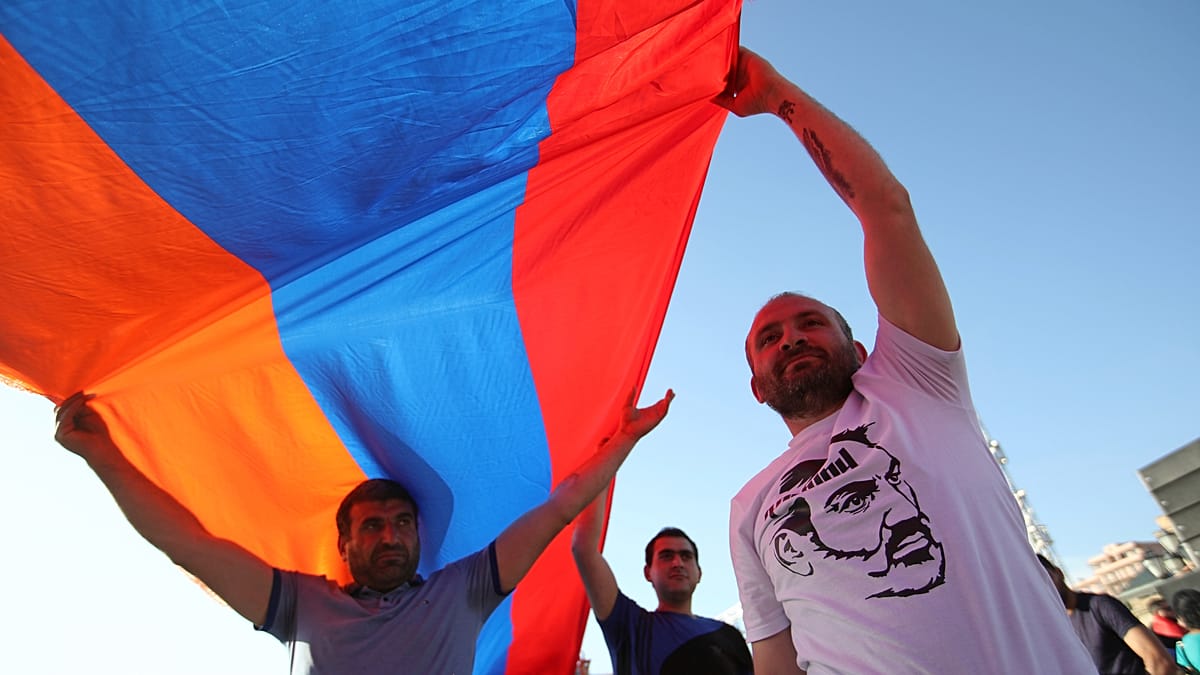
Armenian Prime Minister Nikol Pashinyan told the country’s lawmakers on Monday that Armenia would begin preparing to apply for EU membership, in a historic geopolitical shift for a country formerly in Russia’s orbit and for the South Caucasus as a whole.
asserted
Armenia → tell → whole
In a speech to parliament and the nation, Pashinyan said Armenia would decide its future through a referendum only after formally applying to join the EU, with a timeframe he described as “in the near future”.
asserted
he → say → future
In a calculated set of political moves, the Armenian premier said his government would wait for Brussels' answer to its application, then discuss the roadmap for EU accession negotiations, and only then put EU membership to a national referendum.
asserted
government → say → referendum
Currently a member of the Russia-led Collective Security Treaty Organisation (CSTO), Armenia was given an ultimatum a few months ago from alliance members to choose between continuing its membership or taking its own path toward the EU through a national referendum.
asserted
Armenia → lead → referendum
At the time, Pashinyan said it was premature to make such a decision, in the midst of a massive Russian onslaught of economic restrictions on the former Soviet state for daring to move out of its influence, with Russian president Vladimir Putin threatening Yerevan directly with a “Ukrainian scenario,” as EU and CSTO membership would be incompatible in the Kremlin’s view.
asserted
membership → say → view
But in his groundbreaking speech on Monday, Pashinyan said, “I would be very glad if the organisation decided to remove the Republic of Armenia from the Collective Security Treaty Organisation,” adding that “at least that would free us from the dilemma of whether or not to leave.”
asserted
that → say → dilemma
However, Pashinyan made it clear that Armenia would remain in the CSTO for the time being, until the choice between the Russia-led alliance and the EU “becomes unavoidable”.
asserted
choice → make → alliance
"For two centuries, Armenian-Russian relations have been built on the foundation and understanding that Russia is the guarantor of the security of the Armenian people and the Armenian state,” Pashinyan said, describing the current trajectory of his view on Russia’s role in Armenia’s future.
“The developments of 2021, 2022 and 2023 showed that, due to its own security challenges, the Russian Federation can at times face significant limitations in its ability to perform this role,” he added in reference to Armenia’s wars with Azerbaijan over Karabakh, which since then ended with a historic peace process between the two former rivals.
asserted
which → build → rivals
“This is where we once again came face to face with the fact that we have failed to learn the lessons of our history," the Armenian prime minister said of his vision of Russia’s role in Armenia’s future — a statement which he has repeated several times, pointing at the Kremlin for giving up on Armenia during its last confrontation with Azerbaijan.
asserted
he → come → Azerbaijan
After signing the peace process in August 2025, Armenia and Azerbaijan embarked on a future of economic cooperation and stability that the two former foes are forging ahead together on their own, with significant EU and US participation.
asserted
foes → sign → participation
Armenia’s economy still relies on Russian energy and infrastructure, but in another surprise move on Monday, Pashinyan asked Moscow to give up its monopoly concession of Armenian railways which runs until 2038 so that Yerevan can integrate its rail into international networks, with either Kazakhstan or the UAE as possible investors.
asserted
Yerevan → rely → investors
Russia responded swiftly to Pashinyan’s historic statements, with the Kremlin spokesperson Dmitry Peskov announcing that Armenia’s departure from the CSTO may trigger what he called “deep trade contradictions that will primarily harm Armenia.”
uncertain
that → respond → Armenia
“If Yerevan no longer needs membership in such an important organization for ensuring regional security due to its national interests, it is free to make the corresponding decision and leave this organisation,” Peskov said, signalling that the Kremlin was setting the stage for a turbulent path ahead with its former ally.
asserted
Kremlin → need → ally
 The Aporia