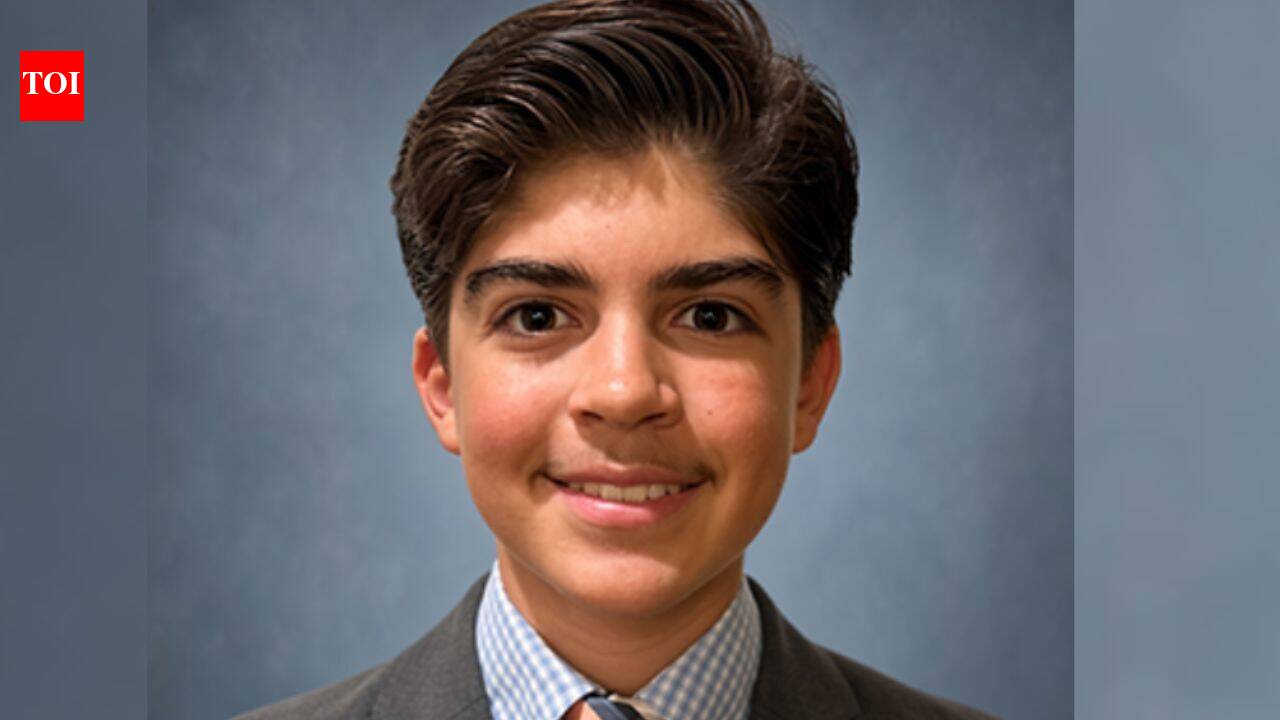
Kianoosh Nawai, an eighth-grader from West Virginia Virtual Academy, designed a low-cost, 3D-printed prosthetic hand aimed at making assistive technology more accessible. His project, "Design, Optimization and Evaluation of a Low-Cost, Compact Bionic Hand for Functional Restoration and Accessibility," involved studying human tendon mechanics and testing various prototypes to improve grip strength and finger movement efficiency. Nawai’s innovation earned him a spot among 30 finalists in the 2026 Thermo Fisher Scientific Junior Innovators Challenge from nearly 2,000 entrants nationwide.
Written locally by qwen2.5:14b on 2026-09-20,
using this article's own text rather than the other coverage of the
same event (that is the story summary below).
Kianoosh Nawai, an eighth-grader at West Virginia Virtual Academy, wanted to explore how technology could help people with disabilities.
uncertain
technology → want → disabilities
His project led him to design and build a 3D-printed prosthetic hand that aims to offer a lower-cost option for people who have lost a limb.
asserted
who → lead → limb
Now, the project has taken him to the national stage.
asserted
project → take → stage
Nawai has been selected as one of 30 finalists in the 2026 Thermo Fisher Scientific Junior Innovators Challenge, a national STEM competition for middle school students.
asserted
Nawai → select → students
According to Society for Science, he was the only student from West Virginia selected as a finalist from nearly 2,000 entrants across the country.
uncertain
he → accord → country
His project, titled “Design, Optimization and Evaluation of a Low-Cost, Compact Bionic Hand for Functional Restoration and Accessibility,” focuses on how a prosthetic hand can reproduce some of the movements of a human hand while keeping the design more affordable.
asserted
hand → title → design
To develop it, Nawai studied how the human hand works, particularly the tendons that help the fingers flex and extend.
asserted
fingers → develop → it
The project also has a personal connection for him.
asserted
project → have → him
Nawai's younger sister uses a cochlear implant, which made him interested in the role of assistive technology.
asserted
him → use → technology
“Watching how this type of bionic technology helps her hear and communicate made me realize how powerful assistive devices can be,” he says.
asserted
he → watch → technology
At the same time, he became interested in the limitations of existing technology and the cost of prosthetics for people who need them.
asserted
who → become → them
How the 3D-printed hand works
Nawai used a 3D printer to make the prosthetic hand.
asserted
Nawai → print → hand
Instead of using biological tendons, he used pulling line as the hand's “tendons”.
asserted
he → use → tendons
Thermoplastic polyurethane was used to provide resistance and help control the movement.
asserted
polyurethane → use → movement
Nawai tested different versions of the hand and measured their grip strength and the force needed to flex each finger.
asserted
Nawai → test → finger
He used a force gauge for these measurements.
asserted
He → use → measurements
Based on the results, he changed several parts of the design, including the pulling lines, the position of the pivots, the geometry of the joints and other components.
asserted
he → base → joints
This testing was important because Nawai wanted to see whether it could perform a basic function consistently.
uncertain
it → want → function
His final design can grip objects consistently.
asserted
design → grip → objects
The work is still developing.
asserted
work → develop → ?
Nawai hopes to eventually power the hand with an actuator so it can generate the force required for movement.
asserted
it → hop → movement
He also wants to study how different hand movements can be produced while using power efficiently.
asserted
movements → want → power
Nawai's younger sister uses a cochlear implant, which made him interested in the role of assistive technology.
asserted
him → use → technology
Building his own parts
Nawai' has been taking things apart and rebuilding them since he was five.
asserted
he → build → them
He also applies the same approach to motocross, or off-road motorcycle racing.
asserted
He → apply → road
“I constantly analyze performance, solve problems, and make small adjustments to improve both my riding and my bike,” he says.
asserted
he → analyze → riding
He has used his engineering skills to upgrade the motor on his bike and has also used his 3D printer to design and print parts for it.
asserted
He → use → it
Apart from motocross, Nawai enjoys road biking and gravel biking.
asserted
Nawai → enjoy → biking
His interest in anatomy and regenerative medicine has also shaped his future plans.
asserted
interest → shape → plans
He hopes to become a surgeon.
asserted
He → hop → ?
His work on the bionic hand was recognised through the West Virginia State Science and Engineering Fair.
asserted
work → recognise → Fair
The state's 2026 official results list Nawai in the medical sciences division for his project on bionic technology and regenerative medicine.
asserted
results → list → technology
Nawai to compete in Washington
asserted
Nawai → compete → Washington
Nawai will now take his project to Washington, DC, where the 30 finalists will take part in the final week of the 2026 Thermo Fisher Scientific Junior Innovators Challenge from October 23 to 28.
asserted
finalists → take → 28
The competition is organised by Society for Science and Thermo Fisher Scientific.
asserted
competition → organise → Science
The finalists will be judged not only on their science research projects but also on collaboration and critical thinking during team challenges.
asserted
finalists → judge → challenges
All 30 finalists will receive $500.
asserted
finalists → receive → 500
They will also compete for more than $100,000 in awards, including the $25,000 Thermo Fisher Scientific ASCEND Award.
asserted
They → compete → Award
 The Aporia