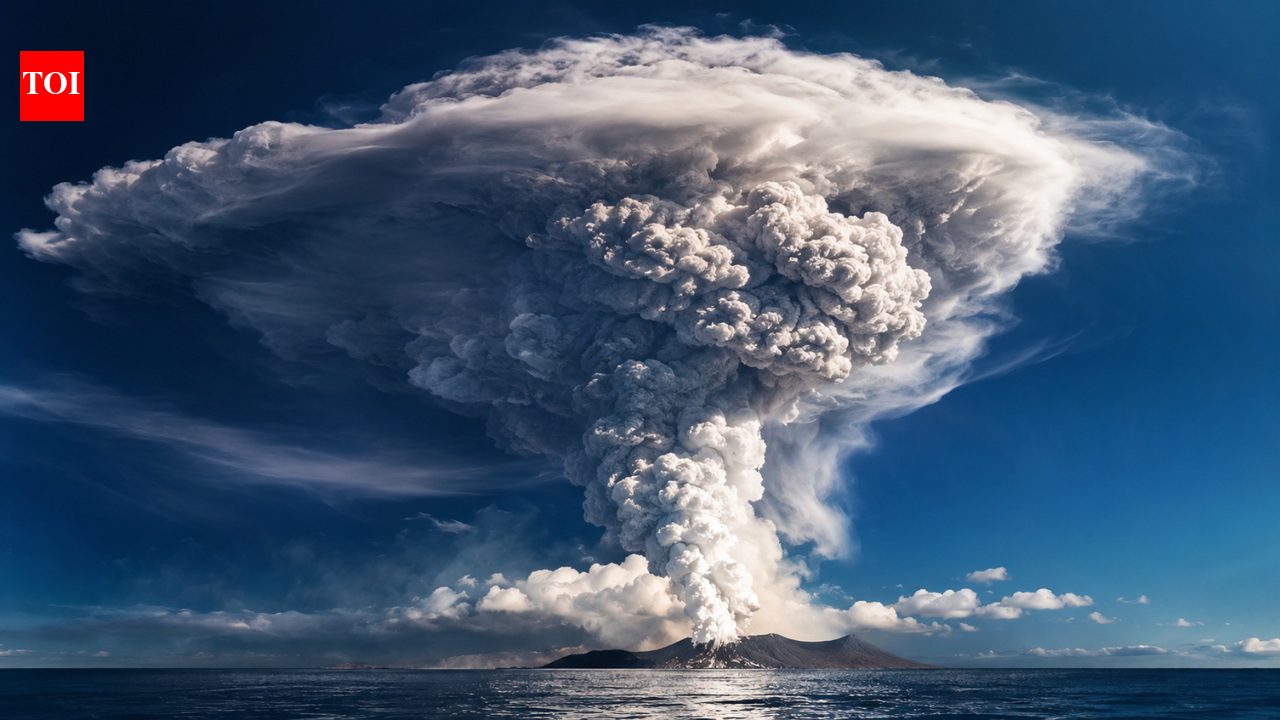
On 15 January 2022, an underwater volcano in the South Pacific sent an extraordinary amount of water vapour into a part of the atmosphere that is normally very dry.
asserted
that → send → atmosphere
The Hunga Tonga-Hunga Ha'apai eruption pushed the moisture high into the stratosphere, with the plume reaching as far as about 53 kilometres above Earth.
asserted
plume → push → Earth
Scientists estimated that around 146 teragrams of water entered the stratosphere, equivalent to roughly 10% of the water already held there.
asserted
teragrams → estimate → water
The unusual injection did not simply fade after the eruption.
asserted
injection → fade → eruption
The vapour spread around the globe and remained detectable through 2022 and 2023, while influencing temperatures, atmospheric circulation, ozone and the way radiation moved through the atmosphere.
asserted
radiation → spread → atmosphere
Later measurements showed that the added moisture's climate influence weakened as it dispersed, with most of the eruption's radiative effects close to disappearing by the end of 2023.
asserted
most → show → 2023
How Hunga Tonga sent huge amounts of water vapour into the stratosphere
Hunga Tonga-Hunga Ha'apai was a submarine volcano, and the setting mattered.
asserted
setting → send → stratosphere
Its caldera had previously been around 150 metres below sea level, meaning enormous volumes of seawater were close to the erupting magma.
asserted
volumes → mean → magma
According to the 2022 study published in Geophysical Research Letters, titled ‘
The Hunga Tonga-Hunga Ha'apai Hydration of the Stratosphere’, the eruption injected an estimated 5 teragrams of water vapour directly into the stratosphere.
uncertain
eruption → accord → stratosphere
That was roughly 10% of the water normally contained in the stratosphere, an amount far beyond anything recorded by the satellite instrument used in the study.
asserted
That → contain → study
The plume also reached 53 km on the day of the eruption.
asserted
plume → reach → eruption
Under normal conditions, much of the water that rises towards the stratosphere is removed near the cold point tropopause, leaving the upper atmosphere comparatively dry.
asserted
that → rise → atmosphere
Hunga Tonga bypassed much of that barrier.
asserted
Tonga → bypass → barrier
The researchers found that the volcanic water reached across a large part of the stratosphere and, at its highest point, into the mesosphere.
asserted
water → find → mesosphere
By 22 January, the upper part of the plume had travelled almost all the way around the planet, while lower sections were moving more slowly.
asserted
sections → travel → planet
By early February, the water had spread across all longitudes, with the strongest enhancements concentrated roughly 22 to 26 km above Earth.
asserted
enhancements → spread → Earth
Image AI genrated
asserted
AI → genrate → ?
Why Hunga Tonga’s water vapour did not simply cause warming
asserted
vapour → cause → warming
Water vapour in the stratosphere can affect how the atmosphere handles radiation, so adding such a large amount was never expected to be climatically neutral.
asserted
adding → affect → amount
Preliminary climate modelling suggested an effective radiative forcing of about +0.15 W/m² at the tropopause from the added water vapour.
uncertain
modelling → suggest → vapour
The researchers said this positive forcing could work against the cooling influence normally associated with volcanic sulfate aerosols.
uncertain
forcing → say → aerosols
Because the Hunga Tonga water plume was expected to remain in the stratosphere for longer than the roughly two to three years often associated with sulfate aerosols, the eruption raised the possibility of a different kind of volcanic climate influence, involving warming rather than cooling.
asserted
eruption → expect → cooling
But the atmosphere did not respond in a single, simple direction.
asserted
atmosphere → respond → direction
As the extra water absorbed and emitted infrared radiation, it helped cool parts of the stratosphere.
asserted
it → absorb → stratosphere
According to the 2024 study published in Advancing Earth and Space Sciences, titled ‘
Evolution of the Climate Forcing During the Two Years After the Hunga Tonga-Hunga Ha'apai Eruption’, tropical stratospheric temperatures dropped by about 4K during March and April 2022 as the additional water increased outgoing infrared radiation.
uncertain
water → accord → radiation
That cooling altered atmospheric circulation, which then affected temperatures and ozone farther away from the original volcanic plume.
asserted
which → cool → plume
In other words, the water did not stay as an isolated pocket above the South Pacific.
asserted
water → stay → Pacific
Its presence became linked to changes in the wider circulation of the stratosphere.
asserted
presence → link → stratosphere
How Hunga Tonga’s water vapour and sulfate aerosols affected climate differently
asserted
aerosols → affect → climate
Water vapour initially increased downward infrared radiation, producing a warming influence below it, but that effect weakened as the plume spread out.
asserted
plume → increase → it
At the same time, the eruption had also introduced sulfur dioxide, which formed sulfate aerosols capable of reducing incoming sunlight.
asserted
which → introduce → sunlight
The aerosol effect was larger than the water vapour effect across most of the two-year period they examined.
asserted
they → examine → period
Instead, the different pieces of the volcanic perturbation pushed in opposite directions.
asserted
pieces → push → directions
The water vapour also affected ozone through changes in circulation.
asserted
vapour → affect → circulation
In the Southern Hemisphere's extra-tropical stratosphere, the researchers observed an ozone decline during 2022 associated with a weakening of the downward branch of the Brewer-Dobson circulation.
asserted
researchers → observe → circulation
The 2024 analysis says that this circulation change was linked to radiative cooling produced by the Hunga water vapour anomaly, although natural atmospheric variability, including the quasi-biennial oscillation, also contributed.
asserted
variability → say → oscillation
The study therefore treats the eruption's influence as part of a much larger atmospheric system, rather than attributing every change to the volcano alone.
asserted
study → treat → volcano
Why Hunga Tonga’s climate effects faded by the end of 2023
asserted
effects → fade → 2023
The original 2022 observations suggested that Hunga Tonga’s unusual moisture could remain in the stratosphere for several years because of the size of the injection and the way the plume was carried through the atmosphere.
uncertain
plume → suggest → atmosphere
The water vapour moved with the Brewer-Dobson circulation towards higher latitudes and the upper stratosphere, and measurements continued to detect it in the lower and middle stratosphere even after it had spread around the globe.
asserted
it → move → globe
…and 4 more, not listed.
 The Aporia