Toronto Star
· collected 2026-09-19 · by Brandon Kaufman Special to the Star
Naoko Matsubara, an 89-year-old artist from Oakville, recently received Japan’s Order of the Rising Sun for her contributions to promoting cultural relations between Canada and Japan through her woodcut prints. Living in a house she designed that reflects Japanese modernism, Matsubara is known globally for her work, which is featured in renowned institutions such as the British Museum and the Smithsonian. The article highlights her journey from wartime Kyoto, where she first experienced the impact of war at age six, to her education under influential artist Felice Rix-Ueno, who taught her to respect materials like katsura wood.
Written locally by qwen2.5:14b on 2026-09-19,
using this article's own text rather than the other coverage of the
same event (that is the story summary below).
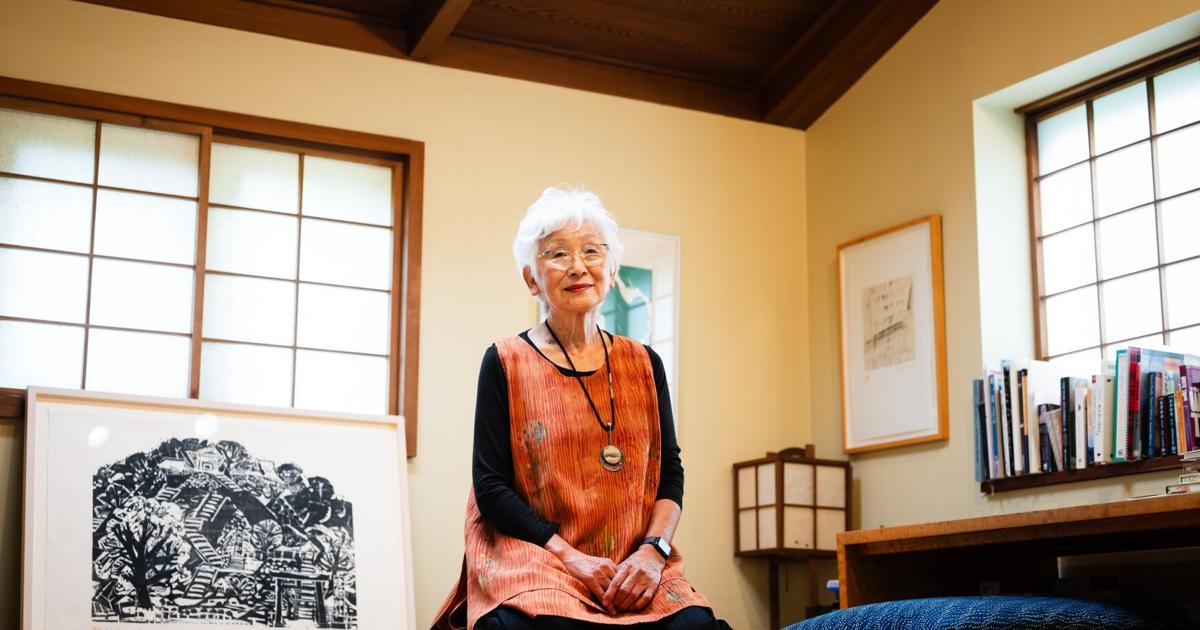
A few weeks ago, I visited the artist Naoko Matsubara at her home in Oakville, where she has lived since the 1970s.
asserted
she → visit → 1970s
The house, which she designed, is a majestic example of Japanese modernism, with its horizontal construction, low-set roofs and dark wood siding, set back in dense greenery.
asserted
she → design → greenery
Matsubara, who is 89, is one of the world’s foremost practitioners of the woodcut print, in which a design is carved into a block of wood, ink is applied to the block, and paper is pressed onto it to transfer the image.
asserted
paper → carve → image
In July, Naruhito, the Emperor of Japan, conferred the Order of the Rising Sun upon Matsubara, recognizing her effort to promote the relationship between Canada and Japan with her art.
asserted
Naruhito → confer → art
Indeed, her work is held by leading institutions around the world, including the British Museum, the Smithsonian, the Albertina, and Tokyo’s National Museum of Modern Art.
asserted
work → hold → Art
I sat with Matsubara in a white-walled living room lit bright by skylights and large windows.
asserted
I → sit → skylights
Large, colourful abstract prints — many of them Matsubara’s own — hung around the room.
asserted
many → hang → room
Nearby, a Corbusier chaise, exercise equipment and a grand piano gave the space the feel of a lived-in, multipurpose room.
asserted
chaise → give → room
More than the light and colour, what dominated was the smell of katsura wood.
asserted
dominated → dominate → wood
Matsubara brought us Japanese tea — “the real stuff,” she said with a laugh — and with humour and stylistic flair, told of how this daughter of a Shinto priest ended up an eminent artist living in Southern Ontario.
asserted
daughter → bring → Ontario
Origin of an artist
Matsubara grew up in Kyoto during the Second World War.
asserted
Matsubara → grow → War
Given its cultural treasures, the ancient city was one the Americans spared from bombing.
asserted
Americans → give → bombing
But Matsubara remembered being in Nagoya as a child when the bombing raids started.
asserted
raids → remember → child
The family evacuated to the deep country, passing trucks full of dead bodies.
asserted
family → evacuate → bodies
“A B-29 (bomber) was the first thing I started to draw,” she said.
asserted
she → start → ?
“When the bomb came down, it looked like fireworks to a child.”
asserted
it → come → child
In 1957, she enrolled at the Kyoto Academy of Fine Art, where she was taught by the artist Felice Rix-Ueno, who studied at the University of Applied Arts Vienna under Josef Hoffmann.
asserted
who → enrol → Hoffmann
Matsubara spoke about Rix-Ueno’s influence, especially her dictum to “respect the material” she worked with.
asserted
she → speak → material
Rix-Ueno illustrated this by asking students to bring a piece of katsura wood to class, along with some children’s cutting tools.
asserted
Ueno → illustrate → tools
She encouraged the students to work automatically, hacking away.
asserted
She → encourage → students
She then taught them how to print the designs in oil ink with handmade Japanese washi paper.
asserted
She → teach → paper
Then, Matsubara remembered, she told the class, “This is going to be your teacher.
asserted
This → remember → class
This will direct you.
asserted
This → direct → you
That line you could not make with pencil, nor a brush, nor anything.
uncertain
you → make → pencil
Only a knife in wood could make that.
uncertain
knife → make → that
However, this was not yet the moment that Matsubara decided to become a woodcut printmaker.
asserted
Matsubara → decide → ?
Instead, she said, she was more lost as an artist than ever.
asserted
she → say → artist
Rix-Ueno gave the promising but wayward student some advice: “Go abroad and look back and see what you really want to do.
asserted
you → give → what
You will find it.”
asserted
You → find → it
Matsubara eventually applied and was admitted to the MFA programs at Yale and Carnegie Mellon, choosing to attend the latter on a Fulbright scholarship.
asserted
Matsubara → apply → scholarship
There, in Pittsburgh, she immersed herself in an artistic milieu, experimenting with a variety of materials and techniques.
asserted
she → immerse → materials
Music as inspiration
One day in 1961, some other students invited Matsubara to a concert; she did not know the performer but decided to go anyway.
asserted
she → invite → performer
The man on stage playing a sitar mesmerized Matsubara, who sensed some incantatory power in the music.
asserted
who → play → music
His name, she read, was Ravi Shankar.
asserted
she → read → ?
“The next day I went (to my instructor) and said, ‘I would like to make a woodcut of Ravi Shankar.
asserted
I → go → Shankar
Can you get me some wood?’
asserted
you → get → wood
I don’t know why I said that, but I wanted it.”
asserted
I → know → it
Matsubara promptly got a piece of wood, which she cut down and started carving with two tools she had brought from Japan.
asserted
she → get → Japan
“It was so hard, but I tried and tried.
asserted
I → try → ?
Many weeks passed, and then I got ink and washi and printed it.
asserted
I → pass → it
…and 21 more, not listed.
 The Aporia