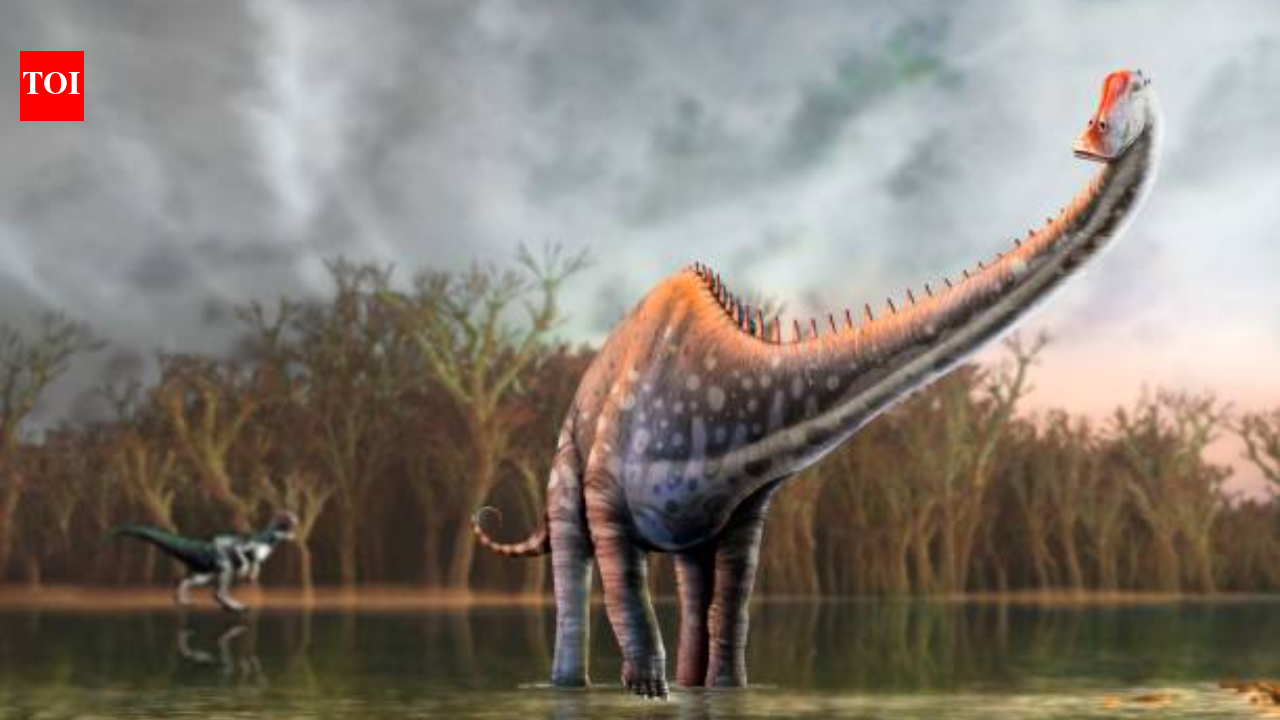
Palaeontologists in Spain have discovered the first confirmed Diplodocus fossils outside of North America, marking the first-ever discovery outside the area.
asserted
Palaeontologists → discover → area
For 150 years, every confirmed bone of the animal came from one place, the Morrison Formation of western US.
asserted
bone → confirm → US
But recently, Sergio Sanchez Fenollosa and his colleagues found the same anatomical signature in a set of tail vertebrae found in Teruel, Spain.
asserted
Fenollosa → find → Teruel
The roughly 150-million-year-old remains turned out to be the first confirmed Diplodocus fossils ever found outside North America, the team reported in the Journal of Vertebrate Palaeontology.
asserted
team → turn → Palaeontology
During the Late Jurassic, falling sea levels may have exposed land that dinosaurs could walk across between the continents.
uncertain
dinosaurs → fall → continents
“With each new result, the picture became clearer: we were looking at a Diplodocus,” Sánchez Fenollosa, the study’s lead author, said in a press release.
asserted
Fenollosa → become → release
The first five vertebrae turned up at La Tejeria back in 2008.
asserted
vertebrae → turn → 2008
It wasn’t until excavations in 2014 and 2015 that the team recovered nine more, along with several chevrons, the bones attached beneath the tail vertebrae.
asserted
team → recover → vertebrae
Some of the vertebrae were still connected in the order they’d been in while the animal was alive.
asserted
animal → connect → order
The whole find covered roughly 108 square feet (10 square meters).
asserted
find → cover → feet
According to Alberto Cobos, one of the study's co-authors, the animal was about 82 feet long.
uncertain
animal → accord → authors
Earlier finds from this family in the region included a tooth and scraps of hip and tail bone.
asserted
finds → include → bone
Sánchez Fenollosa, Cobos, and co-author Josué García Cobeña measured the bones by hand with callipers or a tape measure and compared them with published descriptions of other long-necked, plant-eating sauropods.
asserted
Fenollosa → measure → sauropods
The vertebrae had deep grooves running underneath and no ridges along the sides, while the chevrons were forked.
asserted
chevrons → have → sides
The excellent preservation of the specimen allowed the researchers to recognise several anatomical traits associated with Diplodocus, including:
- Large pneumatic cavities inside the vertebrae
- Deep longitudinal grooves along the underside of the tail bones
- Distinctive forked chevron bones with unique medial fossae
- Elongated vertebral centra without lateral ridges
The team recognised that combination in Diplodocus and checked the identification with computer analyses of the animals’ relationships.
asserted
team → allow → relationships
The results shuffled other parts of the family tree around, but every version placed the Spanish dinosaur on the Diplodocus branch.
asserted
version → shuffle → branch
From North America to Spain
Diplodocus now joins Allosaurus and Stegosaurus among dinosaurs from the Jurassic rocks on both sides of the Atlantic.
asserted
Diplodocus → join → Atlantic
It ranks among the most recognisable dinosaurs ever discovered.
asserted
It → rank → dinosaurs
It is known for its enormous length (up to 25 meters), long whip-like tail, and relatively small head.
asserted
It → know → length
Since Diplodocus was first discovered in the United States in 1878, casts of its skeleton have appeared in major natural history museums around the world, particularly during the early 20th century.
asserted
casts → discover → century
Those displays helped turn Diplodocus into an international symbol of palaeontology and one of the most familiar dinosaurs in popular culture.
asserted
displays → turn → culture
At the time these animals lived, the ocean was still opening between the continents.
asserted
ocean → live → continents
As sea levels fell, stretches of land may have appeared between what’s now Newfoundland and the Iberian Peninsula, home to modern Spain and Portugal.
uncertain
what → fall → Spain
Those temporary routes could have offered animals a way to wander from one continent to the other.
uncertain
routes → offer → other
However, it still remains unknown to the researchers exactly when Diplodocus crossed between them or which route it took.
asserted
it → remain → route
The team can identify the animal as Diplodocus, but the tail doesn’t preserve enough detail to pin down its species.
asserted
tail → identify → species
In their analyses, the Spanish animal came out closest to the North American species Diplodocus hallorum.
asserted
animal → come → species
Finding a more complete skeleton in Europe could help them work out just how closely the two were related.
uncertain
two → find → Europe
The sediments surrounding the bones were deposited on a coastal plain shaped by rivers.
asserted
sediments → surround → rivers
Other enormous plant eaters, including Turiasaurus and Losillasaurus, also lived in what is now Teruel, Cobos notes in the Dinópolis Foundation’s press release.
asserted
Cobos → include → release
These dinosaurs belonged to a different branch of the sauropod family.
asserted
dinosaurs → belong → family
The original tail bones are now on display at Dinópolis in Teruel, while visitors in El Castellar can see replicas of the bones unearthed nearby.
asserted
visitors → see → bones
 The Aporia