Claims extracted
24
sentences that state something as happening or true
Uncertain
21%
5 of 24 hedged
("reportedly", "may", "according to")
Leaning
not political
takes no side on a contested political question
Publisher signals
72/100
BBC News's corrections and
hedging, across everything collected from it. Not a measure of accuracy.
Outlets on this story
1
Environment
Same framing elsewhere
1
articles that frame the event the way this one does
- Published
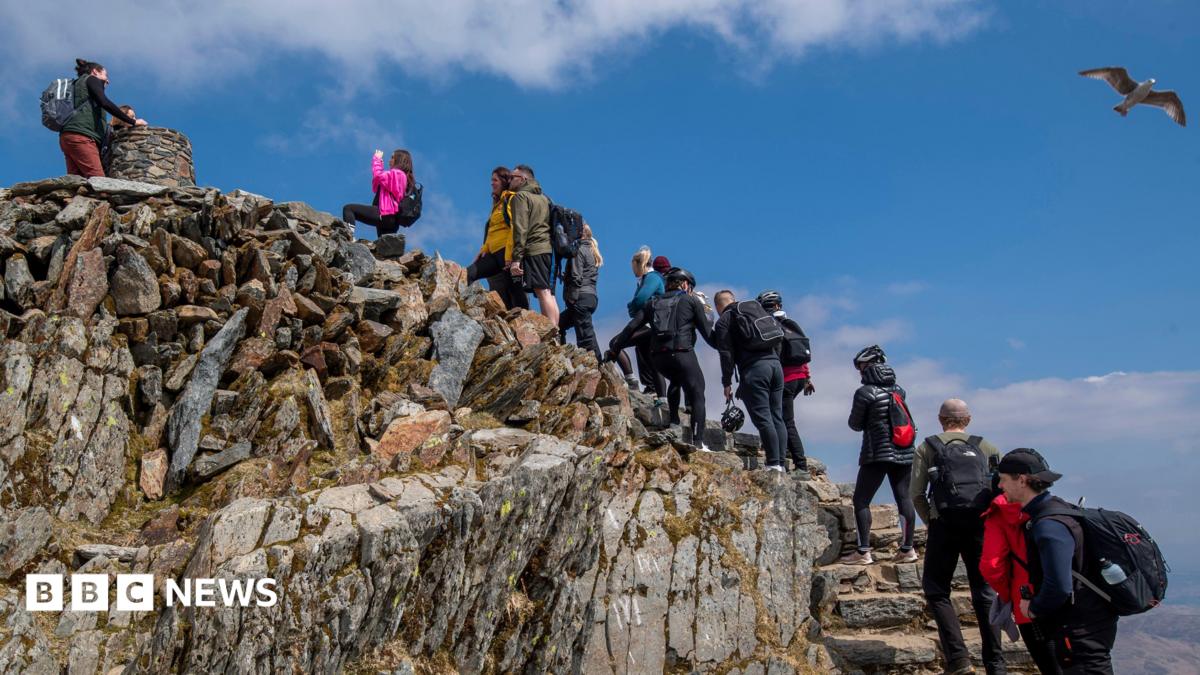
Visitors to Wales' highest mountain are being urged to respect others by not skipping queues to reach the top following rows among climbers.
asserted
Visitors → publish → climbers
Recent hot weather means there have been bumper summer crowds at Yr Wyddfa, also known as Snowdon, where people have reportedly waited more than one hour to reach the 1,085m (3,560ft)-high summit.
uncertain
people → mean → summit
Social media videos have shown arguments among queue-jumpers and those patiently waiting their turn to touch the metal plate that marks the top.
asserted
that → show → top
A recent video showed Marc Screeton, from Manchester, being heckled as he bypassed the line, saying: "Imagine queuing on a mountain?
asserted
he → show → mountain
But others have said queuing is necessary for safety reasons.
asserted
queuing → say → reasons
The mountain's growing popularity in Eryri National Park, also known as Snowdonia, has led to bottlenecks, and queues are now common on the stone steps leading to a metal plate or trig point where people pose for photos and videos.
asserted
people → grow → photos
Two charity hikers raising money for motor neurone disease were booed after skipping queues to reach the summit in May.
uncertain
hikers → raise → May
Speaking to BBC Wales, walkers on the mountain had mixed views about those jumping the queues.
asserted
walkers → speak → queues
Lucy Taylor said: "I think you should queue because it's really quite dangerous and everyone's trying to get up there - it's just not safe."
asserted
it → say → ?
Tina Millard from West Bromwich said: "I don't think that you should have to queue.
"
asserted
you → say → Bromwich
It's a mountain, you should just be able to go up and that's it.
asserted
that → go → ?
It's a mountain, it's for everyone," she said.
asserted
she → say → everyone
Carl Lynch from Dunstable, Bedfordshire said: "It should be: 'go up there, two minutes and then move on for everyone else'.
asserted
It → say → everyone
Throughout this year's hot weather national park wardens have urged visitors to follow the country code by leaving gates as they found them, taking their litter away with them and reducing the risks of wildfires.
asserted
they → urge → wildfires
They have also urged people to wait their turn when queuing.
asserted
They → urge → turn
Alun Jones, an area warden for Eryri National Park Authority, urged those wanting to reach the trig point to be "considerate and don't skip the queue".
asserted
Jones → urge → queue
While queuing is often not compulsory, it is often an "unwritten and unspoken" social contract, according to an expert in moral philosophy.
uncertain
it → accord → philosophy
Johann Go, who is also assistant professor of ethics at University College London, said: "So it's not that I have to queue, but given that others are already restraining themselves, if I were to then jump the queue, I would be saying 'to hell with them' and that my time is more valuable."
asserted
time → say → them
In May a pair of charity hikers were met with jeers from a queue at the summit as they tapped the trig point to complete a charity challenge.
uncertain
they → meet → challenge
Jamie Richardson, 32, and Richard Thiedeman, 34, from Lincolnshire, were climbing Yr Wyddfa as part of the Three Peaks challenge to raise money for their friend who has motor neurone disease (MND).
asserted
who → climb → disease
"I was getting booed and then there was a gentleman who was at the top, who had just had his photo taken and he physically tried to stop me," Richardson said.
asserted
Richardson → boo → me
He said he had just touched the summit point and heard someone say "you should be ashamed of yourself".
asserted
you → say → yourself
Richardson added: "There's no policing of it at all, it is purely free will, if you want to queue you can.
"
asserted
you → add → it
On social media, some described the scenes at the mountain over the May bank holiday weekend as having a carnival atmosphere due to the crowds there.
uncertain
some → describe → crowds
 The Aporia