Solar panels helped Puglia grapevines produce 277% more grapes

World News, Today World News, Latest International News, World Breaking News, Trending News of World - Times of India · collected 2026-08-21 · by TOI Science Desk
Read the original at World News, Today World News, Latest International News, World Breaking News, Trending News of World - Times of India ↗

Summary

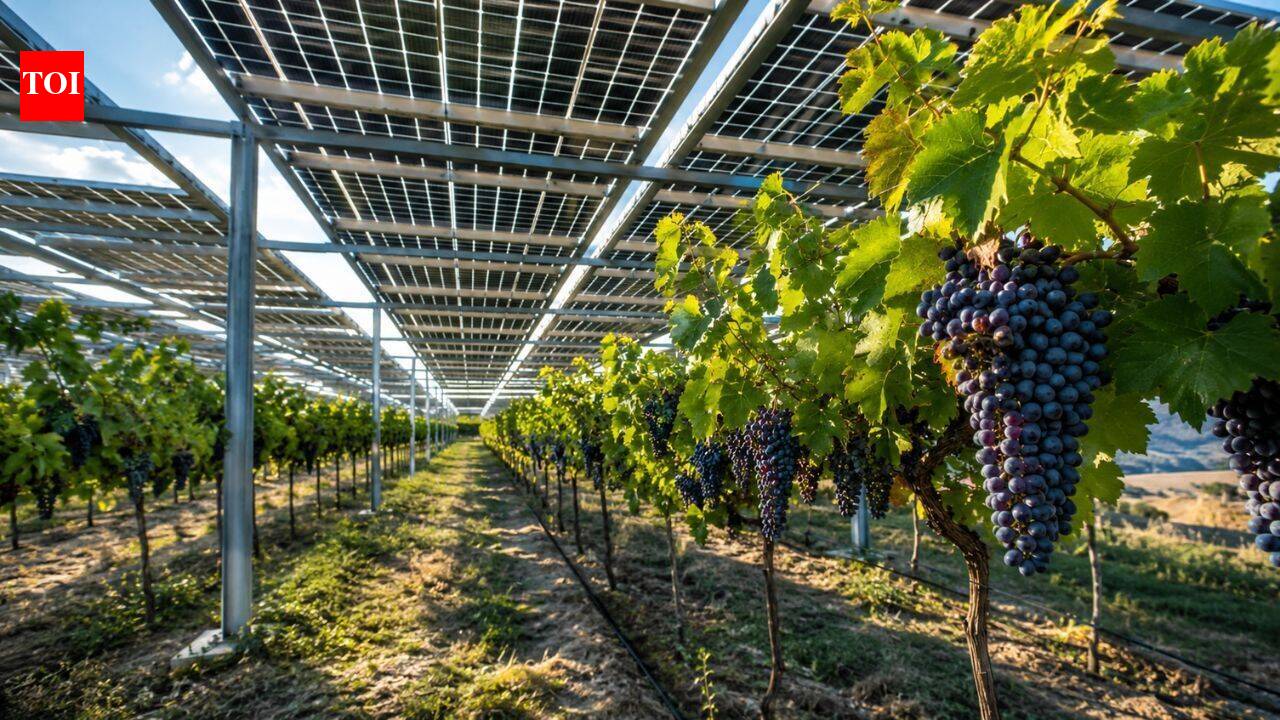
Researchers in Italy's Puglia region published a study in Horticulturae, finding that grapevines growing under photovoltaic panels produced 277% more grapes than those exposed to full sun. The experiment measured soil moisture, temperature, and weather conditions, as well as fruitfulness, and found that the panels provided shade, moderated temperatures, and helped retain moisture. The yield was significantly higher in shaded vines, with better bud fruitfulness suggesting a long-term benefit. This innovative approach to agriculture, known as agrivoltaics, could help farmland adapt to changing climate conditions while generating renewable energy.
Written by the local model on 2026-08-21, using this article's own text rather than the other coverage of the same event (that is the story summary below).

Signals How these are calculated →

Claims extracted
62
claim-shaped sentences
Uncertain
10%
6 of 62 hedged
Leaning
not political
takes no side on a contested political question
Publisher trust
94.0
red-flag proxy, not a credibility rating
Outlets on this story
1
Environment
Narrative spread
1
articles carrying this framing
Analyzed 2026-08-21 · how these are computed

AI analysis (generated at analysis time, not now)

Story summary

In Italy's Puglia region, researchers found that grapevines under *photovoltaic panels* produced 277% more grapes than those exposed to full sun. The study, published in the journal Horticulturae by MDPI, discovered that the panels created a calmer environment around the plants, with *wetter soil* and less extreme temperatures. This unique approach, known as agrivoltaics, allows for both crop growth and renewable electricity generation on the same land. The results have significant implications for farming in regions facing hotter and drier conditions, potentially enabling farmers to produce more food while also harnessing solar power.

Written for “Renewable Energy Boosts Grapes” on 2026-08-31, grounded in this article and the 0 other(s) covering the same event.
Why this leaning score
This article does not take a side on a contested political question, so it has no leaning score. That is an answer rather than a gap: a match report or a rescue can be warmly or critically written without being left or right, and scoring it anyway is how approval of a subject gets recorded as a political position.
No political leaning scored for article 1898 · logged 2026-08-28

Story

📰 Renewable Energy Boosts Grapes
Environment · 1 article(s) covering the same event. This is the one the site leads with.

How this is being covered How these are calculated →

Article leaning vs. publisher reliability
Source leaning vs. consistency

Compared with similar articles

This article reads unscored and hedges 10% of its claims. Each row says how that neighbour differs.
National Post
⚖️ leaning not scored 🔴 14% hedged 7 of 51 📰 publisher trust 96
“Article A discusses California wine grape growers burning their vines due to low demand, while Article B reports on a separate vineyard in Italy using solar panels to increase grape production”

Publisher

World News, Today World News, Latest International News, World Breaking News, Trending News of World - Times of India · 97 article(s) · 0 correction(s) detected
SignalValueWeight
Correction rate 0.000 0.4
Uncertainty density 0.121 0.25
Assertive mismatch rate 0.000 0.35
No corrections detected for this publisher. That may mean careful reporting, or simply that nothing has been checked.

Who wrote this

TOI Science Desk
19 article(s) here · 1 carrying a prediction
🔮 A surface may be able to radiate heat towards the sky, but if it absorbs too much sunlight during the day, the solar heating can cancel much of that benefit.
🔮 High above the ice in Antarctica, a group of enormous balloons was quietly tracking a phenomenon that could not be seen from the ground.
🔮 If the current phase works as expected, the scale will change rapidly.
🔮 What if the rocks beneath our feet could one day be turned into a giant hydrogen factory, not by drilling up an existing fuel reserve, but by sending controlled bursts of electricity deep underground?
🔮 When Apollo 15 astronauts David Scott and James Irwin explored the Moon in 1971, they were looking for rocks that could reveal how the lunar surface formed.
🔮 Air voids replace white pigments The researchers built on earlier work showing that simple polymers such as acrylic, silicone and PET can be effective heat radiators and could be used for PDRC.
🔮 Such regions can be especially important during adaptation because genetic variants introduced through interbreeding may provide useful traits in changing environments.
🔮 Domestic cattle would have indicated contact between Ireland’s Mesolithic communities and Neolithic farming societies elsewhere in Europe.
🔮 A 2023 presentation to the Seismological Society of America described the upper-crustal low-velocity zone as the primary magma reservoir, with estimates suggesting it may contain roughly 10% to 12% partial melt.
🔮 Water vapour in the stratosphere can affect how the atmosphere handles radiation, so adding such a large amount was never expected to be climatically neutral.
Wire or desk byline, not an individual reporter.
Also by TOI Science Desk
In 2022, MIT researchers built a 4-inch cooler that kept food fresh without electricity
2026-08-28 · World News, Today World News, Latest International News, World Breaking News, Trending News of World - Times of India
Nasa sent 20 balloons over Antarctica in 2013 to track particles from space
2026-08-28 · World News, Today World News, Latest International News, World Breaking News, Trending News of World - Times of India
Scientists turn wood waste into foam that replaces plastic and decomposes in soil within months
2026-08-28 · World News, Today World News, Latest International News, World Breaking News, Trending News of World - Times of India
In 2025, a US startup used ‘underground lightning’ to crack rock and unlock hydrogen
2026-08-27 · World News, Today World News, Latest International News, World Breaking News, Trending News of World - Times of India
Nothing else under this byline is closely related to this article, so these are simply their most recent.
All 19 articles by TOI Science Desk →

Topics

Italy MDPI Puglia

Subjects

Puglia GPE · 2× Italy GPE · 1× MDPI ORG · 1×

Narrative

The research published in Horticulturae by MDPI, titled ‘ Exploring the Grape Agrivoltaic System: Climate Modulation and Vine Benefits in the Puglia Region, Southeastern Italy’ revealed when the grapes were harvested in 2025, vines growing under the panels produced 277% more grapes than vines exposed to full sun.
framing: assertive · carried by 1 article(s) · first seen 2026-08-21
🔮 The result has added an unusual dimension to the debate over how farmland might cope with hotter, drier conditions while still being used to produce food and renewable electricity.
2026-08-21 · World News, Today World News, Latest International News, World Breaking News, Trending News of World - Times of India
Solar panels helped Puglia grapevines produce 277% more grapes · assertive framing

Claims (62 extracted, 6 hedged)

In a vineyard in Italy’s Puglia region, rows of grapevines grew beneath something more usually associated with power stations than agriculture: photovoltaic panels. asserted
rows → grow → agriculture
The arrangement changed the amount of sunlight reaching the vines, but it also altered what was happening much closer to the ground. asserted
what → change → ground
Soil stayed wetter, temperatures were less extreme and the air around the plants became calmer. asserted
air → stay → plants
The research published in Horticulturae by MDPI, titled ‘ Exploring the Grape Agrivoltaic System: Climate Modulation and Vine Benefits in the Puglia Region, Southeastern Italy’ revealed when the grapes were harvested in 2025, vines growing under the panels produced 277% more grapes than vines exposed to full sun. asserted
vines → publish → sun
The result has added an unusual dimension to the debate over how farmland might cope with hotter, drier conditions while still being used to produce food and renewable electricity. uncertain
farmland → add → food
How agrivoltaics helps grapevines grow better Agrivoltaics is based on a fairly simple idea. asserted
Agrivoltaics → help → idea
Instead of treating farmland and solar generation as competing uses of land, photovoltaic panels are positioned so that crops can continue growing beneath or between them. asserted
crops → treat → them
The arrangement is particularly interesting in Mediterranean farming regions, where agriculture is already dealing with less predictable rainfall, prolonged heat, drought and periods of unusually heavy rain. asserted
agriculture → deal → rain
Grapevines need sunlight, but excessive heat and water stress can affect both the quantity of fruit and how it develops. asserted
it → need → fruit
The Puglia experiment put that question into a practical setting. asserted
experiment → put → setting
Researchers examined grapevines growing beneath an agrivoltaic installation and compared them with vines receiving unobstructed sunlight. asserted
Researchers → examine → sunlight
They looked beyond the harvest itself, recording soil moisture, soil temperature, local weather conditions and the fruitfulness of the vines. asserted
They → look → vines
The panels changed the growing conditions in several ways at once. asserted
panels → change → ways
How solar panels helped grapevines produce 277% more grapes asserted
grapevines → help → grapes
According to the research, the most striking result was the yield. uncertain
result → accord → research
Grapevines growing under the photovoltaic panels produced 277% more grapes than those in full sun. asserted
Grapevines → grow → sun
The researchers also observed better bud fruitfulness on shaded canes, suggesting that the difference was already being reflected in the vines' reproductive performance. asserted
difference → observe → performance
The panels also helped the soil hold on to moisture. asserted
soil → help → moisture
With part of the ground shielded from direct solar radiation, water was lost less rapidly, while soil temperatures were moderated. asserted
temperatures → shield → radiation
A vineyard does not necessarily benefit from the highest possible amount of heat. asserted
vineyard → benefit → heat
There is a point at which additional warmth becomes a source of stress rather than an advantage. asserted
warmth → be → stress
The shade provided by the panels appears to have shifted that balance. asserted
shade → provide → balance
The vineyard’s biggest changes came from wind and atmospheric dryness The effect was not as simple as creating a cooler pocket of air beneath the panels. asserted
effect → come → panels
Measurements showed that the photovoltaic system had little effect on air temperature. asserted
system → show → temperature
Instead, some of the more subtle changes were found in wind and atmospheric dryness. asserted
some → find → wind
The panels also reduced the vapour pressure deficit, a measure related to how strongly the atmosphere draws moisture from plants and soil. asserted
atmosphere → reduce → plants
Even if the thermometer records a similar temperature, a plant can experience very different levels of water stress depending on humidity, wind and the amount of moisture available around its leaves and roots. asserted
plant → record → leaves
The agrivoltaic structure therefore acted less like a giant shade cloth and more like a change to the vineyard's immediate microclimate. asserted
structure → act → microclimate
The vines still occupied the same piece of land, but the conditions surrounding them were no longer quite the same. asserted
conditions → occupy → them
Grapevines received a different mix of light beneath the panels Light is an obvious concern when solar panels are placed above crops. asserted
panels → receive → crops
Grapevines need radiation for photosynthesis, and reducing direct sunlight too much could potentially work against the purpose of growing them there. uncertain
reducing → need → them
The measurements from Puglia produced a more complicated picture. asserted
measurements → produce → picture
Spectral analysis indicated that the light reaching the vines beneath the panels had a different composition. asserted
light → indicate → composition
There was an increase in UV and blue light, even though the panels reduced the overall exposure to direct sunlight. asserted
panels → be → sunlight
That does not mean the extra UV and blue wavelengths automatically explain the higher yield. asserted
wavelengths → mean → yield
The study points instead to a changed light environment that may influence how the vines respond and photosynthesise. uncertain
vines → point → environment
The result is a reminder that agrivoltaic systems are not simply about deciding how much shade a crop can tolerate. asserted
crop → decide → shade
The height, arrangement and spacing of panels can alter the light reaching plants in ways that are more complicated than a basic reduction in brightness. asserted
that → alter → brightness
Solar panels turned the vineyard into a dual harvest system There was a second harvest taking place above the vines. asserted
panels → turn → vines
The research published by MDPI reports that the photovoltaic installation generated substantial amounts of electricity, with the system producing more than 90% of the output achieved by a conventional ground-mounted solar arrangement. asserted
system → publish → arrangement
…and 22 more, not listed.

💬 Give feedback
🕘 History 🎫 Support