Scientists found the world’s fastest star moving at 15,500 miles per second

World News, Today World News, Latest International News, World Breaking News, Trending News of World - Times of India · collected 2026-08-20 · by TOI Science Desk
Read the original at World News, Today World News, Latest International News, World Breaking News, Trending News of World - Times of India ↗

Summary

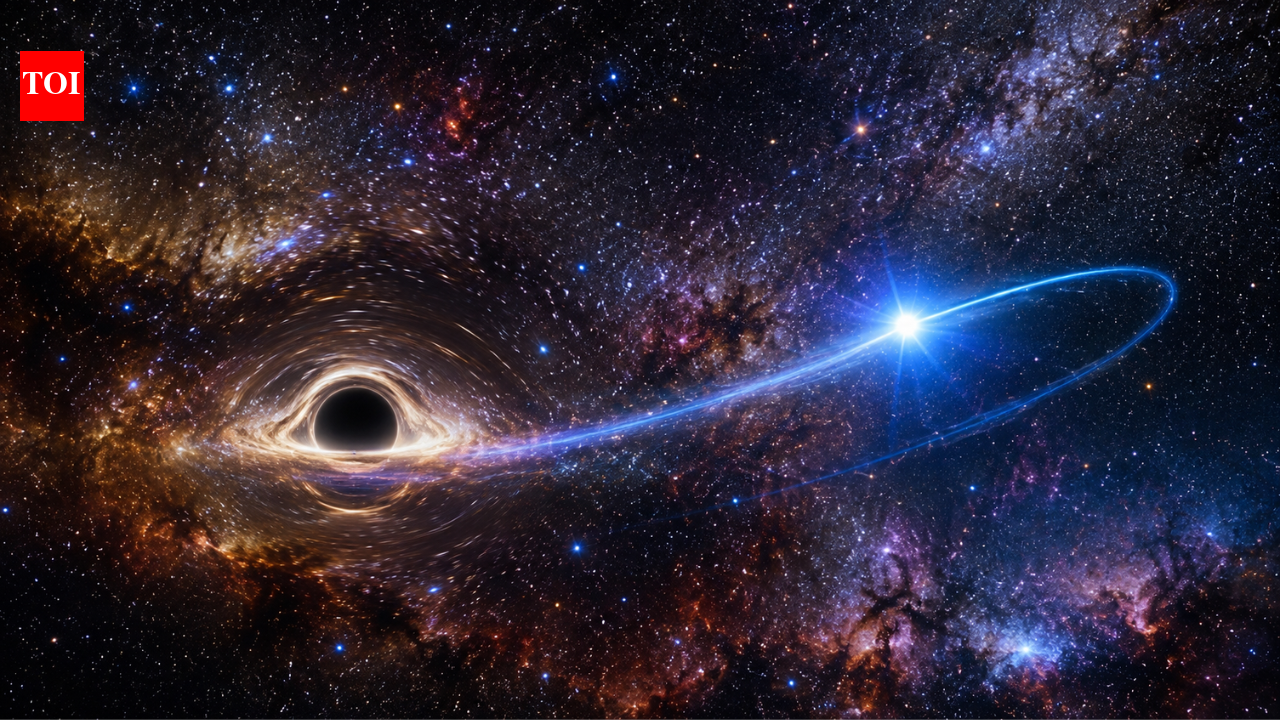
Astronomers have discovered the world's fastest known star, S301, which is currently hurtling through space at 15,500 miles per second, or 25,000 kilometers per second, around the supermassive black hole Sagittarius A* at the center of the Milky Way. The star comes within 1.8 billion kilometers of the black hole and completes an orbit in just 8.7 years. According to researchers, S301's speed is more than 8% of the speed of light, making it a rare opportunity for scientists to study the effects of a spinning black hole. The discovery also allows them to test predictions made by Albert Einstein's general theory of relativity.
Written by the local model on 2026-08-20, using this article's own text rather than the other coverage of the same event (that is the story summary below).

Signals How these are calculated →

Claims extracted
38
claim-shaped sentences
Uncertain
26%
10 of 38 hedged
Leaning
not political
takes no side on a contested political question
Publisher trust
94.0
red-flag proxy, not a credibility rating
Outlets on this story
1
Science
Narrative spread
1
articles carrying this framing
Analyzed 2026-08-20 · how these are computed

AI analysis (generated at analysis time, not now)

Story summary

Astronomers have discovered a star called S301 that is moving at 15,500 miles per second, making it the fastest known star in the Milky Way galaxy. This star is orbiting Sagittarius A*, a supermassive black hole located at the center of our galaxy, and completes an extremely tight orbit around it every 8.7 years. The star's speed approaches 25,000 kilometers per second, which is more than 8% of the speed of light, when it gets closest to the black hole. S301 is a faint star that comes closer to Sagittarius A* than any other known star, and its discovery may provide scientists with a rare opportunity to study the effects of a spinning black hole and test one of Albert Einstein's predictions about general relativity.

Written for “Fastest Star in Universe” on 2026-08-31, grounded in this article and the 0 other(s) covering the same event.
Why this leaning score
This article does not take a side on a contested political question, so it has no leaning score. That is an answer rather than a gap: a match report or a rescue can be warmly or critically written without being left or right, and scoring it anyway is how approval of a subject gets recorded as a political position.
No political leaning scored for article 1640 · logged 2026-08-31

Story

📰 Fastest Star in Universe
Science · 1 article(s) covering the same event. This is the one the site leads with.

How this is being covered How these are calculated →

Article leaning vs. publisher reliability
Source leaning vs. consistency

Compared with similar articles

Nothing to compare against. No article is close enough to this one for the pipeline to have linked or judged the pair.

Publisher

World News, Today World News, Latest International News, World Breaking News, Trending News of World - Times of India · 97 article(s) · 0 correction(s) detected
SignalValueWeight
Correction rate 0.000 0.4
Uncertainty density 0.121 0.25
Assertive mismatch rate 0.000 0.35
No corrections detected for this publisher. That may mean careful reporting, or simply that nothing has been checked.

Who wrote this

TOI Science Desk
19 article(s) here · 1 carrying a prediction
🔮 A surface may be able to radiate heat towards the sky, but if it absorbs too much sunlight during the day, the solar heating can cancel much of that benefit.
🔮 High above the ice in Antarctica, a group of enormous balloons was quietly tracking a phenomenon that could not be seen from the ground.
🔮 If the current phase works as expected, the scale will change rapidly.
🔮 What if the rocks beneath our feet could one day be turned into a giant hydrogen factory, not by drilling up an existing fuel reserve, but by sending controlled bursts of electricity deep underground?
🔮 When Apollo 15 astronauts David Scott and James Irwin explored the Moon in 1971, they were looking for rocks that could reveal how the lunar surface formed.
🔮 Air voids replace white pigments The researchers built on earlier work showing that simple polymers such as acrylic, silicone and PET can be effective heat radiators and could be used for PDRC.
🔮 Such regions can be especially important during adaptation because genetic variants introduced through interbreeding may provide useful traits in changing environments.
🔮 Domestic cattle would have indicated contact between Ireland’s Mesolithic communities and Neolithic farming societies elsewhere in Europe.
🔮 A 2023 presentation to the Seismological Society of America described the upper-crustal low-velocity zone as the primary magma reservoir, with estimates suggesting it may contain roughly 10% to 12% partial melt.
🔮 Water vapour in the stratosphere can affect how the atmosphere handles radiation, so adding such a large amount was never expected to be climatically neutral.
Wire or desk byline, not an individual reporter.
Also by TOI Science Desk
In 2022, MIT researchers built a 4-inch cooler that kept food fresh without electricity
2026-08-28 · World News, Today World News, Latest International News, World Breaking News, Trending News of World - Times of India
Nasa sent 20 balloons over Antarctica in 2013 to track particles from space
2026-08-28 · World News, Today World News, Latest International News, World Breaking News, Trending News of World - Times of India
Scientists turn wood waste into foam that replaces plastic and decomposes in soil within months
2026-08-28 · World News, Today World News, Latest International News, World Breaking News, Trending News of World - Times of India
In 2025, a US startup used ‘underground lightning’ to crack rock and unlock hydrogen
2026-08-27 · World News, Today World News, Latest International News, World Breaking News, Trending News of World - Times of India
Nothing else under this byline is closely related to this article, so these are simply their most recent.
All 19 articles by TOI Science Desk →

Topics

Chile GRAVITY S301 the European Southern Observatory's

Subjects

Einstein PERSON · 2× Albert Einstein's PERSON · 1× Chile GPE · 1× the European Southern Observatory's ORG · 1×

Narrative

Astronomers have found what is currently the fastest known star in the Milky Way, a faint star racing through the extreme environment around Sagittarius A*, the supermassive black hole at the centre of our galaxy.
framing: mixed · carried by 1 article(s) · first seen 2026-08-20
🔮 The discovery could give scientists a rare opportunity to study the effects of a spinning black hole and potentially test one of the predictions of Albert Einstein's general theory of relativity.
2026-08-20 · World News, Today World News, Latest International News, World Breaking News, Trending News of World - Times of India
Scientists found the world’s fastest star moving at 15,500 miles per second · mixed framing

Claims (38 extracted, 10 hedged)

Astronomers have found what is currently the fastest known star in the Milky Way, a faint star racing through the extreme environment around Sagittarius A*, the supermassive black hole at the centre of our galaxy. asserted
what → find → galaxy
Called S301, the star reaches a staggering speed of about 15,500 miles per second, or 25,000 kilometres per second, which is more than 8% of the speed of light. asserted
which → call → light
It completes an unusually tight orbit around the black hole in just 8.7 years and comes closer to Sagittarius A* than any other known star. asserted
It → complete → star
The discovery could give scientists a rare opportunity to study the effects of a spinning black hole and potentially test one of the predictions of Albert Einstein's general theory of relativity. uncertain
discovery → give → relativity
Scientists found a star travelling at 15,500 miles per second S301 is a faint star orbiting Sagittarius A*, which has a mass roughly 4.3 million times that of the Sun. asserted
which → find → Sun
The star reaches its highest speed when it gets closest to the black hole, travelling at about 25,000 kilometres per second. asserted
it → reach → second
That works out to roughly 56 million miles per hour and more than 8% of the speed of light. asserted
That → work → light
The star's orbit is highly stretched rather than circular, meaning it spends much of its journey farther from the black hole before making a rapid close pass. asserted
it → mean → pass
At its closest approach, S301 comes to roughly 12 times the distance between Earth and the Sun, or about 1.8 billion kilometres. asserted
S301 → come → Earth
S301 takes only 8.7 years to complete one trip around Sagittarius A*. asserted
S301 → take → *
What makes its orbit particularly important is how close the star comes to the black hole. asserted
star → make → hole
Its closest approach is unprecedented among the known stars orbiting Sagittarius A*. asserted
approach → know → *
The enormous gravity of the 4.3-million-solar-mass black hole accelerates the star to its record speed as it approaches. asserted
it → accelerate → speed
Despite coming extremely close on astronomical scales, S301 does not simply fall into Sagittarius A*. asserted
S301 → come → *
Its speed carries it through the closest part of its orbit and back out again. asserted
speed → carry → orbit
Researchers believe the star's highly elongated path could also provide clues about its past and how it ended up so close to the centre of the Milky Way. uncertain
it → believe → Way
Scientists used observations dating back to 2017 Researchers identified S301 using the GRAVITY instrument on the European Southern Observatory's Very Large Telescope Interferometer in Chile. asserted
Researchers → use → Chile
The team first spotted the star in observations from 2023 and then searched older observations, finding it in data from 2021 and 2017. asserted
team → spot → 2021
Combining these measurements allowed astronomers to work out the star's path around Sagittarius A* and estimate its speed and closest approach. asserted
astronomers → combine → speed
S301 is extremely faint, with the researchers describing it as a main-sequence star. asserted
researchers → describe → star
They estimate it has around 1.5 times the mass of the Sun and is about five times as bright. asserted
it → estimate → Sun
Its unusual orbit may also have an unusual origin. uncertain
orbit → have → origin
Researchers suggest it could once have been part of a binary system that ventured too close to the black hole. uncertain
that → suggest → hole
Sagittarius A* may have disrupted the pair, capturing S301 while sending its former companion flying away at enormous speed. uncertain
companion → disrupt → speed
The star could help test Einstein's theory The biggest scientific opportunity comes from S301's proximity to Sagittarius A*. uncertain
opportunity → help → *
Einstein's general theory of relativity predicts that a rotating black hole can drag the fabric of spacetime around with it. asserted
hole → predict → it
This effect is known as frame dragging or Lense-Thirring precession. asserted
effect → know → dragging
The spinning black hole should gradually change the orientation of a nearby object's orbit. asserted
hole → spin → orbit
Because S301 travels so close to Sagittarius A*, astronomers may be able to detect these subtle changes by carefully tracking its position over time. uncertain
astronomers → travel → time
If successful, the measurements could provide a direct way to determine the spin of the Milky Way's central black hole. uncertain
measurements → provide → hole
That would offer an important test of general relativity in one of the most extreme environments accessible to astronomers. asserted
That → offer → astronomers
Scientists already know Sagittarius A*'s mass with considerable precision, but measuring its spin is much harder. asserted
measuring → know → spin
The next big opportunity comes in 2031 Astronomers plan to continue monitoring S301 with the upgraded GRAVITY+ instrument and eventually with the European Southern Observatory's Extremely Large Telescope. asserted
Astronomers → come → Telescope
The star's next close pass around Sagittarius A* is expected in 2031, giving researchers another valuable opportunity to measure its motion. asserted
pass → expect → motion
Comparing observations from multiple points in its orbit could reveal tiny changes that would otherwise be difficult to detect. uncertain
that → compare → changes
The researchers published their findings in the journal Nature on August 19, 2026. asserted
researchers → publish → August
The discovery is important not simply because S301 has broken a stellar speed record, but because its extreme orbit turns the star into a natural laboratory for studying a supermassive black hole. asserted
orbit → break → hole
If scientists can detect the predicted orbital changes, S301 could help reveal how Sagittarius A* spins and provide a new test of Einstein's description of gravity. uncertain
* → detect → gravity

💬 Give feedback
🕘 History 🎫 Support