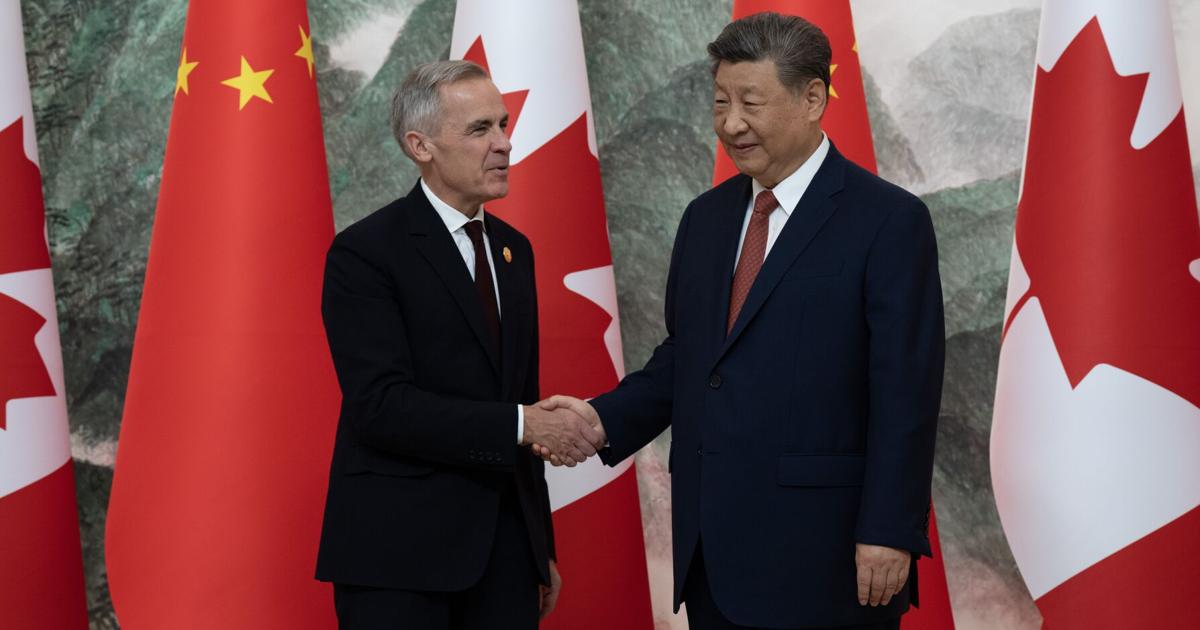
This week, Prime Minister Mark Carney stood in Shenzhen, China, shook hands with Premier Xi Jinping, and signed a $400-million trade deal — tariff relief for Canadian pork and seafood, extended breaks for Chinese steel and aluminum.
asserted
Carney → stand → steel
In the fine print, however, was a reaffirmation that Canada will admit 49,000 Chinese electric vehicles at 6.1 per cent, with real factory investment the price of entry.
asserted
investment → admit → entry
Days earlier in Cambodia, Carney had said the quiet part out loud: if U.S. talks don’t preserve a North American auto industry, Canada will turn to Chinese, European and Japanese automakers.
asserted
Canada → say → automakers
Any Chinese investment, he added, must mean “real factories, real processes,” not “knock-down kits.”
asserted
he → add → factories
Shenzhen turned that doctrine into ink.
asserted
Shenzhen → turn → ink
It is the most important thing said about our auto sector in a generation, and it deserves a serious debate, not a reflexive panic.
asserted
it → say → debate
Start with why the PM is suddenly so blunt.
asserted
PM → start → ?
Canada sends roughly 70 per cent of the vehicles it builds to the United States.
asserted
it → send → States
Trump’s tariffs have shredded that model — the Detroit Three are being told to move production south, and Stellantis just yanked the Jeep Compass out of Brampton.
asserted
Stellantis → shred → Brampton
Exports to China are up
Since January, Canadian exports to China are up 39 per cent; as U.S. tariffs escalated this summer, China’s share of Canada’s non-U.S. trade hit nearly 20 per cent.
asserted
share → escalate → cent
The old dependency is no longer a strategy — it’s a vulnerability.
asserted
it → ’ → ?
Premier Doug Ford sees a threat, and his worry isn’t imaginary.
asserted
worry → see → threat
Chinese EVs could unsettle a sector employing half a million Canadians.
uncertain
EVs → unsettle → Canadians
The deal itself nods to that fear: just 16,211 EVs have entered so far, only two companies are certified, and a price floor keeps a tenth of imports under $35,000, rising to half by 2030.
But the answer isn’t to shut the door — it’s to make sure what comes through is built here, and Carney has now drawn that line.
I was in Wuhu three weeks ago for Chery’s Innovation Week.
asserted
I → nod → Week
What I saw wasn’t a cliché low-cost factory — it was a humanoid robot directing traffic, robotaxis on open roads, autonomous tractors working fields — operating industry, not prototypes behind glass.
asserted
it → see → glass
Canada pioneered much of the battery science behind this transition and then watched others build the industry.
asserted
others → pioneer → industry
We walked away from a Sony gigafactory in 2014; when Northvolt collapsed last year, the gap was undeniable.
asserted
gap → walk → 2014
That’s the real story of the January deal, now lost in the shouting.
asserted
That → ’ → shouting
Canada cut its 100 per cent tariff on Chinese EVs to 6.1 per cent, with a quota that rises over time, in exchange for Chinese tariff cuts on canola and other farm goods.
asserted
that → cut → canola
In June, Industry Minister Mélanie Joly added conditions for any plant: a Canadian-controlled joint venture, Canadian suppliers, Canadian labour standards and data security.
asserted
Joly → add → plant
Shenzhen raised the bar higher still — tariff relief extended to 2028, CEO-to-CEO talks, even a joint documentary on China’s EV industry.
asserted
Shenzhen → raise → industry
Market access for factories
Read the terms together and a coherent policy appears: market access in exchange for factories, jobs and know-how that stay in Canada.
asserted
that → read → Canada
It is the playbook Canada ran when Japanese automakers arrived in the 1980s, when industry and unions also warned of lost jobs.
asserted
industry → run → jobs
Instead we engaged — Honda’s Alliston plant opened in 1986, and a feared competitor became a source of Canadian strength.
asserted
competitor → engage → strength
That argues for firmer guardrails — Canadian-majority ownership, real labour standards, supply chains that grow here — not for abandoning the one playbook that has worked before.
asserted
that → argue → playbook
So Ford is right that Ontario’s workers must not be sacrificed, but wrong if he thinks the answer is no.
asserted
answer → sacrifice → ?
It is a sovereignty we build — turning Carney’s “real factories” into real Canadian jobs — or one we assert while the industry moves on without us.
asserted
industry → build → us
The prime minister has picked a side, and in Shenzhen he put pen to paper.
asserted
he → pick → paper
Ontario should hold him to it, and help him win it.
asserted
him → hold → it
 The Aporia