Photo via Times of India

Trump pushes ban on Chinese AI data center gear despite tech giants' pushback

Read the original at Times of India ↗
Cite

TOI World Desk. (2026, November 18). Trump pushes ban on Chinese AI data center gear despite tech giants' pushback. Times of India. https://timesofindia.indiatimes.com/world/us/donald-trump-is-pushing-ahead-with-restrictions-on-chinese-equipment-used-inside-us-ai-data-centres-despite-objections-from-amazon-google-and-meta-tech-firms-say-replacing-the-components-could-take-10-years/articleshow/135952007.cms

Dated from the outlet's own feed. Check the original for its byline.

Times of India · collected 2026-11-18 · by TOI World Desk

Quick Summary

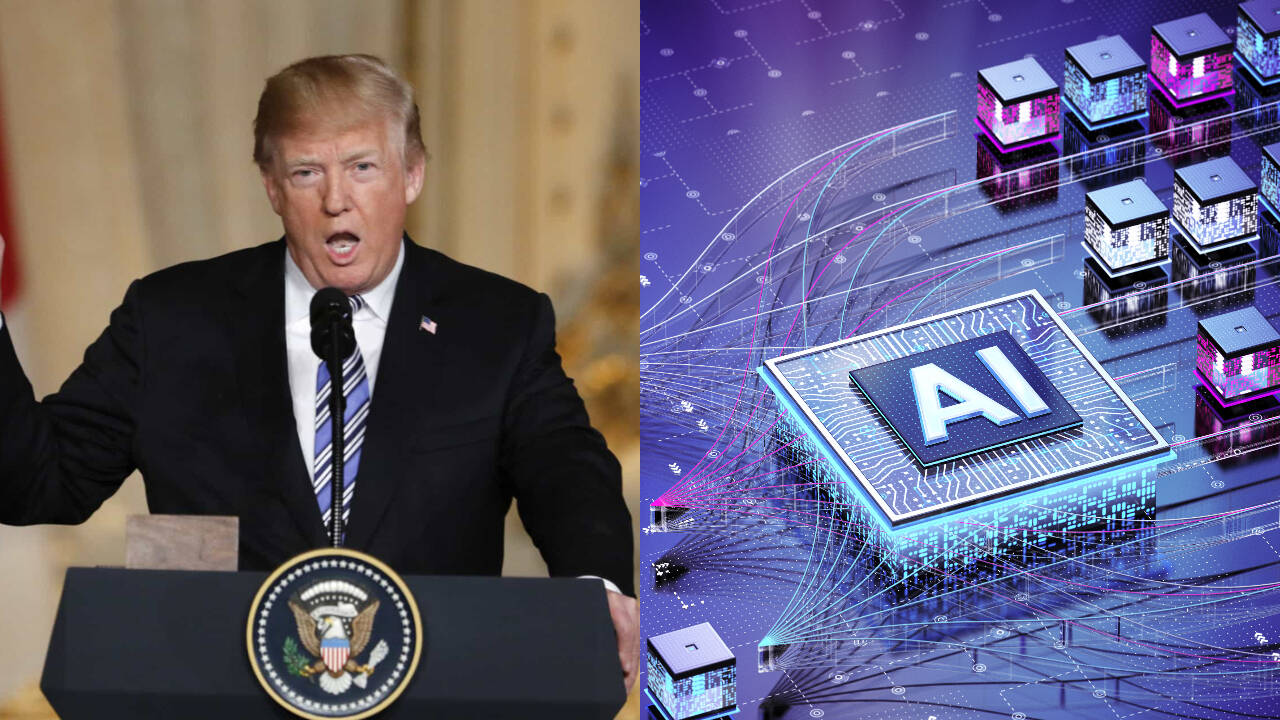
The Trump administration is pushing ahead with a ban on Chinese optical transceivers used in AI data centers, despite opposition from major tech companies like Amazon, Google, and Microsoft. Federal regulators at the FCC are moving forward with the restriction due to national security concerns, even though tech giants argue that replacing Chinese-made components could take up to a decade given the dominance of Chinese suppliers in the market. Meanwhile, Beijing is seeking to ease export bans on high-bandwidth memory chips, crucial for AI model development, amid negotiations with the US.
Written by AI on 2026-11-18, from this article's own text only.

AI analysis

Why this leaning score
The article's own words the score was based on. Each is quoted verbatim and was checked against the article text before being stored, so you can find it in the original.
Reading Leans strongly right (beta estimate) Confidence high
Leaning: leans strongly right for article 163102 (high confidence, 3 verified quotes) · logged 2026-11-18

Compared with similar articles

This article reads leans strongly right and hedges 30% of its claims. Each row says how that neighbour differs.
The Straits Times
Leans right further left than this Hedges 0 of 9 claims Outlet record 64/100
“The articles describe different stages or aspects of the ongoing tension between the US and China over AI technology, with Article B specifically mentioning a rule issued on Nov 16, while Article A does not specify a date for the proposed ban.”
How this article was measured signals, leaning charts, publisher record, byline, topics and claims

Signals How these are calculated →

Claims extracted
20
sentences that state something as happening or true
Uncertain
30%
6 of 20 hedged ("reportedly", "may", "according to")
Leaning
Leans strongly right
of the writing, not the subject · beta estimate
Publisher signals
59/100
Times of India's corrections and hedging, across everything collected from it. Not a measure of accuracy.
Outlets on this story
unclustered
not grouped into a story yet
Same framing elsewhere
1
articles that frame the event the way this one does
Analyzed 2026-11-18 · how these are computed

How this is being covered How these are calculated →

Article leaning vs. publisher reliability
Source leaning vs. consistency

Publisher

Times of India · 5272 article(s) · 6 correction(s) detected
Running correction rate · 6 correction(s)

Who wrote this

TOI World Desk
1544 article(s) here · 1 carrying a prediction
In 1980, Billy Starr launched a charity bike ride in Massachusetts with a simple idea: cyclists could turn miles into money for cancer research.
Despite fierce resistance from Silicon Valley’s biggest hyperscalers—including Amazon, Google, Meta, Microsoft, CoreWeave, and Cisco—federal regulators at the Federal Communications Commission are advancing the restriction over national security fears that Beijing could exploit the hardware to harvest sensitive data, implant malware, or cripple critical computing infrastructure, adds the online report.
According to SEC filings, Bezos donated 1,253,797 shares on May 1 and May 4.
Airport sources reportedly suggested that pilot error may have contributed to the incident, although no official cause had been established.
By May, he was calling for Foster to be suspended, investigated by the state attorney general and possibly removed from office.
Clinical psychologist Dr Bart Ferraro carried out the evaluation between February and May 2022.
In May 2018, one of the boys told a school bus driver that food had been withheld from him over an entire weekend.
What began as an ambitious preservation idea backed by John D. Rockefeller Jr. eventually transformed Williamsburg, Virginia, into one of America's best-known living history museums.
The judge explained that once the site was excavated to the condition required under the contract, some landscaping might still be needed.
Shakira said the children of Tibú would be able to begin a new chapter in their lives, reflecting the foundation’s belief that education can change not only individual futures but entire communities.
Wire or desk byline, not an individual reporter.
Also by TOI World Desk
Nothing else under this byline is closely related to this article, so these are simply their most recent.
All 1544 articles by TOI World Desk →

Topics

American Beijing Chinese Reuters Washington

Subjects

Chinese NORP · 10× Beijing GPE · 6× Reuters ORG · 5× Washington GPE · 5× American NORP · 3× Nvidia ORG · 3× WION ORG · 3× Coherent ORG · 2× Lumentum ORG · 2× White House ORG · 2×

Narrative

Smuggling scandal fuels Hawkish momentum Although President Trump has adopted a relatively measured tone toward Beijing during his second term amid Chinese export controls on vital rare-earth minerals, the FCC has aggressively barred new Chinese drones, routers, robots, and power inverters over the past year, Reuters reported.
framing: mixed · carried by 1 article(s) · first seen 2026-11-18
Despite fierce resistance from Silicon Valley’s biggest hyperscalers—including Amazon, Google, Meta, Microsoft, CoreWeave, and Cisco—federal regulators at the Federal Communications Commission are advancing the restriction over national security fears that Beijing could exploit the hardware to harvest sensitive data, implant malware, or cripple critical computing infrastructure, adds the online report.

Claims (20 extracted, 6 hedged)

Beneath the sleek server racks powering the modern artificial intelligence boom lies an intricate web of fiber-optic cables, microchips, and cross-border dependencies that neither Washington nor Beijing can easily untangle. asserted
Washington → power → that
Even as diplomatic backchannels open ahead of a potential summit between President Donald Trump and Chinese President Xi Jinping, the technological cold war between the world’s two largest economies is entering a high-stakes standoff over the physical building blocks of AI. asserted
war → open → AI
Washington targets data center hardware asserted
Washington → target → hardware
According to Reuters, the Trump administration is pressing forward with plans to block US imports of new Chinese optical transceivers, the vital components that transmit data at light speed across fiber-optic cables inside AI data centers. uncertain
that → accord → centers
Despite fierce resistance from Silicon Valley’s biggest hyperscalers—including Amazon, Google, Meta, Microsoft, CoreWeave, and Cisco—federal regulators at the Federal Communications Commission are advancing the restriction over national security fears that Beijing could exploit the hardware to harvest sensitive data, implant malware, or cripple critical computing infrastructure, adds the online report. uncertain
report → include → infrastructure
During a previously undisclosed meeting with White House officials earlier this year, executives from these tech giants warned that replacing Chinese-made transceivers could take up to a decade, Reuters reported. uncertain
Reuters → warn → decade
Market realities explain why: Chinese suppliers such as Eoptolink and Zhongji Innolight control roughly two-thirds of global optical transceiver production, while American alternatives like Coherent and Lumentum currently lack the manufacturing scale to fill the void. asserted
alternatives → explain → void
Following news of the administration’s resolve, shares of Coherent and Lumentum climbed, even as tech leaders cautioned that Beijing could retaliate by halting exports of indium phosphide, a critical mineral required to manufacture domestic transceivers. uncertain
Beijing → follow → transceivers
Beijing presses for chip relief asserted
Beijing → press → relief
While Washington tightens the screws on networking hardware, Beijing is lobbying aggressively to loosen existing American chokeholds on semiconductor technology. asserted
Beijing → tighten → technology
According to WION, Chinese trade negotiators have urged US counterparts to relax export bans on high-bandwidth memory (HBM) chips ahead of the anticipated Trump-Xi summit. uncertain
negotiators → accord → summit
HBM chips are needed to stack memory and logic components for data-heavy AI models, but Biden administration restrictions in 2024 have severely limited Chinese champions like Huawei and SMIC. asserted
restrictions → need → Huawei
Chinese officials argue that the curbs unfairly obstruct their legitimate commercial access to global supply chains, WION noted. asserted
WION → argue → chains
However, national security hawks and industry analysts in Washington warn that easing HBM restrictions would hand Huawei and SMIC a lifeline, enabling them to scale domestic AI chip production and erode the market dominance of American firms like Nvidia. asserted
easing → warn → Nvidia
Smuggling scandal fuels Hawkish momentum Although President Trump has adopted a relatively measured tone toward Beijing during his second term amid Chinese export controls on vital rare-earth minerals, the FCC has aggressively barred new Chinese drones, routers, robots, and power inverters over the past year, Reuters reported. asserted
Reuters → smuggle → year
Momentum for the optical transceiver crackdown has been further supercharged by political fallout surrounding Nvidia CEO Jensen Huang’s alleged affair with a suspected Chinese spy, according to Reuters. uncertain
Momentum → supercharge → Reuters
The controversy has intensified scrutiny over enforcement gaps at the Commerce Department, particularly regarding cases in which advanced Nvidia chips were smuggled into China or where non-AI gaming processors were repurposed for artificial intelligence workloads, WION reported. asserted
WION → intensify → workloads
Lawmakers including Representative John Moolenaar have demanded stricter oversight to close these loopholes. asserted
Lawmakers → include → loopholes
While a White House official maintained to Reuters that recent FCC restrictions have spurred billions of dollars in domestic manufacturing investments, the Chinese Embassy in Washington condemned the administration for overstretching national security concepts and vowed to defend Chinese corporate interests. asserted
Embassy → maintain → interests
Caught between geopolitical security mandates and decade-long supply chain realities, America’s AI giants now face a turbulent transition. asserted
giants → catch → transition

Give feedback · no sign-in needed

No sign-in needed for now. Your note is sent without a name, so it cannot be answered.

History Support