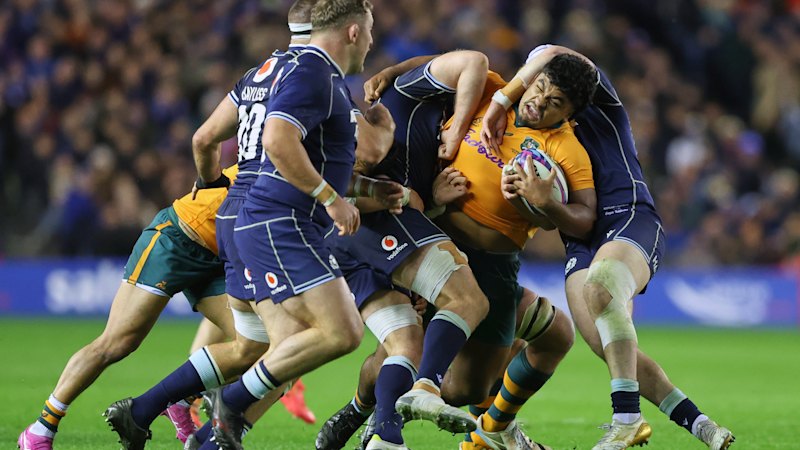
Photo via The Sydney Morning Herald

The Wallabies’ attack has been misfiring for six weeks. These stats show why

Read the original at The Sydney Morning Herald ↗
Cite

Payten, I. (2026, November 18). The Wallabies’ attack has been misfiring for six weeks. These stats show why. The Sydney Morning Herald. https://www.smh.com.au/sport/rugby-union/the-wallabies-attack-has-been-misfiring-for-six-weeks-these-stats-show-why-20261118-p61f2j.html?ref=rss&utm_medium=rss&utm_source=rss_feed

Dated from the outlet's own feed. Check the original for its byline.

The Sydney Morning Herald · collected 2026-11-18 · by Iain Payten

Quick Summary

Tom Donnelly, Wallabies forwards coach, highlighted that the team's attack has been struggling due to a decline in physicality and urgency in ball carrying, as evidenced by recent statistics. Over the last four Test defeats, the Wallabies have seen a drop in their ability to break through defensive lines, with the percentage of successful carries across the gain line falling from 48% to 43%, and even lower to 38% against Scotland. Donnelly emphasized the importance of quick ball recycle and effective carry-clean detail to unlock the team's attacking potential against well-set defenses.
Written by AI on 2026-11-18, from this article's own text only (the story summary below draws on all the coverage).

Compared with similar articles

This article reads unscored and hedges 0% of its claims. Each row says how that neighbour differs.
ABC News (AU)
Hedges 0 of 16 claims Outlet record 67/100
“The articles discuss different aspects of the Wallabies' performance and strategies, with the first article focusing on lineup changes for the upcoming Scotland Test, while the second discusses the team's attack issues after a recent defeat.”
Evening Standard
Hedges 1 of 27 claims Outlet record 64/100
“Article A describes the upcoming rugby match and recent results, while Article B discusses the Wallabies' defense and attack issues following a previous match against Scotland.”
ABC News (AU)
Hedges 2 of 29 claims Outlet record 67/100
“The articles discuss the Wallabies' performance and strategy, but do not refer to the same specific match or training session.”
BBC News
Hedges 3 of 37 claims Outlet record 65/100
“Article A covers Scotland's coach praising the team's defensive performance after a match, while Article B focuses on analyzing the Wallabies' attack issues and defense improvement in the same match but from the perspective of the opposing team's coaching staff.”

Story

The Wallabies’ attack has been misfiring for six weeks.
Other · 1 article(s) covering the same event.
How this article was measured signals, leaning charts, publisher record, byline, topics and claims

Signals How these are calculated →

Claims extracted
29
sentences that state something as happening or true
Uncertain
0%
0 of 29 hedged ("reportedly", "may", "according to")
Leaning
not political
takes no side on a contested political question
Publisher signals
61/100
The Sydney Morning Herald's corrections and hedging, across everything collected from it. Not a measure of accuracy.
Outlets on this story
1
Other
Same framing elsewhere
1
articles that frame the event the way this one does
Analyzed 2026-11-18 · how these are computed

How this is being covered How these are calculated →

Article leaning vs. publisher reliability
Source leaning vs. consistency

Publisher

The Sydney Morning Herald · 7597 article(s) · 15 correction(s) detected
Running correction rate · 15 correction(s)

Who wrote this

Iain Payten
37 article(s) here · 1 carrying a prediction
The Wallabies’ attack is based on getting good go-forward in the middle, and with a fast recycle, a compressed defensive line will allow a sweeping attack to exploit space.
The ban will cover the rest of the Nations Championship and stretch until the eve of the 2027 Rugby World Cup in Australia, but South Africa Rugby immediately sought an appeal hearing, denying that Erasmus intended to impugn the referees’ integrity.
Even the mighty Welsh teams of the 1970s, with stars like JPR Williams and Gareth Edwards, didn’t get it done.
Wales’ confidence about beating the Wallabies will now be sky-high, but they’ll also have to contend with the after-effects of their leg-sapping effort against New Zealand, and a potential emotional comedown, too.
Last week, deep down, the Wallabies probably thought it would get easier this week given their next stop is a clash with Wales in Cardiff on Sunday morning, AEDT.
When they did in the Scottish half, the attack couldn’t make any headway.
The internet attributes the quote to Nelson Mandela, but it may as well have come from Ted Lasso: “You either win or you learn.”
Late tries to Filipo Daugunu and Jeremy Williams in the last quarter bolstered the Wallabies’ score, but it was far too little, and far too late.
What is a pass mark for the tour, and who will the Wallabies play in the Nations Championships finals?
Wallabies stars will kick off the spring tour in London this week amid an escalating pay dispute with Rugby Australia, with the players’ union confirming it plans to take legal action after failing to strike a deal with RA for a new collective bargaining agreement.
Also by Iain Payten
Nothing else under this byline is closely related to this article, so these are simply their most recent.
All 37 articles by Iain Payten →

Topics

Edinburgh Scotland Test Tests Wallabies

Subjects

Wallabies NORP · 8× Scotland GPE · 5× Donnelly PERSON · 4× New Zealand GPE · 3× Australia GPE · 2× England GPE · 2× Carter Gordon PERSON · 1× Edinburgh GPE · 1× Ireland GPE · 1× Tom Donnelly PERSON · 1×

Narrative

“It’s the sort of name of the game that we’re trying to get quick ball and momentum and defences are trying to slow us down, and so if you don’t quite get it right or you’re a little bit off, there’s different ways you have to adjust, and kick strategy becomes a bit of it.
framing: assertive · carried by 1 article(s) · first seen 2026-11-18
The Wallabies’ attack is based on getting good go-forward in the middle, and with a fast recycle, a compressed defensive line will allow a sweeping attack to exploit space.
2026-11-18 · The Sydney Morning Herald
The Wallabies’ attack has been misfiring for six weeks. These stats show why · assertive framing

Claims (29 extracted, 0 hedged)

Wallabies forwards coach Tom Donnelly said the key to getting the side’s attack firing is more urgency and muscle when carrying the ball, as stats emerged showing the team’s power in the contact zone has nosedived in the past four Test defeats. asserted
power → say → defeats
Donnelly’s comments came as he rejected talk of the squad being weary at the end of a long season. asserted
squad → come → season
Returning No.10 Carter Gordon also said the team’s confidence had been reinstalled by a spirited performance at Murrayfield, despite the defeat to Scotland. asserted
confidence → return → Scotland
The Wallabies fixed their leaky defence against Scotland, going from an average of 46 points per game in the last three Tests, to conceding 15 in Edinburgh. asserted
Wallabies → fix → Edinburgh
But the attack didn’t fire enough shots to win a dour, grinding contest. asserted
attack → fire → contest
The Wallabies scored two tries, in the 12th and the 79th minute. asserted
Wallabies → score → minute
“We had a really good review this morning around our carry-clean detail, and some of our fundamentals of our game,” Donnelly said. asserted
Donnelly → have → game
“If we get that right, on the back of that, it allows us to play with quick ball and allows us to be able to use our attacking weapons. asserted
us → get → weapons
“If we don’t quite get that right, the ball becomes slow and it becomes a lot harder. asserted
it → get → ?
Defences over here get set pretty quick and early, and they’re pretty hard to break down if you’re not getting your carry-clean detail right. asserted
detail → set → ?
The Wallabies’ attack is based on getting good go-forward in the middle, and with a fast recycle, a compressed defensive line will allow a sweeping attack to exploit space. asserted
attack → base → space
It worked pretty well in the first eight games of the year - with mostly competitive showings against Ireland and France, and an undefeated run of six matches against Italy, Japan, Argentina and South Africa. asserted
It → work → Italy
But stats show the Wallabies’ ability to punch holes in the line has degraded in the last two months, which saw big losses to New Zealand, a record defeat against England and then the Scottish loss. asserted
which → show → England
After getting across the gainline with 48 per cent of their carries between July and September, the last four games have seen the Wallabies only do it on 43 per cent of carries. asserted
Wallabies → get → carries
Against Scotland, Australia only crossed the gainline with 38 per cent of carries, and had 93 post-contact metres. asserted
Australia → cross → metres
The average post-contract metres fell from 136 metres to 117 per Test, in those two blocks, and so did percentage of dominant carries (down from 23 per cent to 20 per cent) “Scotland defended really well. asserted
Scotland → fall → cent
If we carry high, they’re really good at choke-tackling, holding you up, wrestling, creating slow ball. asserted
they → carry → ball
So we had to get our body height down and we didn’t get that right on a number of occasions, so we’ll get that right this weekend and hopefully our attack will be unlocked on the back of it,” Donnelly said. asserted
Donnelly → have → it
“It’s the sort of name of the game that we’re trying to get quick ball and momentum and defences are trying to slow us down, and so if you don’t quite get it right or you’re a little bit off, there’s different ways you have to adjust, and kick strategy becomes a bit of it. asserted
strategy → ’ → it
Didn’t quite get it right on the weekend.” asserted
it → get → weekend
The Wallabies’ struggle was doubled against New Zealand and England by the fact their opposition were crossing the gainline with over half of their carries, and being far higher in line break efficiency (when a line break turns into a try). asserted
break → double → try
But igniting attack will be the aim for Australia in Cardiff on Sunday morning, given their Welsh opponents turned in one of the all-time defensive efforts to beat New Zealand. asserted
opponents → ignite → Zealand
“Obviously playing off slow ball makes it quite tough and gives the defence time to set their line, so you’re always playing into a wall rather than into space. asserted
you → play → space
But I thought the few moments that we did have where we did have some space to play and do, we actually looked quite good,” Gordon said. asserted
Gordon → think → space
“We were able to start playing a bit more shape and the footy we kind of want to play. asserted
we → start → shape
Donnelly brushed off questions of players potentially being weary at the end of a long year, and the prospect of rotating in fresher players against Wales. asserted
players → brush → Wales
But in the search for more urgency at the breakdown and punch at the line, it’s highly likely some of the Wallabies forwards will change, with Tom Hooper a big chance of starting. asserted
Hooper → ’ → forwards
Gordon said the Wallabies’ belief levels are still high. asserted
levels → say → ?
It’s just unlocking it, and Scotland really reinstalled that belief and that confidence,” he said. asserted
he → unlock → belief

Give feedback · no sign-in needed

No sign-in needed for now. Your note is sent without a name, so it cannot be answered.

History Support