Saudi Arabia continues to execute people at an alarming rate.
asserted
Arabia → continue → rate
On Saturday, Jawad Abdullah Qureiris and Fadel Hassan al-Safwani were executed in Saudi Arabia's Eastern Province.
asserted
Qureiris → execute → Province
Both men were convicted of terrorist offenses, according to Saudi authorities.
uncertain
men → convict → authorities
In 2011, al-Safwani was a prominent organizer of the peaceful protests that called for civil rights and the release of detainees.
asserted
that → call → detainees
Qureiris, who was a minor at the time, participated in one of these protests in the city of Qatif.
asserted
who → participate → Qatif
The UN Working Group on Arbitrary Detention called for Qureiris' release in November 2024, after finding that his detention was arbitrary.
asserted
detention → call → November
The opinion also covered four other men.
asserted
opinion → cover → men
Qureiris was the fourth of these five to be executed.
asserted
Qureiris → execute → five
The fifth, Yousef al-Manasif, remains at risk after Saudi Arabia's Supreme Court upheld his death sentence, according to human rights organizations.
uncertain
Court → remain → organizations
The two executions brought the number of people executed in Saudi Arabia in 2026 to 211, according to an AFP tally reported on Monday.
uncertain
executions → bring → Monday
The news agency said that the tally includes 126 people convicted of drug trafficking and 17 people executed on terrorism-related charges.
asserted
tally → say → charges
Of the 211 people, 100 were Saudi nationals, while the rest were foreign nationals, AFP said.
asserted
AFP → say → people
In July, Saudi authorities executed five Ethiopian migrants for nonviolent drug-related offenses, Human Rights Watch reported.
asserted
Watch → execute → offenses
In October, Saudi authorities executed two Bangladeshi nationals, according to rights organizations.
uncertain
authorities → execute → organizations
Human Rights Watch separately reported the execution of another Saudi national, Hassan Zaki al-Faraj, on October 17, for alleged offenses committed when he was a minor.
asserted
he → report → offenses
"In 2025, a record high of at least 356 people were executed and executions have continued at a high rate in 2026
asserted
executions → execute → 2026
," Ahmed Benchemsi, Human Rights Watch's MENA spokesperson, told DW.
asserted
Benchemsi → tell → DW
"Saudi Arabia has executed more than 2,000 people in the past decade," he confirmed.
asserted
he → execute → decade
According to the Death Penalty Information Center, Saudi Arabia ranks third in executions after China and Iran.
uncertain
Arabia → accord → China
However, comprehensive global data for 2026 are not yet available, and many countries treat execution numbers as state secrets.
asserted
countries → treat → secrets
However, the ranking is consistent with earlier findings from Amnesty International, which ranked Saudi Arabia as the world's third-most prolific executioner between 2022 and 2025, behind China and Iran.
asserted
which → rank → China
According to the NGO Together against the death penalty, or ECPM, the two main methods of execution in Saudi Arabia are stoning or beheading.
uncertain
methods → accord → Arabia
However, in many cases, including those of Qureiris and al-Safwani, death sentences are issued as discretionary rulings, called ta'zir.
asserted
sentences → include → rulings
Ta'zir means that neither the crime nor the punishment is defined in Islamic law, contrary to fixed punishments under the Saudi interpretation of Islamic law, or Sharia.
asserted
crime → mean → law
As a result, little to no information about the execution or the fate of the bodies is provided.
asserted
information → provide → bodies
Is the Iran war affecting Saudi domestic repression?
asserted
war → affect → repression
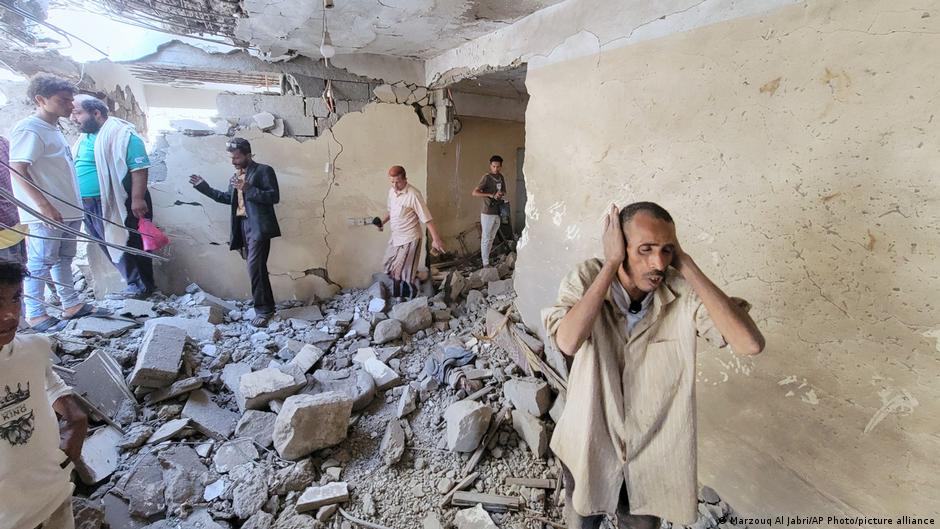
Following the US-Israeli attacks on Iran in February, Saudi Arabia has been targeted by Iran and the Iran-aligned Houthi group in Yemen.
asserted
Arabia → follow → Yemen
In turn, Saudi Arabia's de facto leader, Crown Prince Mohammed bin Salman, is faced with a profound dilemma as the attacks have killed and injured scores of people and threaten Riyadh's efforts to diversify its economy under the Vision 2030 reform plan.
asserted
attacks → face → plan
Several summits and international sports events had to be canceled or postponed in light of the ongoing danger.
asserted
summits → have → danger
"The Saudi government has shown itself to be unable to defend its population from repeated Houthi attacks on its airports, exposing the vulnerability of the country despite world-record spending levels on defense equipment," Sarah Lea Whitson, human rights lawyer and former executive director of the US-based human rights watchdog DAWN, told DW.
asserted
Whitson → show → DW
"Amid the war in Iran, the Saudi government has resumed its relentless pace of executions and corporal punishment sentences," she said.
asserted
she → resume → executions
This week, watchdogs reported on a Kenyan woman in Saudi Arabia who was sentenced to 100 lashes for giving birth outside marriage.
asserted
who → report → marriage
"The recent executions and the sentencing of a migrant domestic worker to 100 lashes for having a child out of wedlock are clear indications that the Saudi government continues to rely on brute repression to rule the country," Whitson told DW.
asserted
Whitson → have → DW
Saudi Arabia's repression against the Shia minority
Maryam Aldossari, acting director of the London-based human rights organization ALQST, echoes this view.
asserted
Aldossari → act → view
"Saudi Arabian authorities have undoubtedly used the war in Iran and wider regional tensions to intensify their crackdown, most notably through their increased use of the death penalty and as a tool of political repression against the country's Shia minority," she told DW.
asserted
she → use → DW
The country's oil-rich Eastern Province — from which the recently executed men Jawad Abdullah Qureiris and Fadel Hassan al-Safwani hailed — is home to most of Saudi Arabia's Shia minority.
asserted
men → execute → minority
Saudi authorities have long viewed some forms of Shia political activism with suspicion, partly because of concerns over Iranian influence and alleged links between domestic dissent and Tehran, accusations that rights groups say have been used to justify repression of the minority.
asserted
groups → view → minority
However, Neil Quilliam, associate fellow in the Middle East and North Africa Programme at the London-based think tank Chatham House, remains cautious about drawing a direct causal connection between the conflict involving Iran and developments in Saudi Arabia's human rights environment.
asserted
Quilliam → base → environment
"The kingdom has introduced social reforms over the past decade, including measures that have expanded opportunities for women, while retaining controls over political dissent and activism," he told DW.
asserted
he → introduce → DW
"What periods of regional tension can do is heighten official concern about national security," he said, adding that this reduces tolerance for any public criticism or perceived threats to social cohesion.
asserted
this → do → cohesion
…and 2 more, not listed.
 The Aporia