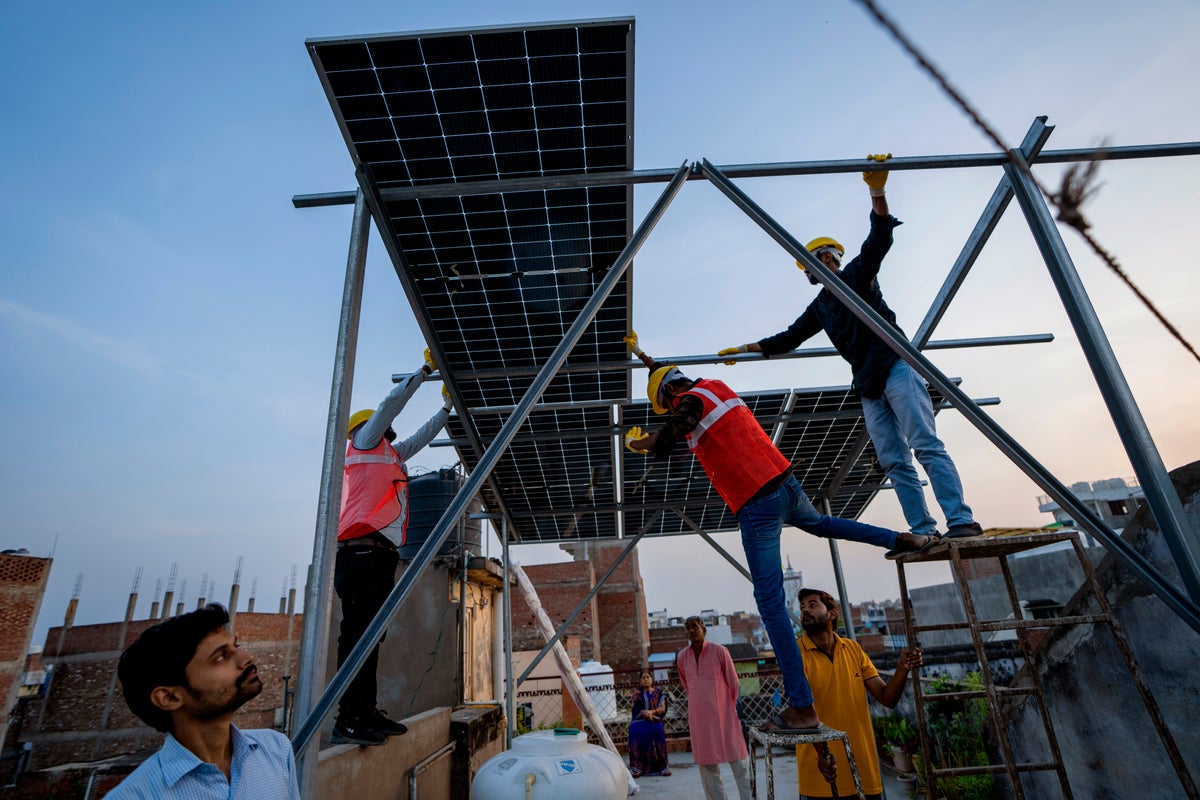
Countries are embracing clean power and taking steps to use less energy because of the war against Iran, but it is not yet enough to help address climate change.
asserted
it → embrace → change
When the U.S. and Israel launched the war in February, some backers of renewables opined it could drive a green transition as oil and gas prices spiked.
uncertain
prices → launch → transition
So far, more than 30 governments have enacted policies to move away from fossil fuels or improve energy efficiency.
asserted
governments → enact → efficiency
Yet at the same time, global emissions of greenhouse gases increased slightly and investments in clean energy fell compared to the same period last year.
asserted
investments → increase → period
The Associated Press talked to a dozen experts who said that while the Iran war appears to be helping the adoption of clean energy, the world is still heavily dependent on fossil fuels.
asserted
world → talk → fuels
They said it will take more time for new policies to show results.
asserted
policies → say → results
“Governments are currently doing a dance between acknowledging the importance of clean power while continuing to support fossil fuel expansion,” war studies lecturer Pauline Heinrichs at King’s College London wrote in an email.
asserted
Heinrichs → do → email
“We are seeing an old and a new world interact in contradiction with each other.”
asserted
old → see → other
The government is also considering expanding natural gas production.
asserted
government → consider → production
In Asia, where there’s massive demand for solar power and electric vehicles, Indonesia is replacing some diesel power plants with solar, while also doubling down on coal for heavy industries.
asserted
Indonesia → ’ → industries
Clean investment lost momentum globally, but the story differs importantly by region
asserted
story → lose → region
Global investment in wind and solar deployment fell in the first half of 2026 compared to the same period last year, after several years growth, according to Rhodium Group’s Clean Investment Monitor.
uncertain
investment → fall → Monitor
China accounted for most of the global decline.
asserted
China → account → decline
In the U.S., Europe and India, where economies are more exposed to gas and oil prices, solar investment grew and wind investment held stable or grew, said Hannah Pitt, a director at Rhodium.
asserted
Pitt → expose → Rhodium
In February, Stanford University climate scientist Rob Jackson said it was “just wishful thinking” that the new war would boost support for homegrown renewables over imported fossil fuels — unless it turned out to be a sustained conflict.
asserted
it → say → fuels
Six months later, Jackson said he didn’t anticipate oil prices hurdling past $90 or $100 a barrel for so long.
asserted
prices → say → 90
If dozens of countries are promoting electric vehicle incentives, charging infrastructure and electrification in general, that can help in the fight against climate change, added Jackson.
asserted
Jackson → promote → change
But only if those actions are sustained.
asserted
actions → sustain → ?
“We need that action over years, to decades, to make a dent in the climate problem,” Jackson said Monday.
asserted
Jackson → need → problem
Climate pollution increased marginally
asserted
pollution → increase → ?
Thirty-three governments adopted policies to switch from fossil fuels to electricity or improve energy efficiency in response to the Middle East conflict, as of Sept. 9, according to the International Energy Agency.
uncertain
governments → adopt → Agency
This includes supporting EV adoption, promoting renewable energy, replacing gas boilers with electric heat pumps and retrofitting homes and businesses to use less energy.
asserted
This → include → energy
The Netherlands, Spain and the U.K. are doing everything on that list.
asserted
Netherlands → do → list
China is working to make heavy industry more energy efficient and pushing to electrify heavy vehicles.
asserted
industry → work → vehicles
India and Indonesia are shifting to electric stoves to replace imported liquefied petroleum gas as a cooking fuel.
asserted
India → shift → fuel
Laos suspended gas and diesel car imports through 2026 to boost EVs.
asserted
Laos → suspend → EVs
These efforts haven't moved the needle yet.
asserted
efforts → move → needle
Incentivizing EV purchases or encouraging energy efficiency take time and scale, according to researchers for the Climate TRACE database of emissions.
uncertain
Incentivizing → incentivize → emissions
At the same time, many governments are cutting fuel taxes.
asserted
governments → cut → taxes
That provides immediate relief to consumers but disincentivizes switching to EVs.
asserted
That → provide → EVs
And, the war itself will spike emissions.
asserted
war → spike → emissions
Global greenhouse gas emissions increased 0.2% in the first half of 2026, compared with the first half of 2025, according to Climate TRACE.
uncertain
emissions → increase → TRACE
While emissions from road transportation increased, Climate TRACE found that power sector emissions declined, despite concern that disruptions in oil and gas markets would push countries to use more coal for electricity.
asserted
disruptions → increase → electricity
Shipping emissions also declined, likely due to the Strait of Hormuz closure.
asserted
emissions → decline → closure
Countries that import fossil fuels are footing higher bills
Those bills would have been even steeper, though, if not for the clean power added since 2020.
asserted
bills → import → 2020
Fossil fuel importers have paid prices that are $330 billion higher compared to prewar market expectations, making it the largest sustained price shock since the 1990 Gulf War, according to research by the Centre for Research on Energy and Clean Air.
uncertain
it → pay → Energy
The European Union, China and India paid the most.
asserted
Union → pay → most
Countries that invested in clean energy after past energy crises saved an estimated $36 billion in avoided fossil fuel imports in the first five months of the conflict, the research found.
asserted
research → invest → conflict
China and Japan saved the most, followed by Spain, France, Italy, the Netherlands, Brazil and India.
asserted
China → save → Spain
Governments are trying to insulate themselves from geopolitical volatility and fuel price instability, said Caspian Conran, lead economist at the global consultancy firm Baringa.
asserted
Conran → try → firm
…and 16 more, not listed.
 The Aporia