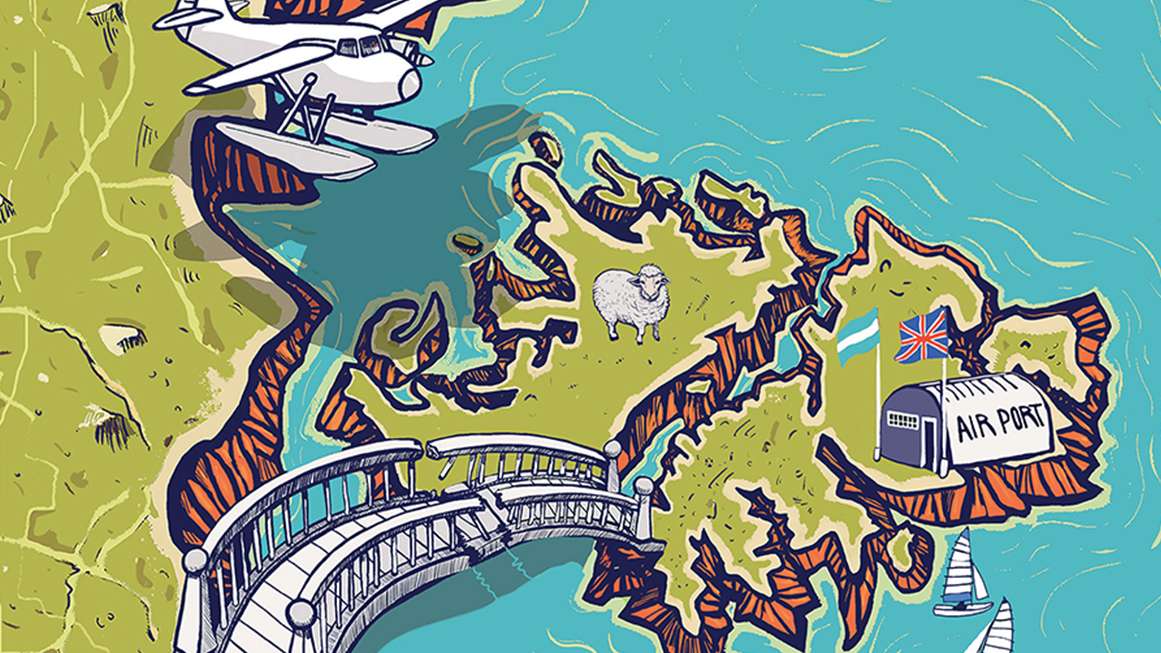
Pamela McLeod and her husband, Reynaldo Reid, set off for Buenos Aires for a belated honeymoon in November 1970, likely hoping for a little privacy, relaxation, and time together.
asserted
McLeod → set → privacy
They got anything but.
asserted
They → get → anything
Their marriage, it turned out, was politically irresistible.
asserted
it → turn → ?
This was gold to an Argentine press eager to present the couple as evidence of the bonds between the British-held islands and Argentina.
asserted
This → present → islands
When the couple arrived in Buenos Aires, reporters and cameramen were waiting.
asserted
reporters → arrive → Aires
The honeymoon became a 15-day publicity tour through television studios, ministries, and political offices.
asserted
honeymoon → become → studios
The growth of Argentine nationalism, and Britain's increasing separation of the islands from the mainland, eventually allowed "the relationship between countries to displace the relationship between neighbors," writes Sebastián Carassai in Beyond the War.
asserted
Carassai → increase → War
Carassai's book reminds us of the relationships between Argentines and Falklanders that existed beyond—and were eventually eclipsed by—their governments' competing nationalisms.
asserted
that → remind → nationalisms
(Those who side with Argentina would call the islands the Malvinas.)
asserted
who → side → islands
His father was Scottish and his mother English; he was born in Argentina, had Chilean sisters and an Argentine brother, and later spent much of his life with McLeod in the Falklands capital of Stanley.
asserted
he → bear → Stanley
The couple had seven daughters and two sons together, the youngest of whom was born in 1981.
asserted
youngest → have → 1981
In Stanley, Reid became an informal Argentine delegate, and he co-ran what is now the third-oldest bar in the islands.
asserted
what → become → islands
After living in Stanley for more than a decade, he told the Argentine press that the island community had accepted him as just another member.
asserted
community → live → member
McLeod, who grew up in the Falklands' rural countryside, was an orphan brought up by families that took turns raising her.
asserted
that → grow → her
After living a "homeless life," as she described it to Carassai, she moved on to married life in Stanley.
asserted
she → live → Stanley
In April 1982, a few days after the Argentine invasion of the Falkland Islands, McLeod and seven of her children flew to Argentina to avoid the conflict.
asserted
McLeod → fly → conflict
Her eldest two children were already studying on the continent.
asserted
children → study → continent
The family intended to return to the islands once the crisis was over—the eldest daughter, who was studying to become a teacher in Buenos Aires, told a TV program that she planned to work at a school in Stanley.
asserted
she → intend → Stanley
Yet the family ended up staying: "We went to spend a few days and stayed for thirty years," McLeod told Carassai.
asserted
McLeod → end → Carassai
After her husband's death, McLeod enjoyed the network of support she received from Jehovah's Witnesses while looking after her family of "refugees."
asserted
she → enjoy → refugees
Starting in the '90s, many of her children, now married to Argentines, began moving back to the Falklands.
asserted
many → start → Falklands
McLeod, with a new Argentine husband, also moved back to Stanley.
asserted
McLeod → move → Stanley
They weren't the only border-crossing individuals whose lives were disrupted by the clashing nationalisms.
asserted
lives → cross → nationalisms
James Peck, an artist from the Falklands, was married to an Argentine woman and had two children, but he became estranged from his wife and kids in the late 2000s.
asserted
he → have → 2000s
Amid the family crisis, he was offered and accepted an Argentine identity card.
asserted
he → offer → card
The ceremony became an extraordinary political spectacle.
asserted
ceremony → become → ?
It was chaired by then-president of Argentina, Cristina Fernández de Kirchner, and the official propaganda for the event described Peck as the first islander "to receive the Argentine DNI (Documento Nacional de Identidad) after the conflict."
asserted
propaganda → chair → conflict
According to Carassai, the entire situation was "overwhelming" for Peck, who was considered a traitor by many Falkland Islanders.
uncertain
who → accord → Islanders
The Argentine government took advantage of a father in distress and used him to score political points.
asserted
government → take → points
"I feel like Argentina has cast a big shadow over my soul," Peck told The Guardian in 2016.
asserted
Peck → feel → 2016
"I had one thing on my mind: to fix my family and move on."
asserted
I → have → family
After four years, Peck cut up the Argentine document, posted a photo of the pieces on Facebook, and returned to Stanley.
asserted
Peck → cut → Stanley
"I realized, after, that real people did not seem to matter; it was all about making a statement, about the islands, and they had this prize," he told The Guardian.
asserted
he → realize → Guardian
Carassai spoke with islanders from across society (including politicians, business owners, and retirees), in addition to doing archival work.
asserted
Carassai → speak → work
The interviews in his epilogue tell human stories too often lost in historical accounts of the Falklands, which tend to focus exclusively on the war; his conversations reveal a relationship far more complicated than the stories told by both the Argentine and the British governments.
asserted
conversations → tell → Argentine
Outside of the messy human accounts revealed through marriages, friendships, and migration, Beyond the War explores the economic ties that inevitably developed between the islands and the South American mainland.
asserted
that → reveal → islands
Falkland Islanders, who often referred to the nearby mainland simply as "the coast," were instrumental in establishing sheep farming, working on Patagonian estancias (ranches), and transferring agricultural expertise across the South Atlantic.
asserted
who → refer → Atlantic
Indeed, the Falkland Islands and Patagonia were economically intertwined long before the sovereignty dispute came to dominate relations.
asserted
dispute → intertwine → relations
In the late 19th century, Argentina actively recruited Falklanders to help with economic development in Patagonia.
asserted
Argentina → recruit → Patagonia
In 1886, the governor of Santa Cruz, Carlos María Moyano, married a Falkland Islander, Ethel Turner.
asserted
governor → marry → Islander
…and 26 more, not listed.
 The Aporia