That is 0 articles you have read today.
The Aporia is free and carries no advertising, so readers are the only
thing paying for it. If you are getting this much out of it, a small
donation is what keeps it independent.
Daily limit reached
You have read 0 articles today.
That is more than the 15 a day The Aporia gives away,
and well past what it can carry on nothing. Your allowance resets at
midnight.
There is no advertising here and nothing about you is sold, so readers
are the only thing paying for it. If the site is worth this much of
your day, it is worth a few dollars.
Everything else stays open: the
maps, the
directory and
search do
not count against this, and neither does re-opening something you have
already read today.
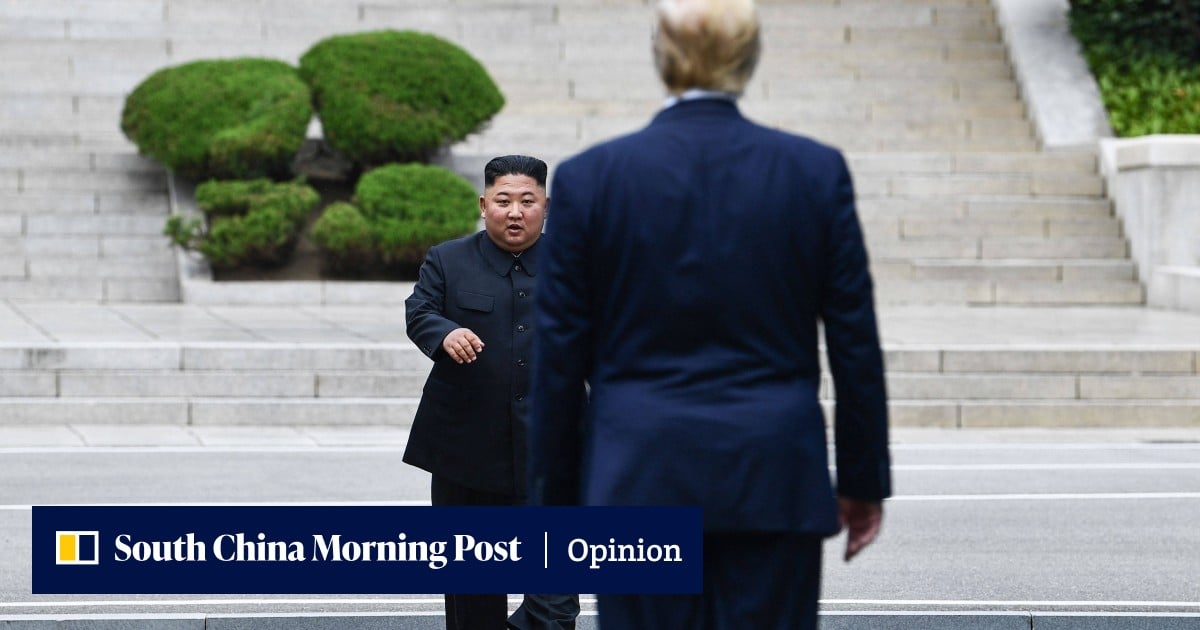
US President Donald Trump is seeking another summit with North Korean leader Kim Jong-un in the coming months, despite concerns from South Korea and other nations about potential compromises that could undermine regional security. The proposed meeting would likely bypass critical issues such as denuclearization, focusing instead on mutual benefits for both leaders—sanctions relief and recognition of North Korea’s nuclear status for Trump, while Kim aims to legitimize his nuclear program. This approach risks sidelining key allies like South Korea and Japan who could face significant threats from North Korea's shorter-range missiles without substantial progress toward denuclearization or improved missile technology by Pyongyang.
Written locally by qwen2.5:14b on 2026-09-17,
using this article's own text rather than the other coverage of the
same event (that is the story summary below).
Story summary
US President Donald Trump is pushing for a new summit with North Korean leader Kim Jong-un in the coming months. To facilitate this meeting, Trump seems willing to compromise on joint military exercises between the US and South Korea, potentially jeopardizing their alliance. The upcoming summit would be bilateral, excluding key players like Seoul, Beijing, Moscow, and Tokyo.
Both sides aim for different outcomes: Trump seeks to secure US security interests, while Kim wants de facto recognition as a nuclear weapons state along with sanctions relief and investment. North Korea possesses a functioning nuclear arsenal but lacks reliable intercontinental delivery systems. Short-range missiles can easily target South Korea and Japan, but North Korea has only tested engines for an intercontinental ballistic missile (ICBM) that could hit the mainland United States. However, it still lacks re-entry technology, payload capacity for multiple warheads, and precise guidance capabilities.
Written for “Trump Kim Summit Talks” on 2026-09-17,
grounded in this article and the 0 other(s) covering the same event.
Why this leaning score
The article's own words the score was based on. Each is quoted
verbatim and was checked against the article text before being
stored, so you can find it in the original.
-
To achieve that, he appears prepared to downgrade and jeopardise the US-South Korea alliance, as seen in his recent move to scale back joint military exercises.
left criticizes Trump for undermining alliances
-
For Trump, this will be a purely bilateral exercise, with both Seoul and Beijing totally sidelined, let alone Moscow and Tokyo.
left portrays Trump's approach as isolating allies
-
In these circumstances, constructing a bilateral deal where both sides can credibly claim a win – at least to their own domestic audiences – is a challenge but nevertheless possible with some misdirection.
left suggests Trump and Kim are misleading the public
-
However, this will come at considerable cost to their friends and neighbours who will suffer serious collateral damage.
left warns of negative consequences for allies
Leaning score -0.65 for article 15968 (high confidence, 4 verified quotes) · logged 2026-09-17
Claims extracted
11
claim-shaped sentences
Uncertain
9%
1 of 11 hedged
Leaning
Leans strongly left
of the writing, not the subject
Correction & hedging signals
93.5
corrections and hedging in what we collected;
not a measure of accuracy
Outlets on this story
1
Politics
Narrative spread
1
articles carrying this framing
It is clear that US President Donald Trump is pushing hard for
a fresh summit with North Korean leader Kim Jong-un in the coming months.
asserted
Trump → push → months
To achieve that, he appears prepared to downgrade and jeopardise the US-South Korea alliance, as seen in his recent move to scale back
joint military exercises.
asserted
he → achieve → exercises
For Trump, this will be a purely bilateral exercise, with both Seoul and Beijing totally sidelined, let alone Moscow and Tokyo.
asserted
Seoul → sideline → Trump
Equally, there is now a general acceptance that the
issue of denuclearisation will not be on the table at any future summit.
asserted
issue → be → summit
Trump is looking for an outcome that protects US security interests, while Kim’s interests are in de facto recognition as a nuclear weapons state, sanctions relief and investment.
asserted
interests → look → state
Kim has a functioning nuclear arsenal but lacks any reliable intercontinental delivery system.
asserted
Kim → have → system
South Korea and Japan are easy targets for his short and intermediate range missiles, but Pyongyang currently has only
tested engines for an intercontinental ballistic missile (ICBM) that can hit the mainland United States.
asserted
that → have → States
It lacks re-entry technology, payload capacity for multiple independently targetable re-entry vehicles and pinpoint guidance capacity.
asserted
It → lack → vehicles
In these circumstances, constructing a bilateral deal where both sides can credibly claim a win – at least to their own domestic audiences – is a challenge but nevertheless possible with some misdirection.
uncertain
sides → construct → misdirection
However, this will come at considerable cost to their friends and neighbours who will suffer serious collateral damage.
asserted
who → come → damage
Washington and Pyongyang can be expected to collude to save face.
asserted
Washington → expect → face
 The Aporia