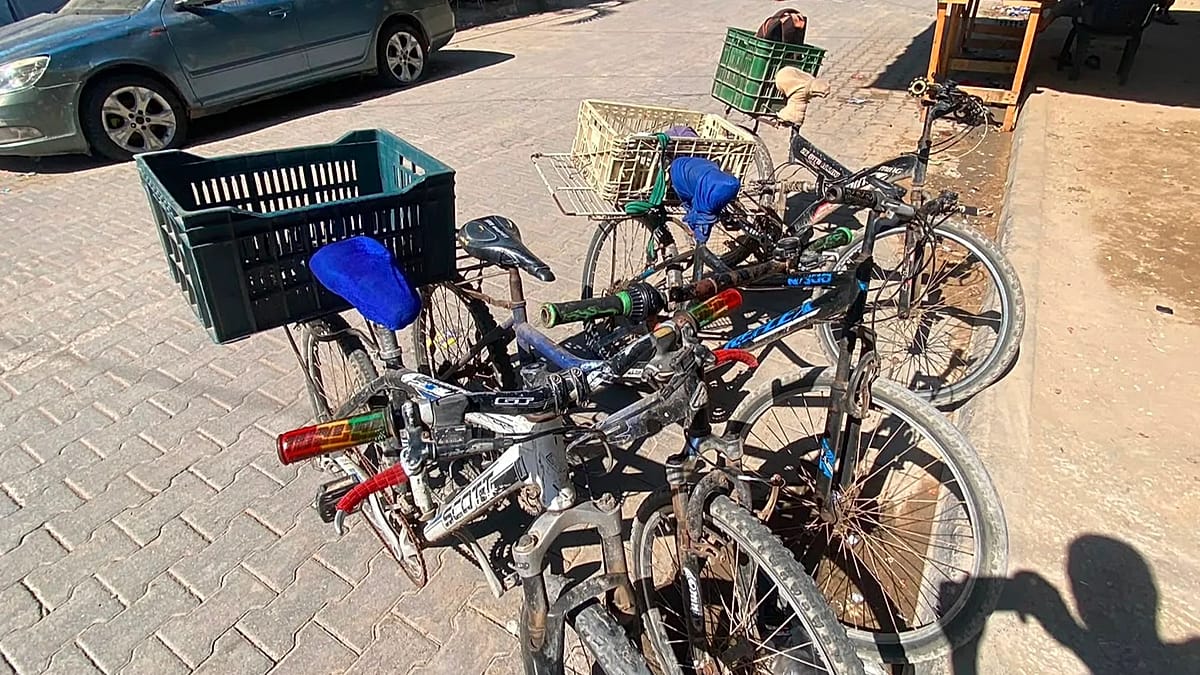
Between 40 and 50 workers have died in the Israel-Hamas war, yet hundreds remain on the roads, covering routes by bicycle after fuel shortages and the destruction of 74% of Gaza's road network made motorised delivery impossible.
asserted
delivery → die → network
Gaza delivery workers pedalling through rubble on bicycles can spend 40 of their 50-shekel (€12) daily earnings fixing a single puncture.
asserted
workers → pedal → puncture
Between 40 and 50 bicycle couriers have been killed in the Israel-Hamas war, yet around 400 continue to move packages through damaged streets and active bombardment.
asserted
400 → kill → streets
Fuel shortages, transport disruption and the destruction of Gaza's road network have made bicycles — known colloquially as "baskleet" — the primary means of delivery across the Strip.
asserted
bicycles → make → Strip
Workers who spoke to Euronews at Hamama, one of the main delivery companies operating in the Strip, described a job that keeps them under relentless pressure: the physical strain of cycling through rubble, the cost of constant repairs, and the danger of passing daily through areas still under bombardment.
asserted
that → speak → bombardment
In the Maghazi area in central Gaza, Mohammed Abu Amra works for the delivery company Barq.
asserted
Amra → work → company
Trips he used to complete by motorbike in under 10 minutes now take him 30 or more by bicycle, with heat, rain, road conditions, and the distances involved making it much more challenging.
asserted
it → use → bicycle
Tareq Abu Zekri launched Barq during the second ceasefire in January 2025, then expanded by hiring workers who used their own bicycles.
asserted
who → launch → bicycles
When he advertised for riders, 109 applications arrived within a day and a half, among them university graduates with few other options in what remains of the Strip's labour market.
asserted
what → advertise → market
The company now has more than 50 employees operating across three branches in Gaza City, central Gaza and Khan Younis.
asserted
company → have → City
Orders are transferred between areas by whatever means are available before couriers complete local deliveries, covering shop orders as well as goods sold from tents and homes.
asserted
couriers → transfer → tents
Bicycle delivery predates the 2023 Israel-Hamas war: a pilot scheme in Rafah began in March 2021, and since October 2023, bicycles have become standard as fuel has run short and vehicles have been destroyed.
asserted
vehicles → predate → October
Repairs that cost more than a day's work
Abbas Al-Souri estimates his daily earnings at between 50 and 60 shekels (€12 to €14), depending on how many orders he completes.
asserted
he → cost → orders
A puncture repair costs between 30 and 40 shekels (€7 to €10).
asserted
repair → cost → shekels
A worker who earns 50 shekels and pays 40 to fix a tyre is left with 10 shekels — roughly €2.
asserted
who → earn → shekels
Larger repairs cost more.
asserted
repairs → cost → more
Abu Zekri estimates that fixing wheels, hubs and pedals runs between 200 and 500 shekels (€48 to €120), depending on what needs replacing.
asserted
what → estimate → shekels
When a bicycle breaks down, workers strip components from bikes too damaged to ride and use them to keep others moving.
asserted
workers → break → others
"From broken bikes to other bikes — it's patchwork on top of patchwork," Al-Souri said.
asserted
Souri → say → patchwork
A joint assessment published in April 2026 by the World Bank, European Union and United Nations found that around 74% of Gaza's road network — approximately 4,500 kilometres — had been classified as destroyed, with a further 13% partially damaged.
asserted
% → publish → %
The assessment put total damage to the transport sector at approximately $3.21 billion (€2.97 billion) and losses at around $1.18 billion (€1.09 billion), covering roads, bridges, vehicles and transport facilities.
asserted
assessment → put → roads
The figures cover damage recorded up to October 2025, calculated primarily from satellite imagery.
asserted
figures → cover → imagery
Barq attempted to introduce electric bicycles to reduce the strain on workers.
asserted
Barq → attempt → workers
The experiment stalled when charging costs proved prohibitive: powering an electric bike costs around 30 shekels (€7) — roughly half a day's earnings.
asserted
powering → stall → shekels
Danger beyond breakdowns
On 29 August, delivery worker Raed Adel Mohammed Alyan was killed alongside Abdel Fattah Abu Al-Eesh when a strike hit an electric bike in the Tel al-Hawa neighbourhood of south-west Gaza City, according to local reports citing medical and local sources.
uncertain
strike → kill → sources
Three others were wounded, one critically.
asserted
one → wound → ?
Alyan worked for the Hamama delivery company and was on a delivery run at the time, according to the company's director Jamil Al-Yazji.
uncertain
Alyan → work → director
Al-Yazji said earlier this month that between 40 and 50 of his workers had been killed since the war began, and that around 400 — including roughly 300 in Gaza City — were still working on bicycles.
asserted
400 → say → bicycles
The figure covers Hamama staff only.
asserted
figure → cover → staff
Abu Zekri said some of his workers were wounded in a strike in Khan Younis and others narrowly escaped shelling near them in the Al-Jalaa area of Gaza City.
asserted
others → say → City
Despite the losses, both companies continue taking on workers.
asserted
companies → continue → workers
For Abu Zekri, the project is partly about providing income when other options have gone.
asserted
options → provide → income
What workers need to keep going, he said, is straightforward: passable roads, repairable bikes and available parts.
asserted
he → need → What
"Let us bring in pedals, half-frames, tyres, patches for the bikes," he said.
asserted
he → let → bikes
 The Aporia