Claims extracted
16
sentences that state something as happening or true
Uncertain
31%
5 of 16 hedged
("reportedly", "may", "according to")
Leaning
not political
takes no side on a contested political question
Publisher signals
96/100
Toronto Sun's corrections and
hedging, across everything collected from it. Not a measure of accuracy.
Outlets on this story
1
Science
Same framing elsewhere
1
articles that frame the event the way this one does
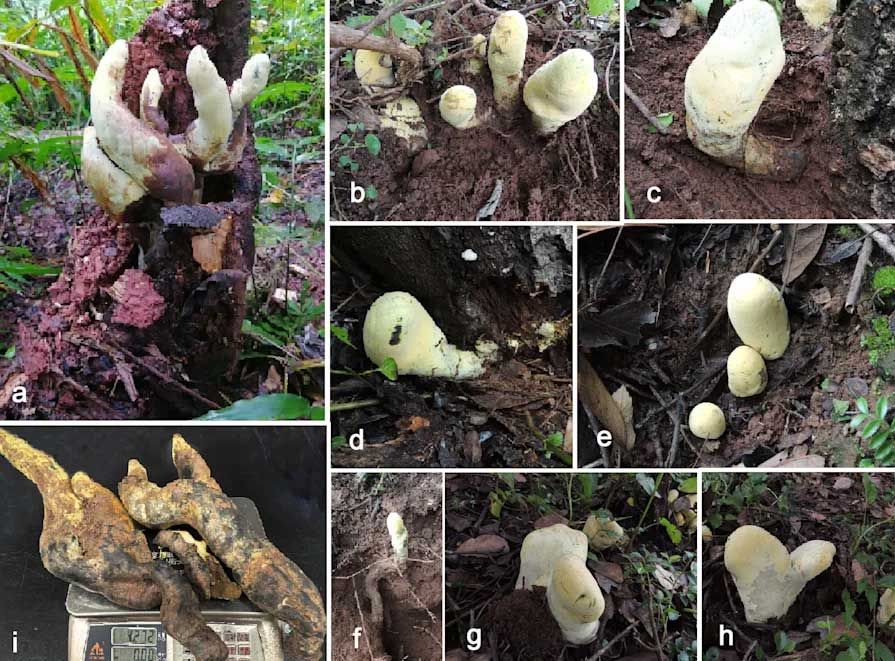
A new giant fungus, whose evolutionary lineage dates back to roughly 65 million years ago — around the time dinosaurs went extinct — has been discovered by scientists in China.
asserted
dinosaurs → date → China
The fungus, named Dianjunus rex or “D-rex,” produces finger-like fruiting bodies that can reach up to 20 inches high (about the width of a standard pillow) and weigh up to 4.9 pounds, making it the largest known among the phylum Ascomycota, which is a diverse group of fungi containing over 64,000 species.
“This remarkable species represents a new fungal family, Dianjunaceae, and provides a rare window into the evolution of extreme fungal body forms,” said Dr. Indunil C. Senanayake, an associate professor at the Kunming Institute of Botany in China and corresponding author of the new study, published in the journal Frontiers in Fungal Biology.
asserted
Senanayake → name → Biology
“The discovery illustrates how much fungus biodiversity remains to be discovered in East Asian forests,” she added.
asserted
she → illustrate → forests
Scientists discovered the giant fungus in 2024 while doing fieldwork in the forests of Yunnan, China — a region known for its fungal diversity.
asserted
Scientists → discover → diversity
Farmers first found peculiar fungus
asserted
Farmers → find → fungus
According to a recent ScienceNews report, local farmers told the scientists about the peculiar fungus’ fleshy, whitish, finger-like fruiting bodies called stromata.
uncertain
farmers → accord → bodies
They provided them with photos, Senanayake told ScienceNews.
asserted
Senanayake → provide → ScienceNews
The farmers reportedly even took a bite of the fungus to see if it was edible.
uncertain
it → take → fungus
Senanayake and her colleagues went to the location and found the fungus’ stromata growing from the woody roots of Chinese cork oak trees.
asserted
stromata → go → trees
The researchers then took samples of the fungus and compared them with those from other fungi, and found that they were looking at something so different it wasn’t just a new species, it represented an entirely new genus and family.
asserted
it → take → genus
RECOMMENDED VIDEO
How scientists pinned its origins to extinction event
asserted
scientists → recommend → event
The scientists also performed a “molecular clock” analysis of the new species’ DNA, comparing it to the genome of hundreds of fungi with known evolutionary age.
asserted
scientists → perform → age
This led them to estimate that the new fungus emerged around 65 million years ago — about one million years after the mass extinction event that wiped out non-avian dinosaurs.
asserted
that → lead → dinosaurs
The timing of Dianjunus rex’s emergence suggests that the mass die-off may have produced favourable conditions for the fungus’ ancestors.
uncertain
off → suggest → ancestors
“For wood-associated decomposing fungi, such environmental disruption may have created new ecological opportunities,” Senanayake said.
uncertain
Senanayake → associate → opportunities
As for why the fungus can become so large, Senanayake believes it may have something to do with reproductive adaptations its ancestors made growing above the forest floor so the wind can carry its spores across dense forests.
“However, such a large structure requires substantial energy investment, suggesting that this strategy likely evolved only where the ecological benefits outweighed the costs,” Senanayake added.
uncertain
Senanayake → become → costs
 The Aporia