Why reshaping memories may hold the key to raising self-esteem
Never miss a story or episode from Life Kit.
uncertain
reshaping → reshape → Kit
Sign up for our weekly newsletter to get our journalism delivered directly to your inbox.
asserted
journalism → sign → inbox
"You're weak."
Have you ever said critical things to yourself when you feel any emotions?
asserted
you → say → emotions
If so, it may be a sign you struggle with self-worth, says psychologist Marisa Franco.
uncertain
Franco → struggle → worth
That means feeling good about yourself and "treating your emotions like they matter.
asserted
they → mean → emotions
Feeling insecure? Try this memory-update exercise
The good news is that self-worth is a skill that you can learn and get better at, says Franco, author of Worth: The New Science of Self-Esteem and Secure Attachment, published in September.
asserted
Franco → feel → September
Drawing on the latest research in psychology and neuroscience, the book offers insights and exercises on how to build a stronger sense of value for yourself.
asserted
book → draw → yourself
One effective way to do that is to revisit difficult memories, Franco says.
asserted
Franco → do → memories
This approach is based on memory reconsolidation theory, based on the work of behavioral neuroscientist Karim Nader.
asserted
approach → base → Nader
"It's about looking back at these memories, giving yourself catharsis and allowing those feelings to move through you more so they don't continue to shape your sense of self right now," Franco says.
asserted
Franco → look → self
In a conversation with Life Kit, Franco explains the benefits of good self-esteem — and shares an exercise to boost your sense of self-worth.
asserted
Franco → explain → worth
This interview has been edited for length and clarity.
asserted
interview → edit → length
Let's talk about memory reconsolidation.
asserted
's → let → reconsolidation
Researchers have found that we can transform our memories, and that can make us feel more worthy.
asserted
us → find → memories
The thing about memories is they don't just record the past, they predict the future.
asserted
they → record → future
When you return to a memory and envision yourself intervening as an adult and saying, "You're safe, I care about you and I'm never going to leave you," it can be quite transformative.
asserted
it → return → you
That leads to higher self-esteem, less symptoms of trauma, and also changes in the hippocampus, which is the part of our brain where our memories are stored.
asserted
memories → lead → brain
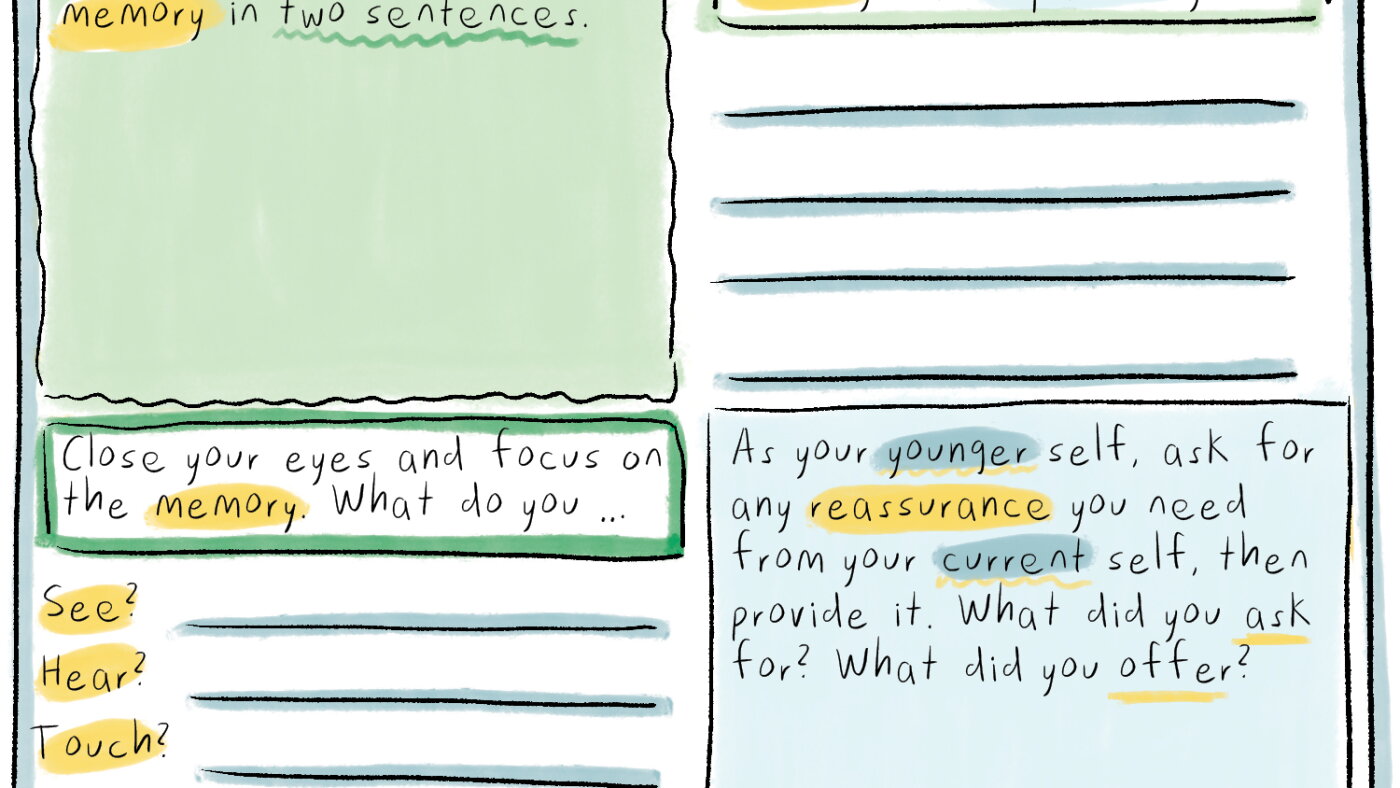
In your book, you explain how to do a memory reconsolidation exercise called reparenting (see instructions above).
asserted
you → explain → instructions
It asks you, as your current self, to provide reassurance to your younger self as a way to work through a troubling past event.
asserted
It → ask → event
Can you share an example?
asserted
you → share → example
One of the memories I reconsolidated was the experience of being a kid whose mom showed up late to soccer practice.
asserted
mom → reconsolidate → practice
When I go back to that memory, I can viscerally experience how I felt ashamed, embarrassed and different from everyone else.
asserted
I → go → everyone
I picture my current self showing up before my mom gets there.
asserted
mom → picture → ?
Adult me looks so excited to see younger me.
asserted
me → look → me
Adult me gives younger me a hug and says, "Oh my gosh, I'm so happy that I get to pick you up.
asserted
I → give → you
Even though your mom is late, she loves you."
asserted
she → love → you
How does this exercise make you feel?
asserted
you → make → ?
It allows me to see the good in the world, to not evaluate things based off of the negativity eclipsing everything good about it.
asserted
me → allow → it
[It makes me] feel more valued, more enthusiastic, less afraid, bolder.
asserted
me → make → ?
Why is it worth addressing low self-esteem?
asserted
it → address → esteem
All the beauties of life slip off of you when you have lower self-esteem.
asserted
you → slip → esteem
You can experience great success and still feel like a failure.
asserted
You → experience → failure
You can find great love and still feel unlovable.
asserted
You → find → love
So your ability to internalize the good is disrupted by your own sense of self.
asserted
ability → internalize → self
If we're able to feel good about ourselves, we are able to receive all the good happening in our lives more deeply.
asserted
we → feel → lives
According to the field of attachment theory, each person has a unique attachment style that informs how that person relates to intimacy: secure, anxious or avoidant.
uncertain
person → accord → intimacy
We talk with Amir Levine, a neuroscientist and co-author of the book Attached, about how your attachment style can impact your relationships.
asserted
style → talk → relationships
Researchers and psychologists share how to break the cycle.
asserted
Researchers → share → cycle
How to stop stewing about something you've taken (a little too) personally.
asserted
you → stop → something
Being offended by something that someone did or said can be upsetting — but it doesn't have to eat away at us.
asserted
it → offend → us
…and 4 more, not listed.
 The Aporia