Scientists discovered four snakes curled together in a burrow for 38 million years

World News, Today World News, Latest International News, World Breaking News, Trending News of World - Times of India · collected 2026-08-20 · by TOI Science Desk
Read the original at World News, Today World News, Latest International News, World Breaking News, Trending News of World - Times of India ↗

Summary

A team of scientists has discovered four complete skeletons of a newly recognized species of snake, known as "Hibernophis breithaupti," that were curled together in a burrow for 38 million years. The fossils date back to the early Oligocene era and were found in Wyoming's White River Formation. According to researchers, the unique preservation of the snakes is likely due to a combination of volcanic ash, mud, and floodwater that buried and protected them. This discovery offers a rare glimpse into snake evolution and behavior, with the possibility that the snakes may have sheltered together in communal groups.
Written by the local model on 2026-08-20, using this article's own text rather than the other coverage of the same event (that is the story summary below).

Signals How these are calculated →

Claims extracted
47
claim-shaped sentences
Uncertain
11%
5 of 47 hedged
Leaning
not scored
needs a local LLM pass
Publisher trust
94.0
red-flag proxy, not a credibility rating
Outlets on this story
1
Science
Narrative spread
1
articles carrying this framing
Analyzed 2026-08-20 · how these are computed

AI analysis (generated at analysis time, not now)

Story summary

Scientists from the United States have discovered four ancient snakes curled together in a burrow in Wyoming, dating back to approximately 38 million years ago. The fossils were found in the White River Formation and represent a newly recognized species of snake, an early member of the 'boa family'. Three of the snakes were preserved together in a single cast, while a fourth specimen from the same formation provided additional evidence for identifying the species. This discovery is significant because ancient snakes are usually known only from scattered vertebrae, rather than complete skeletons like this. The fossils date to the early Oligocene, more than 30 million years ago**. Researchers believe that these snakes may have been sheltering together in a communal behavior, a rare glimpse into snake evolution and behavior millions of years ago.

Written for “Snakes Frozen in Time” on 2026-08-31, grounded in this article and the 0 other(s) covering the same event.
Why this leaning score
This article does not take a side on a contested political question, so it has no leaning score. That is an answer rather than a gap: a match report or a rescue can be warmly or critically written without being left or right, and scoring it anyway is how approval of a subject gets recorded as a political position.
No political leaning scored for article 1540 · logged 2026-08-21

Story

📰 Snakes Frozen in Time
Science · 1 article(s) covering the same event. This is the one the site leads with.

How this is being covered How these are calculated →

Article leaning vs. publisher reliability
Source leaning vs. consistency

Compared with similar articles

Nothing to compare against. No article is close enough to this one for the pipeline to have linked or judged the pair.

Publisher

World News, Today World News, Latest International News, World Breaking News, Trending News of World - Times of India · 97 article(s) · 0 correction(s) detected
SignalValueWeight
Correction rate 0.000 0.4
Uncertainty density 0.121 0.25
Assertive mismatch rate 0.000 0.35
No corrections detected for this publisher. That may mean careful reporting, or simply that nothing has been checked.

Who wrote this

TOI Science Desk
19 article(s) here · 1 carrying a prediction
🔮 A surface may be able to radiate heat towards the sky, but if it absorbs too much sunlight during the day, the solar heating can cancel much of that benefit.
🔮 High above the ice in Antarctica, a group of enormous balloons was quietly tracking a phenomenon that could not be seen from the ground.
🔮 If the current phase works as expected, the scale will change rapidly.
🔮 What if the rocks beneath our feet could one day be turned into a giant hydrogen factory, not by drilling up an existing fuel reserve, but by sending controlled bursts of electricity deep underground?
🔮 When Apollo 15 astronauts David Scott and James Irwin explored the Moon in 1971, they were looking for rocks that could reveal how the lunar surface formed.
🔮 Air voids replace white pigments The researchers built on earlier work showing that simple polymers such as acrylic, silicone and PET can be effective heat radiators and could be used for PDRC.
🔮 Such regions can be especially important during adaptation because genetic variants introduced through interbreeding may provide useful traits in changing environments.
🔮 Domestic cattle would have indicated contact between Ireland’s Mesolithic communities and Neolithic farming societies elsewhere in Europe.
🔮 A 2023 presentation to the Seismological Society of America described the upper-crustal low-velocity zone as the primary magma reservoir, with estimates suggesting it may contain roughly 10% to 12% partial melt.
🔮 Water vapour in the stratosphere can affect how the atmosphere handles radiation, so adding such a large amount was never expected to be climatically neutral.
Wire or desk byline, not an individual reporter.
Also by TOI Science Desk
In 2022, MIT researchers built a 4-inch cooler that kept food fresh without electricity
2026-08-28 · World News, Today World News, Latest International News, World Breaking News, Trending News of World - Times of India
Nasa sent 20 balloons over Antarctica in 2013 to track particles from space
2026-08-28 · World News, Today World News, Latest International News, World Breaking News, Trending News of World - Times of India
Scientists turn wood waste into foam that replaces plastic and decomposes in soil within months
2026-08-28 · World News, Today World News, Latest International News, World Breaking News, Trending News of World - Times of India
In 2025, a US startup used ‘underground lightning’ to crack rock and unlock hydrogen
2026-08-27 · World News, Today World News, Latest International News, World Breaking News, Trending News of World - Times of India
Nothing else under this byline is closely related to this article, so these are simply their most recent.
All 19 articles by TOI Science Desk →

Topics

The Daily Galaxy Wyoming Zoological Journal of the Linnean Society the ' Zoological Journal of the Linnean Society

Subjects

Hibernophis breithaupti PERSON · 3× Wyoming GPE · 2× Brent H. Breithaupt PERSON · 1× David Duvall PERSON · 1× Greek NORP · 1× Latin NORP · 1× The Daily Galaxy ORG · 1× Zoological Journal of the Linnean Society ORG · 1× the ' Zoological Journal of the Linnean Society ORG · 1×

Narrative

What began as a strange cluster of fossil bones has become evidence for a previously unknown species and a potentially ancient behaviour, offering a rare glimpse into how snakes lived millions of years ago.
framing: assertive · carried by 1 article(s) · first seen 2026-08-20
🔮 According to the research paper, scientists Brent H. Breithaupt and David Duvall first described them in 1986 and suggested that they could represent a fossil snake hibernaculum, essentially a place where snakes sheltered together.
2026-08-20 · World News, Today World News, Latest International News, World Breaking News, Trending News of World - Times of India
Scientists discovered four snakes curled together in a burrow for 38 million years · assertive framing

Claims (47 extracted, 5 hedged)

A snake fossil discovery in Wyoming has given palaeontologists an unusually close look at the lives of these ancient reptiles. asserted
discovery → give → reptiles
Four complete skeletons belonging to a newly recognised species, have helped researchers understand an early member of the ‘boa family’ and the history of small, burrowing snakes in North America. asserted
researchers → belong → America
Three of the snakes were preserved together in a burrow-like cast, while a fourth specimen from the same formation provided additional evidence for identifying the species. asserted
specimen → preserve → species
The fossils date to the early Oligocene, more than 30 million years ago, and were found in the White River Formation. asserted
fossils → date → Formation
Their preservation is especially important because ancient snakes are usually known from scattered vertebrae rather than complete skeletons. asserted
snakes → know → skeletons
The findings, published in the ' Zoological Journal of the Linnean Society,' offer a rare glimpse into snake evolution and possibly ancient communal sheltering behaviour. uncertain
findings → publish → evolution
What makes these 38-million-year-old snake fossils unique Fossil snakes are often frustratingly incomplete. asserted
snakes → make → ?
Their slender skeletons can break apart and become scattered before fossilisation, leaving researchers with isolated vertebrae rather than a complete animal that can be studied from head to tail. asserted
that → break → tail
The discovery described is therefore particularly valuable. asserted
discovery → describe → ?
Researchers examined four fossil snakes belonging to the newly established species ‘Hibernophis Breithaupti. ’ asserted
Researchers → examine → species
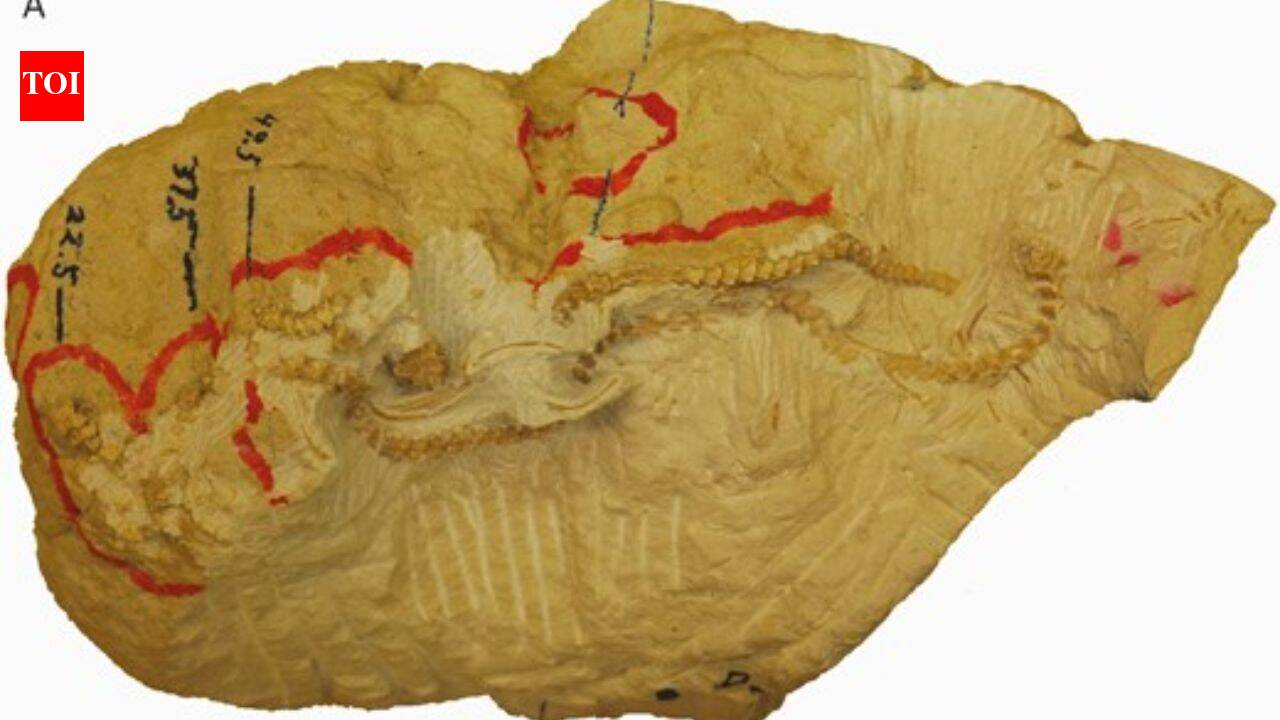
Three are part of specimen UW-11120, preserved together in two matching blocks of rock. asserted
Three → preserve → rock
Two can be seen on the surface, while CT scanning revealed a third snake hidden inside the rock. asserted
scanning → see → rock
A fourth specimen, UW-11990, came from a different locality in the same formation. asserted
specimen → come → formation
The arrangement of the first three fossils had already attracted attention decades ago. asserted
arrangement → attract → attention
According to the research paper, scientists Brent H. Breithaupt and David Duvall first described them in 1986 and suggested that they could represent a fossil snake hibernaculum, essentially a place where snakes sheltered together. uncertain
snakes → accord → hibernaculum
The new study has now provided the detailed anatomical work needed to identify what these animals actually were Overview of UW-11990, the referred specimen of Hibernophis breithaupti. asserted
animals → provide → breithaupti
Image Credit: Zoological Journal of the Linnean Society How did these ancient snakes become preserved together asserted
snakes → preserve → Society
The fossils were found in Wyoming's White River Formation, in rocks dating to the early Oligocene. asserted
fossils → find → Oligocene
The study explains that surrounding material is a fine, sandy mudstone and that the sediments were probably deposited during a small flood. asserted
sediments → explain → flood
The volcanic connection comes from the geology of the wider formation. asserted
connection → come → formation
The study notes that volcanic ash layers elsewhere in the White River Formation have been used to establish a minimum age of about 32 million years for these rocks. asserted
layers → note → rocks
The Daily Galaxy describes the preservation as the result of volcanic ash, mud and floodwater working together to bury and protect the snakes. asserted
ash → describe → snakes
That combination created an unusual fossil record. asserted
combination → create → record
Instead of being scattered by the environment, the snakes remained sufficiently intact for researchers to study their bones. asserted
researchers → scatter → bones
The researchers determined that the fossils represented a previously unknown snake and named it Hibernophis Breithaupti. asserted
fossils → determine → it
The genus name combines the Latin ‘hibernare,’ meaning to pass the winter, with the Greek word ‘ophis,’ meaning snake. asserted
name → combine → snake
The name reflects the unusual preservation of the four individuals and the earlier suggestion that they may have occupied a shared winter shelter. uncertain
they → reflect → shelter
The study found that Hibernophis could not simply be placed among previously recognised fossil snakes such as Ogmophis and Calamagras. uncertain
Hibernophis → find → Ogmophis
Detailed examination showed differences in the vertebrae and skull, allowing the researchers to establish it as a distinct species. asserted
researchers → show → species
The researchers' evolutionary analysis places HibernophisBreithaupti as the sister group to all other booids. asserted
analysis → place → booids
But another possible position close to some New World 'erycines' and ungaliophiines could not be completely ruled out. uncertain
position → rule → erycines
Did the snakes really hibernate together asserted
snakes → hibernate → ?
This is perhaps the most intriguing question raised by the fossils, but it requires some caution. asserted
it → raise → caution
The three snakes preserved together were found in an arrangement that resembles a shared shelter or hibernation site. asserted
that → preserve → shelter
The study records that their unusual preservation had previously been interpreted as a possible fossil hibernaculum. asserted
preservation → record → hibernaculum
The Daily Galaxy also highlights the comparison with modern garter snakes, which can gather in large numbers inside dens and burrows during cold periods. asserted
which → highlight → periods
However, the fossil evidence cannot prove exactly why the snakes were together. asserted
snakes → prove → ?
The researchers can identify their position and anatomy, but behaviour is much harder to establish millions of years later. asserted
behaviour → identify → position
The arrangement is therefore best treated as possible evidence of communal sheltering rather than definite proof that the snakes were hibernating. asserted
snakes → treat → sheltering
Analysing snake evolution through these complete fossils The discovery matters beyond the unusual sight of several snakes preserved together. asserted
discovery → analyse → snakes
…and 7 more, not listed.

💬 Give feedback
🕘 History 🎫 Support