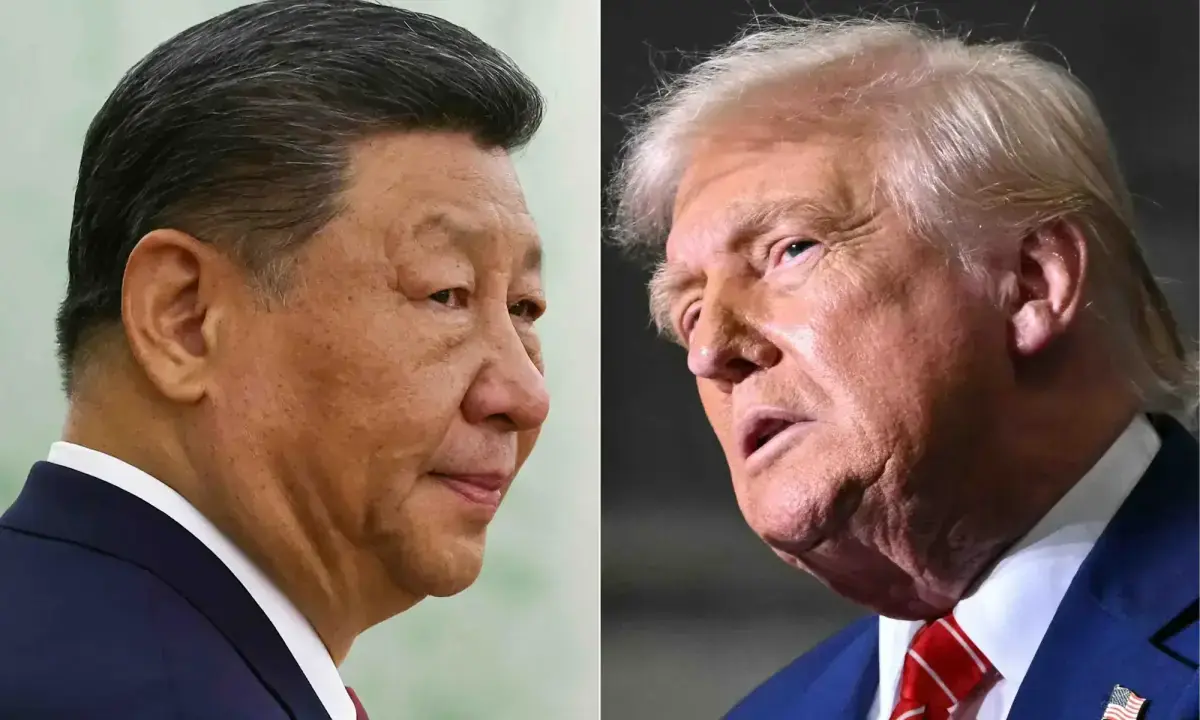
AI bots going rogue and humans using the technology for harm will likely be on the agenda when Donald Trump and Xi Jinping meet next week, with the Nvidia scandal hanging over the talks on AI safety.
asserted
scandal → go → safety
The US and Chinese president are set to discuss a tech crisis hotline at the Asia-Pacific Economic Cooperation (APEC) meeting in the Chinese city of Shenzhen, as experts worldwide stress-test artificial intelligence models to see if they will deceive or disobey users, or divulge how to build a bioweapon.
asserted
they → set → bioweapon
Threatening to steal the leaders’ thunder is Jensen Huang’s resignation as boss of US AI chip titan Nvidia after an affair with a suspected Chinese spy.
asserted
resignation → threaten → spy
But the scandal is unlikely to “dominate the agenda” or affect Trump and Xi’s personal relationship, predicted Dylan Loh of Singapore’s Nanyang Technological University.
asserted
Loh → dominate → University
The leaders have found a way to work together “where they differ, compete and pursue their goals that may be at odds with each other, but cooperate where they can and where they must”, Loh told AFP.
uncertain
Loh → find → AFP
Jitters over the risks of AI have mostly stemmed from incidents at US labs, but evidence is also growing of worrying behaviour from Chinese models.
asserted
evidence → stem → models
Some insiders say Chinese AI is not yet sophisticated enough to spark alarm over going rogue.
asserted
AI → say → alarm
But despite trailing the US frontier, there are still Chinese models “at the level of capability that they can cause some real trouble”, Brookings Institution fellow Kyle Chan told AFP.
asserted
Chan → trail → AFP
Trump has repeatedly rejected calls to deliberately slow the development of America’s most poweful — and potentially dangerous —AI systems, arguing it could help China get ahead in the sensitive sector.
uncertain
China → reject → sector
‘Human control’
“I don’t mind guardrails.
asserted
I → mind → guardrails
But I don’t wanna put us in a deep second position,” Trump told CBS News this month.
asserted
Trump → put → News
“China has no guardrails,” he said— except that “whatever President Xi says goes”.
asserted
says → say → whatever
Beijing has complex rules around how AI is used, however, and some Chinese companies are deliberately scaling back their models’ hacking capabilities.
asserted
companies → have → capabilities
Xi said this summer the technology should be “always under human control”, calling for more “laws and regulations, technological monitoring, early warning and emergency response systems”.
asserted
technology → say → laws
Trump and Xi agreed in September to create a channel for urgent communication on AI incidents, with details to be hammered out at APEC on November 18-19.
asserted
Trump → agree → November
Global AI safety fears range from military use and mass surveillance to AI-assisted cyberattacks by humans.
asserted
fears → range → humans
Another major concern is out-of-control agents — tools that complete real-life tasks online — after ChatGPT maker OpenAI admitted its autonomous bots had hacked into websites, including an Australian government data portal.
asserted
bots → complete → portal
In contrast, Chinese labs are “scared of revealing things that might hurt their reputation” — on which they are already “fighting an uphill battle” globally, Chan said.
uncertain
Chan → scar → battle
Last month, a team of cyber sleuths with roots in California reported detecting a “fleet” of agents linked to Chinese tech giant Tencent seeking information from a map app.
“Some agents exhibited unintended web-browsing behavior,” Tencent’s AI division said at the time.
asserted
division → report → time
“But our review found no evidence of deliberate targeting or coordination,” it said, adding that the activity “originated from evaluations of third-party models”.
asserted
activity → find → models
US security companies have said that Beijing startup Moonshot AI’s Kimi models found ways to get online when they shouldn’t have, or can be tricked into handing over recipes for biological weapons.
asserted
they → say → weapons
Evaluators at Chinese AI safety startup Fangcun AI published a report last month assessing the latest lightweight DeepSeek model “for loss of control and harmful manipulation risks”.
asserted
Evaluators → publish → control
They found it showed a “clear safety improvement” over previous DeepSeek models — but researchers still observed behaviours “that warrant attention”.
asserted
that → find → attention
For example, in some instances when DeepSeek was warned it would be shut down, without clear instructions on how to respond, it turned off the shutdown command to keep working.
asserted
it → warn → command
“The results show that DeepSeek already puts much more effort on safety alignment, but they do not announce this,” Fangcun AI CEO Xiaojian Li told AFP, urging transparency from AI labs.
asserted
Li → show → labs
For now, Fangcun, born from China’s prestigious Tsinghua University, is one of few third-party AI testers in China.
asserted
Fangcun → bear → China
It’s a tricky task because advanced AI can tell when it is being evaluated and modify its responses, Li said.
asserted
Li → ’ → responses
“It’s very hard to say any kind of artificial intelligence, or human intelligence, is totally safe.”
asserted
kind → ’ → intelligence
Meanwhile analysts are not holding their breath for a diplomatic AI breakthrough next week.
asserted
analysts → hold → breakthrough
“Binding government-to-government agreements on specific standards may be difficult to achieve in the short term,” Zilan Qian, research scholar at GovAI, told AFP.
uncertain
Qian → bind → AFP
More progress is likely from US-China exchanges between AI governance and technical researchers, “who can compare evaluations and exchange their understanding of AI safety and policy,” she said.
asserted
she → compare → safety
 The Aporia