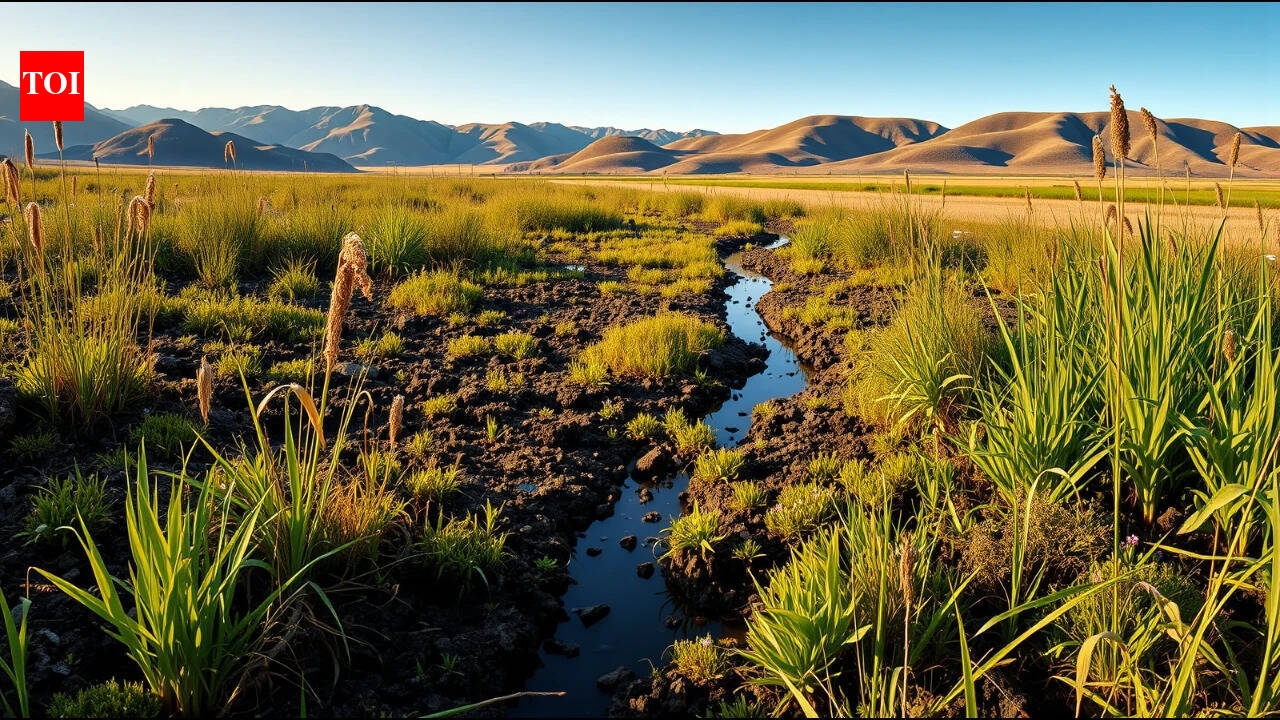
California has spent decades restoring wetlands in the Sacramento-San Joaquin Delta, hoping that reflooded farmland can rebuild soil, store carbon and help reduce greenhouse gas emissions.
asserted
farmland → spend → emissions
A new study published titled
Interannual Variability in Greenhouse Gas Emissions Challenges Post-Restoration Net Sink Predictions in California Delta Wetlands in Global Change Biology found that the climate benefits of these projects can take longer to emerge than expected and vary substantially between sites and years.
asserted
benefits → publish → sites
Researchers analysed 44 site-years of continuous measurements of carbon dioxide and methane exchange from six restored wetlands across the Delta.
asserted
Researchers → analyse → Delta
The results showed that restoration does not automatically turn a former agricultural landscape into a consistent greenhouse gas sink.
asserted
restoration → show → sink
Some wetlands remained sources of greenhouse gases years after restoration, particularly where vegetation establishment was delayed by high or inconsistent water levels.
asserted
establishment → remain → levels
Others transitioned towards net climate benefits more quickly, highlighting the importance of restoration design, water management and long-term monitoring.
asserted
Others → transition → design
Why California restored Delta wetlands to store carbon
The Sacramento-San Joaquin Delta was historically covered by wetlands that accumulated large amounts of carbon in their soils as plants grew and organic matter built up.
Much of this landscape was later drained for agriculture, exposing peat-rich soils to conditions that accelerated decomposition and caused stored carbon to be released.
asserted
carbon → restore → decomposition
Restoring wetlands by bringing water back onto former agricultural land has therefore been promoted as a nature-based approach to rebuilding wetland ecosystems and recovering some of their carbon-storage function.
asserted
Restoring → restore → function
But restoring the vegetation and hydrology of a wetland does not immediately recreate the conditions of an established ecosystem.
asserted
restoring → restore → ecosystem
The new study examined this recovery process across six restored sites: Hill Slough, Mayberry, Sherman Wetland, Gilbert Tract, East End and West Pond.
asserted
study → examine → sites
The sites differed in their restoration histories, hydrological conditions and approaches to planting and vegetation establishment.
asserted
sites → differ → planting
How scientists measured greenhouse gases in restored wetlands
asserted
scientists → measure → wetlands
The researchers used eddy covariance, a technique that continuously measures exchanges of gases between an ecosystem and the atmosphere.
asserted
that → use → ecosystem
Towers equipped with instruments recorded carbon dioxide and methane fluxes across the restored wetlands, producing measurements that could be compared across different years and sites.
uncertain
that → equip → years
The study found substantial interannual variability in greenhouse gas exchange.
asserted
study → find → exchange
Restoration design, water management and vegetation establishment were among the factors associated with differences between sites.
asserted
design → associate → sites
Rapid vegetation growth could increase carbon dioxide uptake, but dense stands of wetland plants could also increase methane emissions.
uncertain
stands → increase → emissions
Conversely, wetlands where vegetation establishment was delayed by high or inconsistent water levels could remain greenhouse gas sources even years after restoration.
uncertain
establishment → delay → restoration
The researchers also found differences in soil carbon and nitrogen between older and younger restored wetlands.
asserted
researchers → find → wetlands
West Pond, Mayberry and East End, which represented the older restored wetlands in the study, had substantially higher soil carbon and nitrogen concentrations than the younger Gilbert Tract, Sherman Wetland and Hill Slough sites.
asserted
which → represent → sites
The authors describe this as evidence that soil biogeochemical recovery is a gradual process that can continue over long periods after restoration.
asserted
that → describe → restoration
Why methane makes the climate benefits harder to predict
One of the central complications is methane.
asserted
One → make → methane
Wetlands can absorb carbon dioxide as vegetation grows while simultaneously producing methane under waterlogged conditions.
asserted
vegetation → absorb → conditions
Because methane contributes to warming, its emissions can offset some of the climate benefit associated with carbon dioxide uptake.
asserted
emissions → contribute → uptake
The researchers therefore looked beyond whether a wetland was simply absorbing more carbon dioxide than it released.
asserted
it → look → dioxide
They calculated the net radiative forcing of restored wetlands relative to their previous land uses, including the effects of both carbon dioxide and methane.
asserted
They → calculate → dioxide
They then estimated a “switchover time”, defined as the point when the warming effect associated with the restored wetland falls to zero and becomes neutral or negative as cumulative carbon dioxide removal overtakes the warming effect of methane emissions.
asserted
removal → estimate → emissions
The researchers used Monte Carlo simulations to account for uncertainty caused by year-to-year variation in methane and carbon dioxide fluxes.
asserted
researchers → use → fluxes
This means that the age of a restoration project alone cannot determine when it will deliver a net climate benefit.
asserted
it → mean → benefit
A wetland with rapid vegetation establishment may begin removing carbon dioxide relatively quickly, but methane emissions can complicate that trajectory.
uncertain
emissions → begin → trajectory
Sites with slower or inconsistent vegetation establishment may take longer to reach the same point, while some can remain sources for years.
uncertain
some → take → years
What the findings mean for future wetland restoration
The researchers' findings do not mean that restoring Delta wetlands cannot provide climate benefits.
asserted
restoring → mean → benefits
Instead, they show why those benefits cannot necessarily be treated as immediate or uniform across restoration projects.
asserted
benefits → show → projects
The 44 site-years of observations revealed large differences in greenhouse gas exchange from one site and year to another, making long-term monitoring important for understanding whether individual wetlands are moving towards becoming net sinks.
asserted
wetlands → reveal → another
The study also points to the importance of site-specific restoration strategies.
asserted
study → point → strategies
Tailored planting or rapid natural recolonisation was associated with earlier transitions towards net sink conditions at some sites, while delayed vegetation establishment under problematic water conditions was linked with persistent greenhouse gas emissions.
asserted
establishment → associate → emissions
For restoration projects intended to deliver climate benefits, the researchers argue that ecological recovery, water management and methane emissions need to be considered alongside carbon dioxide uptake rather than treating carbon storage as a single predictable outcome.
asserted
recovery → intend → outcome
 The Aporia