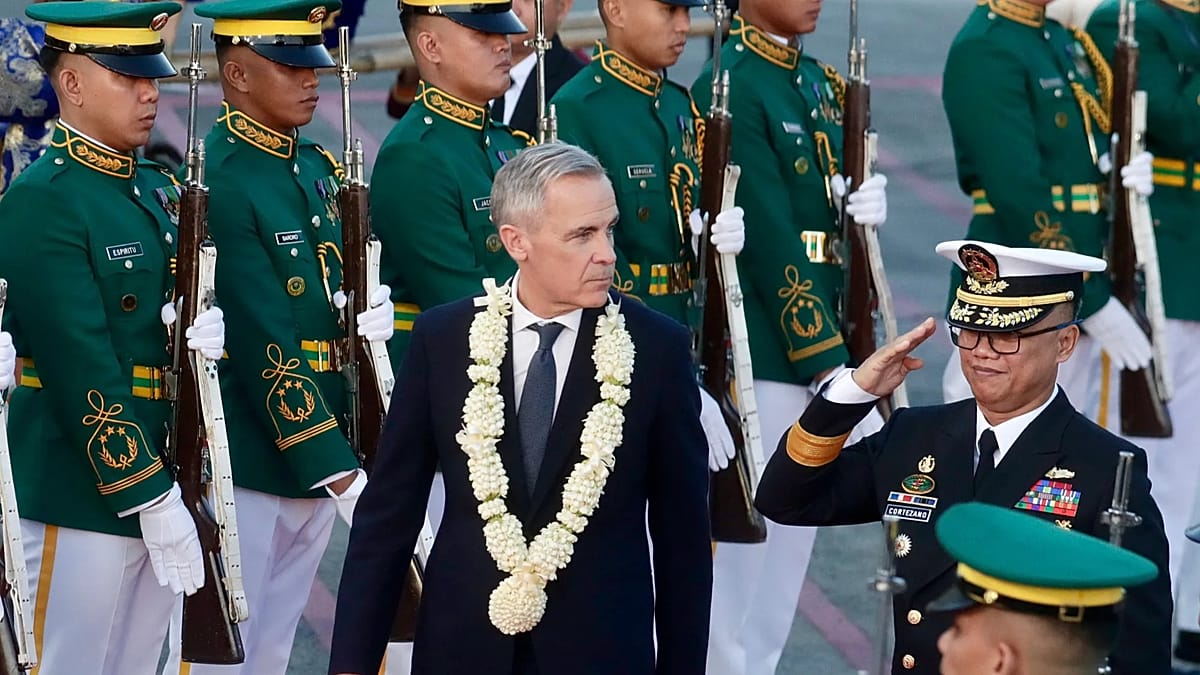
Prime Minister Mark Carney is, following a stopover in Ireland, on his way to Asia.
asserted
Carney → follow → Asia
The trip is yet another in the PM’s concerted efforts to diversify Canada’s economy and lessen the country’s reliance on the U.S.
asserted
trip → diversify → U.S.
There’s nothing wrong with the impulse, but Canada must stay clear-eyed about the most prosperous path forward.
asserted
Canada → ’ → path
As Canada-U.S. trade talks collapsed in August, Prime Minister Carney characterized the fallout in the strongest terms: “You are at war when you get attacked.”
asserted
you → collapse → war
On Oct. 16, Carney claimed that the U.S. was trying to break Canada through the Alberta referendum so that it could “own us.”
uncertain
it → claim → us
This narrative provides strong talking points and serves the prime minister politically, but that storyline is built on a house of cards.
asserted
storyline → provide → cards
Canadians must understand how flimsy it really is.
asserted
it → understand → ?
Yes, we are still in a trade war–and President Trump seems to have lost sight of who America’s allies are–but Trump is not America, and America is not our enemy.
asserted
America → seem → sight
While the president and his administration have acted belligerently and dealt Canada unnecessary insults and inconsiderate pain, the more critical risks–economic and otherwise–to Canada’s democracy are posed by the actions of authoritarian states, like China, Iran, Russia, North Korea, and others–not the democratic U.S.
asserted
risks → act → China
Canada needs to be strong to address these threats and provide Canadians with future prosperity, but that cannot be achieved by diverting our attention or failing to identify Canada’s vulnerabilities.
asserted
that → need → vulnerabilities
Many Canadians have bought into two related but false ideas.
asserted
Canadians → buy → ideas
The first is that Canada’s current economic challenges are solely the fault of the U.S., and the second is that it is in Canada’s interests to unite the country around pushing back against our continental cousin.
asserted
it → unite → cousin
There is no disagreement that Canada’s economy has suffered since the start of President Trump’s second administration, especially with the imposition of U.S. tariffs and the rounds of counter-tariffs (and even counter-counter-tariffs).
asserted
economy → be → tariffs
These effects are more acute in Canada than in any other country, and only Mexico comes close to being impacted to a similar degree.
asserted
Mexico → come → degree
Rightly or wrongly, the U.S. tariffs are meant to address problems in the American economy, and it should not be forgotten that its financial system is significantly impacted by the measures.
asserted
system → mean → measures
Canadians are justified in their anger, but the fallacy is to merely blame President Trump as the cause of Canada’s broader malaise without acknowledging that, one, many of the issues we face are longstanding vulnerabilities that precede Trump’s second term, and two, that Canada has allowed its economy to be too tied to decisions outside Ottawa’s control.
asserted
economy → justify → control
That is a loss of sovereignty and reflects a lack of responsibility on the part of the successive Canadian governments.
asserted
That → reflect → governments
Free trade has underpinned the continent’s prosperity for decades.
asserted
trade → underpin → decades
However high our elbows, it cannot be abandoned wholesale.
asserted
it → abandon → ?
Some might argue that Canada is not at fault–that a free trade agreement, CUSMA, was in place with the U.S. and Mexico.
uncertain
agreement → argue → U.S.
Those people would say that Canada’s problems are because President Trump didn’t abide by the terms of CUSMA.
asserted
Trump → say → CUSMA
Clearly, the effects of free trade on security and sovereignty were forgotten, and Canadians became complacent.
asserted
Canadians → forget → security
Other aspects of those structural problems include the well-known, but persistent interprovincial trade barriers–most of which remain in place.
asserted
most → include → place
Canada’s premiers, evidently, find it easier to scapegoat the U.S. administration for Canada’s problems than to do the hard work of fixing what they most readily control.
asserted
they → find → what
President Trump and the U.S. administration will be held accountable in time (including in the recent mid-term elections) for failing to abide by the terms of their agreements, including CUSMA.
asserted
Trump → hold → CUSMA
But Canadians need to be accountable for failing to establish sufficient economic sovereignty, such that a decision or action taken in a foreign capital risks the economic stability of the nation.
asserted
decision → need → nation
Christopher Coates argues that while Prime Minister Mark Carney’s efforts to diversify Canada’s economy away from reliance on the U.S. are commendable, Canadians must recognize their own vulnerabilities and not scapegoat the U.S. for their economic challenges.
asserted
Canadians → argue → challenges
Canada’s economic issues are rooted in longstanding structural problems, and blaming the U.S. distracts from the need for self-reliance and accountability.
asserted
blaming → root → reliance
Coates calls for a clear-eyed understanding of the real threats to Canada, particularly from authoritarian states, and urges Canadians to prepare for future challenges without creating convenient political narratives.
asserted
Coates → call → narratives
 The Aporia