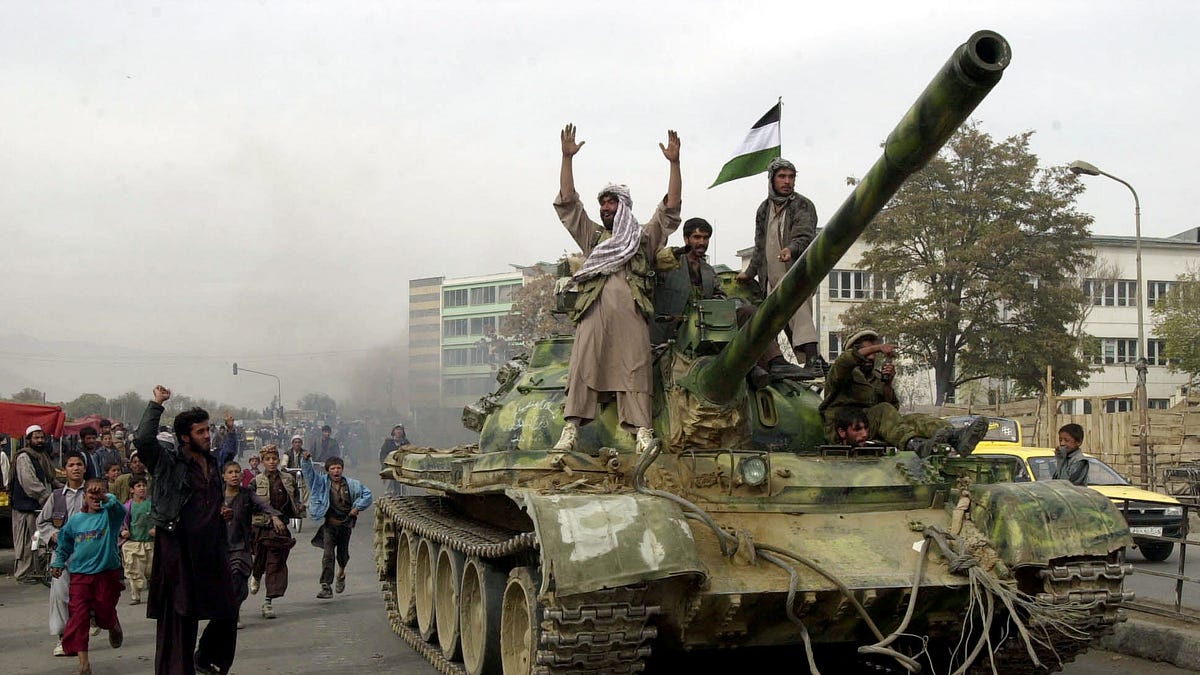
Photo via Zeteo

There Was No ‘Liberation’ of Afghanistan

Read the original at Zeteo ↗
Cite

Feroz, E. (2026, November 13). There Was No ‘Liberation’ of Afghanistan. Zeteo. https://zeteo.com/p/there-was-no-liberation-of-afghanistan

Dated from the outlet's own feed. Check the original for its byline.

Zeteo · collected 2026-11-13 · by Emran Feroz commentary

Quick Summary

In November 2001, as the Taliban retreated from Kabul, Afghans celebrated what was perceived as liberation from five years of strict Taliban rule. However, the article argues that this initial euphoria quickly turned sour as the ensuing chaos led to widespread human rights abuses, including bounty hunting and mass graves. The author, through interviews and historical context, critiques the U.S. and NATO's involvement in Afghanistan, asserting that they supported warlords rather than fostering a democratic state, ultimately leading to the Taliban's return.
Written by AI on 2026-11-15, from this article's own text only (the story summary below draws on all the coverage).

AI analysis

Story summary

As of November 13, 2026, Emran Feroz's article in Zeteo reflects on the aftermath of the U.S. invasion of Afghanistan in 2001. On that morning, Abdul Maruf Ahmadi, a teenager at the time, witnessed the Taliban's retreat from Kabul and the arrival of the Northern Alliance, marking a moment of relief for many Afghans who had endured the Taliban's repressive rule. However, the joy was short-lived as the country quickly descended into chaos, with bounty hunters targeting anyone suspected of being affiliated with the Taliban or al-Qaeda. The U.S. spent over $100 billion over two decades trying to stabilize Afghanistan but ultimately handed power back to warlords whose civil war had facilitated the rise of the Taliban.

Written for “There Was No Liberation Of Afghanistan” on 2026-11-18, grounded in this article and the 0 other(s) covering the same event.

Compared with similar articles

This article reads leans strongly left and hedges 5% of its claims. Each row says how that neighbour differs.
The Sydney Morning Herald
Hedges 3 of 95 claims Outlet record 61/100
“The articles describe different events; Article A discusses the fall of the Taliban in Kabul in November 2001, while Article B describes the arrest and imprisonment of Australian aid workers by the Taliban in August 2001.”

Story

There Was No Liberation Of Afghanistan
Politics · 1 article(s) covering the same event.
How this article was measured signals, leaning charts, publisher record, byline, topics and claims

Signals How these are calculated →

Claims extracted
22
sentences that state something as happening or true
Uncertain
5%
1 of 22 hedged ("reportedly", "may", "according to")
Leaning
Leans strongly left
expected in commentary, which argues a position · beta estimate
Publisher signals
not measured
these signals count newsroom corrections; Commentary has none to count
Outlets on this story
1
Politics
Same framing elsewhere
1
articles that frame the event the way this one does
Analyzed 2026-11-15 · how these are computed

How this is being covered How these are calculated →

Article leaning vs. publisher reliability
Source leaning vs. consistency

Publisher

Zeteo · 275 article(s) · 0 correction(s) detected
No corrections detected for this publisher. That may mean careful reporting, or simply that nothing has been checked.

Who wrote this

Emran Feroz
1 article(s) here · 0 carrying a prediction
The only article under this byline in the corpus.

Topics

Afghanistan Afghans Americans KABUL Taliban

Subjects

Taliban ORG · 9× KABUL GPE · 6× Afghanistan GPE · 2× Afghans NORP · 2× Ahmadi PERSON · 2× Abdul Maruf Ahmadi PERSON · 1× Afghan NORP · 1× American NORP · 1× Americans NORP · 1× Northern Alliance ORG · 1×

Narrative

It handed it back to the warlords whose civil war made the rise of the Taliban possible in the first place, and then spent two decades and well over $100 billion to keep them in power.
framing: assertive · carried by 1 article(s) · first seen 2026-11-15
2026-11-15 · Zeteo
There Was No ‘Liberation’ of Afghanistan · assertive framing

Claims (22 extracted, 1 hedged)

On the morning of Nov. 13, 2001, Abdul Maruf Ahmadi was a teenager standing on a street in Kabul, watching men shave off their beards. asserted
men → stand → beards
The Taliban had slipped out of the capital overnight after they were overthrown by the invading Americans and their Afghan allies. asserted
they → slip → Americans
By dawn, the fighters of the so-called Northern Alliance were rolling in on pickup trucks, and music, banned for five years, was playing again from shopfronts. asserted
music → call → shopfronts
People cheered. asserted
People → cheer → ?
Women who had been confined to their homes stepped outside and threw away their burqas. asserted
who → confine → burqas
They have had enough of the repressions,” Ahmadi told me when I met him in Kabul this autumn. asserted
I → have → Kabul
He is in his early 40s now, and he does not romanticize the Taliban, then or now. asserted
he → romanticize → Taliban
But he remembers how quickly the joy curdled. asserted
joy → remember → ?
Within days, Kabul and the rest of the country became a hunting ground. asserted
Kabul → become → country
American aircraft dropped leaflets promising “wealth and power beyond your dreams” to anyone who handed over Taliban or al-Qaeda fighters. asserted
who → drop → fighters
Men who had been nobody the week before picked up rifles and became bounty hunters. asserted
who → pick → rifles
“Suddenly, everyone who spoke Pashto [the dominant language within the Taliban] became suspicious, also men who wore beards and turbans,” Ahmadi, a Tajik and native of Kabul, said. asserted
Ahmadi → speak → Kabul
A 2006 study by Seton Hall University’s law school of the Pentagon’s own records on Guantánamo detainees found that only a small fraction had been captured by U.S. forces. asserted
fraction → find → forces
The large majority had been handed over by Pakistani authorities or the Northern Alliance, at a time when the US was paying bounties. asserted
US → hand → bounties
In the north, forces loyal to the warlord Abdul Rashid Dostum packed surrendered Taliban prisoners into sealed shipping containers. asserted
forces → pack → containers
Hundreds, perhaps thousands, suffocated or were shot on the way to Sheberghan prison, and were buried in the desert at Dasht-e-Leili. asserted
Hundreds → suffocate → Leili
This is the part of the story the anniversary leaves out. asserted
anniversary → leave → story
The fall of Kabul was sold as a liberation, and for many Kabulis that morning it felt like one. asserted
it → sell → one
But Washington and its NATO allies did not hand Afghanistan to the people, to ordinary Afghans. asserted
Washington → hand → Afghans
It handed it back to the warlords whose civil war made the rise of the Taliban possible in the first place, and then spent two decades and well over $100 billion to keep them in power. asserted
rise → hand → power
What followed was a grim “War on Terror” that filled the dungeons of Bagram with the tortured and the innocent, an allegedly democratic state hollowed out by plunder, and a Taliban insurgency fed by both. uncertain
that → follow → both
Now the Taliban are back and the warlords are in exile, and many Afghans fear the same cycle of conquest and revenge is about to happen once more. asserted
cycle → fear → conquest

Give feedback · no sign-in needed

No sign-in needed for now. Your note is sent without a name, so it cannot be answered.

History Support