The Sydney Morning Herald
· collected 2026-09-17 · by Andrew Fuhrmann, Giselle Au-Nhien Nguyen, Tony way, Bridget Davies
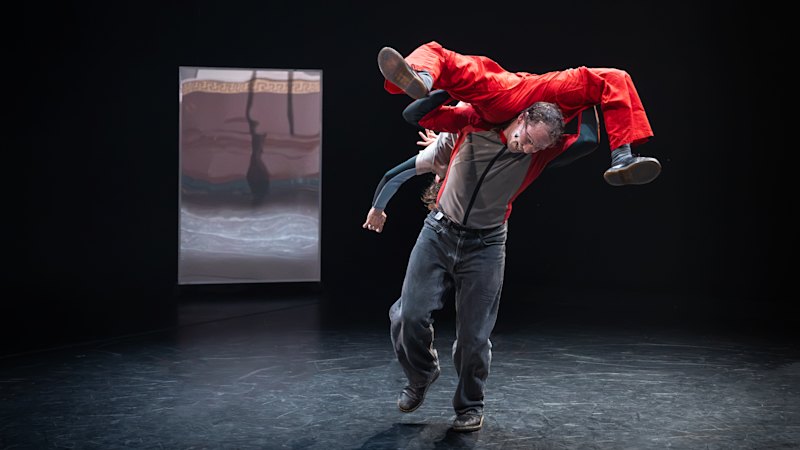
Their vocabulary of sporty grappling and mutual manipulation, first seen several years ago in the excellent Cuddle, combines rough-handling with exquisite responsiveness and apparent sensitivity.
asserted
vocabulary → see → responsiveness
The opening section of their latest collaboration has playful echoes of a ballroom routine.
asserted
section → have → routine
Extravagant lifts and twists and shifts of momentum also suggest a wrestling contest, with each dancer constantly tracing the other’s body to maintain contact, seeking ways to connect their repertoire of moves.
asserted
dancer → suggest → moves
As in Cuddle, they keep up a murmured dialogue, discussing their options and deciding what comes next.
asserted
what → keep → options
Moves are named like invitations which can be accepted or rejected.
asserted
which → name → invitations
These casual exchanges make the choreography seem negotiated live: an intricate physical conversation with its own laconic commentary.
asserted
choreography → make → commentary
Paradoxically, this verbal back and forth makes us more aware of who initiates and who responds, inviting us to diagnose power relations in the mechanics of partnering.
asserted
who → make → partnering
Or, at the very least, it draws attention to the contrast in their stage personalities: one expansive and eager, the other more reserved and reactive.
asserted
other → draw → personalities
Structurally, the development of the show from scene to scene feels a little arbitrary.
asserted
development → feel → scene
Of course, the unexpected twists and turns are part of the fun, but I think I would have enjoyed this show even more if there was a clearer sense of narrative progress.
asserted
I → think → progress
Ritchie-Jones’s program statement describes pushing their partnering practice to its limits and exploring how it fails.
asserted
it → describe → limits
Does apparent failure count as success for the performers, or is the other way around?
asserted
way → count → performers
It sounds a little too much like navel gazing.
asserted
It → sound → gazing
Reviewed by Andrew Fuhrmann
MUSIC
Belle and Sebastian ★★★★★
Palais Theatre, September 12
“Welcome to the second recording session for this still quite-new band,” Stuart Murdoch says with a grin.
asserted
Murdoch → review → grin
His tongue is firmly in cheek – Belle and Sebastian, the indie-pop group he’s led for more than half his life, is on tour celebrating its 30th year.
asserted
he → lead → year
In 1996, the bookish Scots made their debut with two albums: Tigermilk and If You’re Feeling Sinister.
asserted
You → make → Sinister
On this anniversary tour, they’re alternating playing those records in full.
asserted
they → alternate → records
Melbourne gets the Sinister treatment.
asserted
Melbourne → get → treatment
Playing albums in full live can be a cynical cash-cow in the age of commodified nostalgia, but there’s no denying the sheer delight of hearing a beloved album like this in all its glory.
asserted
Playing → play → glory
On record, Sinister’s arrangements are delicate; live, they’re injected with a shot of joyous energy, with buzzing synth to boot.
asserted
they → inject → synth
Many of these songs begin with Murdoch alone, singing with that sweet, instantly recognisable voice, before the eight other musicians on stage slowly blossom to create sunlight in musical form.
asserted
musicians → begin → form
Lead guitarist Stevie Jackson raucously takes on the harmonica for Me and the Major, his movements a chaotic blur.
asserted
movements → take → Me
As the album reaches its halfway point, a projection behind the band shows the LP being flipped on a turntable – “a bit of antiquated attention to detail,” Murdoch says.
asserted
Murdoch → reach → detail
Eager fans have been dancing in the aisles from the beginning, but when the band plays Get Me Away, I’m Dying, the entire venue is on its feet.
asserted
venue → dance → feet
The gorgeous Mayfly is another highlight from this half, but really, it’s all joy, not least because Murdoch and co are clearly having a blast, too.
asserted
Murdoch → ’ → blast
Murdoch’s signature humour is on display all night as he intersperses the music with quips, including a spiel about Victoria’s slogans as seen on number plates and a joke about Viagra as he takes his medication on stage.
asserted
he → intersperse → stage
“Back to sweetness and light!” he says, and back they go.
asserted
they → say → sweetness
A guitar-heavy I’m a Cuckoo kicks off the second set, comprising songs from the rest of the band’s long career.
asserted
I → ’m → career
Belle and Sebastian have such a varied discography that it’s a grab-bag every night.
asserted
it → have → discography
There are some deeper cuts here, such as 2010’s Little Lou, Ugly Jack, Prophet John, recorded with Norah Jones; here, it’s long-time vocalist Sarah Martin who does the honours, beautiful as ever.
asserted
who → be → honours
The band is pulling songs out on the fly by the end, with Another Sunny Day closing the night.
asserted
Day → pull → end
It’s apt – with 30 years of sunny days up their sleeves, Belle and Sebastian keep on delivering.
asserted
Belle → ’ → sleeves
These two words arguably encapsulate the astonishing imagination behind the three solo suites that Benjamin Britten composed for the Russian cellist Mstislav Rostropovich between 1964 and 1971.
asserted
Britten → encapsulate → 1964
Taking Bach’s fabled cello suites as a model, these tours de force remain revolutionary in pushing the instrument’s boundaries of timbre and texture.
asserted
force → take → timbre
Over three evenings, Dutch cellist Pieter Wispelwey, long an ardent and persuasive exponent of these works, is performing programs centred around each suite.
asserted
Wispelwey → perform → suite
Prokofiev and Shostakovich were appropriate stablemates in the series opener, not least because Prokofiev wrote his Cello Sonata in C, Op. 119 for Rostropovich, but also that the cellist was part of the deep friendship and admiration shared between himself, Shostakovich and Britten.
asserted
cellist → write → himself
Providing the first taste of Wispelwey’s chameleonic way with his 1760 Guadagnini cello, the Prokofiev ran the gamut of emotions, starting with its dark, sombre opening before flowering into rich lyricism, moments of childlike wonder and folkloric exuberance.
Britten’s Cello Suite No. 1, Op. 72 was full of ear-bending marvels, including a witty, cleverly constructed fugue and an evocative march in which the masterly bouncing of the bow summoned up martial images.
asserted
bouncing → provide → images
Few others would be capable of bringing this music alive so vibrantly and comprehensibly.
asserted
others → bring → music
Wispelwey ensured Shostakovich’s Cello Sonata in D minor, Op. 40 brimmed over with fascinating detail; bringing richly burnished tone to the eerie opening melody and plaintive Largo, unerring technique to the manic second movement and cheeky playfulness to the finale.
asserted
Sonata → ensure → finale
Setting aside the substandard printed program that doesn’t even list the movements of the works performed, don’t miss the remaining two opportunities to hear astounding music performed by musicians of genius.
asserted
that → set → genius
…and 51 more, not listed.
 The Aporia