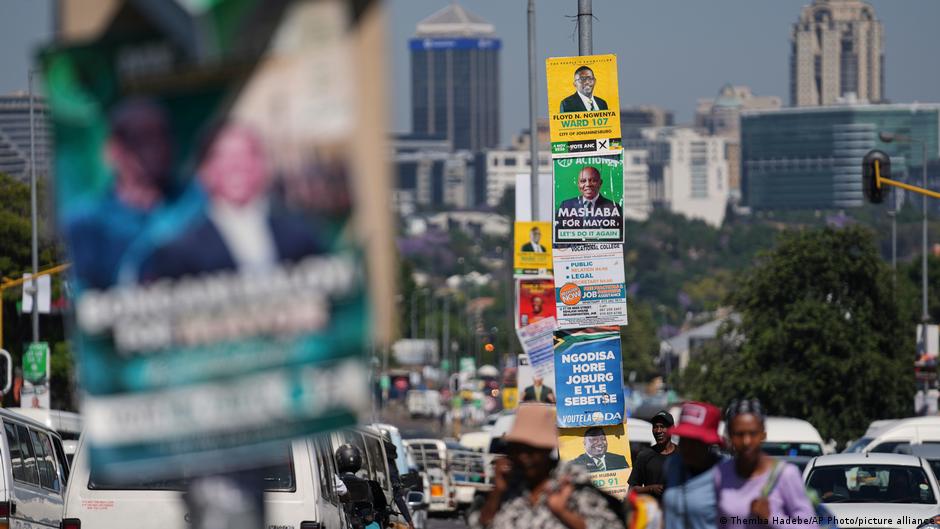
South Africa's governing African National Congress (ANC) party is forced to confront its worst electoral setback to date after securing under 31% of the vote in the country's significant local government elections; party leaders themselves have described the result as "catastrophic."
asserted
leaders → govern → result
This outcome marks a steep decline for the party that had once led South Africa's liberation struggle; the party that had dominated the country's political landscape since the end of apartheid in 1994.
asserted
that → mark → 1994
The result reflects growing public frustration about the ANC's lack of performance in key areas such as skyrocketing unemployment, poor service delivery, local governance failures and years of graft and corruption — sometimes at the highest levels of government.
asserted
result → reflect → government
So what comes next for the ANC — and for South Africa?
asserted
what → come → Africa
Voters express growing frustration and despair
asserted
Voters → express → frustration
Tasnim Essop, a researcher at the Society, Work and Politics Institute (SWOP) at the University of the Witwatersrand in Johannesburg, says it is time for the party to undertake some serious introspection.
asserted
party → say → introspection
She believes that the ANC has to confront a long list of difficult questions about governance, leadership and accountability.
asserted
ANC → believe → governance
"You're talking about issues like water, electricity, housing, public services at the basic municipal level.
asserted
You → talk → level
And ... research has shown that unemployment is also a big part of what drives people to vote in certain ways" she told DW.
asserted
she → show → DW
Essop also highlights the fact that the outcome of the vote didn't happen overnight, and that it rather reflects a slow erosion of public confidence in the erstwhile ruling party over a long period.
asserted
it → highlight → period
DW correspondent Dianne Hawker-Kalubi, who reported from various polling stations during the election, agrees with that observation, stressing that many of the voters she had spoken to expressed "a lot of frustration, a lot of concern about basic services not being delivered" for years.
Mokhiri Phooko, a Cape Town resident, said that "people are losing hope" across the country after over three years of the political landscape being dominated by late President Nelson Mandela's party:
"You promised us jobs, why [are] you not keeping up the end of your bargain right," she told Reuters, stressing that "(t)he unemployment rate went up drastically" in the past few years.
A shifting role for the ANC
The ANC itself meanwhile has acknowledged that things have to change: In a statement, the party announced that its National Executive Committee would convene a special meeting to deal with the "serious political responsibility to listen to the people, confront its shortcomings and provide leadership.
asserted
Committee → report → leadership
Furthermore, the party also has to prepare a framework for upcoming coalition negotiations at the same time — many times involving some of its biggest rivals, as was the case after the 2024 general elections.
asserted
case → have → elections
The election results therefore signal a broader shift in South African politics, with voter support increasingly spread across multiple parties rather than being concentrated behind a single dominant force.
asserted
support → signal → force
While nationally, the ANC remained the country's largest party, opposition parties made significant gains; the Democratic Alliance (DA) managed to strengthen its position across several major urban centers.
asserted
Alliance → remain → centers
Meanwhile the uMkhonto weSizwe (MK) party, launched by former President Jacob Zuma in late 2023, performed rather strongly in the KwaZulu-Natal provice despite entering the political arena so recently.
asserted
party → launch → arena
At the local level, smaller civic organizations and community-based movements also recorded notable successes.
asserted
organizations → base → successes
'Vote fluidity' enters South African politics
Essop describes this trend as a growing sense of "vote fluidity," with voters increasingly willing to move their support between parties instead of remaining loyal to a single political organization.
asserted
voters → enter → organization
Some observers have already linked this drift to the idea of South Africans are moving beyond liberation-era loyalties; however, Essop opines: "I would be cautious to say that liberation politics are dead and gone," as many political parties continue to draw ther legitimacy and support from the country's liberation history — even if they no longer operate under the ANC banner.
asserted
they → link → banner
Essop argues that the political shift does not signify a wholesale rejection of that liberation narrative itself, but rather a growing demand for effective governance and leadership.
asserted
shift → argue → governance
A critical test for the ANC
For the ANC, the challenge now is rebuilding trust, with South African President Cyril Ramaphosa saying that the results are a challenge not just for his party but for all political parties to come together and perform better for citizens.
asserted
parties → rebuild → citizens
In a statement, Ramaphosa said that "[t]hose who have been elected to councils now need to prove themselves worthy of the trust placed in them by the South African people."
asserted
themselves → say → people
While the ANC still remains South Africa's largest political party, its latest setbacks at the polls underscore how much the country's political landscape is no longer what it was when apartheid ended.
asserted
apartheid → remain → polls
The era of undisputed ANC loyalty and dominance appears to be over as voters are showing a greater willingness to support alternative parties and punish those they believe have fallen short.
asserted
they → appear → those
Whether the ANC can reverse this decline will depend largely on how convincingly it can deliver not only improved public services, but effective change throughout.
asserted
it → reverse → services
 The Aporia
