A possible China-US-Russia summit has prompted alarm of a modern-day Yalta Conference, with three powerful men carving up the world — with little regard for Ukraine, Europe and Taiwan or anyone else.
asserted
men → prompt → Ukraine
But apart from an historic photo opportunity, the meeting between Presidents Xi Jinping, Donald Trump and Vladimir Putin at the November 18-19 APEC summit in Shenzhen will likely achieve little, analysts say.
asserted
analysts → achieve → little
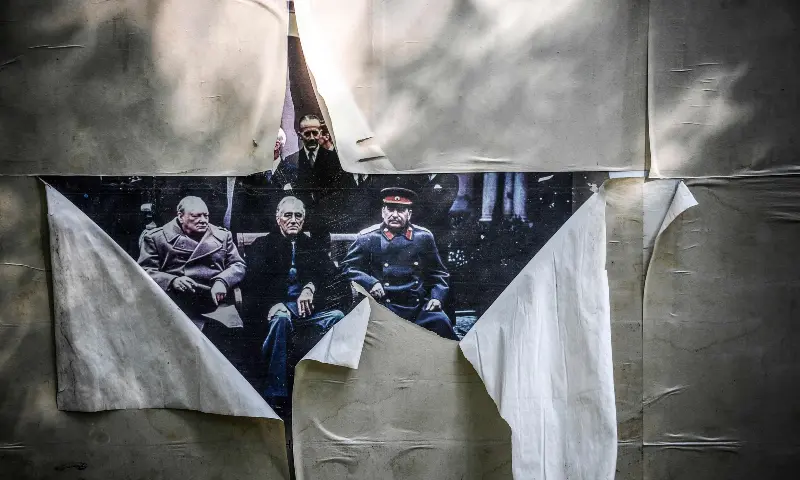
When then US president Franklin D. Roosevelt, Britain’s Winston Churchill and Soviet leader Joseph Stalin met in Yalta in February 1945, they laid out the post-WWII settlement and new territorial boundaries in Europe.
asserted
they → meet → Europe
That meeting in Yalta, then in the Soviet Union and now in a part of Ukraine annexed by Russia in 2014, laid out the foundations for the Soviet domination of Eastern Europe and the Cold War.
asserted
meeting → annex → Europe
Ukraine’s President Volodymyr Zelensky has raised alarm that Shenzhen could be a Yalta-like “redistribution of spheres of influence” for the 21st century.
uncertain
Shenzhen → raise → century
At talks in Abu Dhabi this week — the first since February — Russian negotiators rattled Ukraine and its European supporters by pushing a review of the continent’s security architecture as part of any peace deal, with the US also floating a new framework.
asserted
US → rattle → framework
Russia’s delegation chief in Abu Dhabi, Vladimir Medinsky, fanned such fears by questioning the inclusion of Europe in further talks.
asserted
chief → fan → talks
The trilateral rankles because it signals “the idea that a few great powers can decide the security and future of other countries over their heads”, according to Tsiporah Fried at the Hudson Institute.
uncertain
powers → rankle → Institute
The format alone “would already send a message about who counts, and whose interests can be negotiated by others”, she told AFP.
asserted
she → send → AFP
Divergent interests
Beyond the symbolism, however, divergent interests make the creation of a new world order in Shenzhen unlikely.
asserted
creation → make → Shenzhen
Even the agenda reportedly remains contentious: Russia has suggested the meeting focus on Ukraine, Trump has pushed for talks on nuclear weapons and the Iran war, and China has remained tight-lipped on both.
“The three parties have vastly different demands, making the management of expectations difficult.
uncertain
management → remain → expectations
There is a high probability that talks could end without a breakthrough,” according to Wang Wen, dean of the Chongyang Institute for Financial Studies at Renmin University in Beijing.
uncertain
talks → be → Beijing
There are also few issues where input from all three leaders could bring progress.
uncertain
input → be → progress
Beijing — which presents itself as a champion of multilateralism — has repeatedly said that Europe should be part of peace negotiations over Ukraine.
asserted
Europe → present → Ukraine
German President Frank-Walter Steinmeier said that in a recent meeting, Xi showed “irritation” when the idea of the trilateral talks covering Ukraine came up.
asserted
idea → say → Ukraine
“He explicitly pointed out that this is a European conflict, in which the Europeans must also be at the table,” Steinmeier told ARD.
asserted
Steinmeier → point → ARD
On nuclear disarmament, China has long insisted that the US and Russia reduce their own giant nuclear arsenals before it agrees to talks on its own stockpile.
asserted
it → insist → stockpile
The summit therefore is more likely to produce minor outcomes such as crisis hotlines or some cooperation on counter-terrorism, public health, or climate change, Wang told AFP.
“There is no single enemy to unite all three great powers the way that the fight against Nazi Germany united Roosevelt, Churchill, and Stalin,” said Wen-Ti Sung, a political scientist at Australian National University.
asserted
Sung → produce → University
“It follows that piecemeal horse-trading is in; a grand bargain is out.”
asserted
bargain → follow → ?
However, Taiwan — which China claims — will still be watching the meeting closely, Sung said.
uncertain
Sung → claim → meeting
“If the Trump administration is open to abandoning one partner (Ukraine) out of convenience, then it can abandon another,” he said.
asserted
he → abandon → another
A post-Shenzhen world
The Trump administration has sought to reassert US dominance over the “Western hemisphere” — including by capturing Venezuelan President Nicolas Maduro in January — but splitting the world among great powers like it’s 1945 may not guarantee security.
uncertain
it → seek → security
China has opposed the logic of Yalta — the clandestine division of spheres of influence and major powers determining the fate of other nations — “from the very beginning”, according to Renmin University’s Wang.
uncertain
China → oppose → Wang
China could allay fears of a second Yalta by using the summit to “emphasise the defence of sovereignty and support for multilateral organisations”, Wang said.
uncertain
Wang → allay → organisations
If Beijing uses the meeting to insist on European inclusion in talks regarding the continent’s security, it “could, in fact, open a new window for communication between China and Europe”, he said.
uncertain
he → use → China
“The original Yalta opened the path to the Korean War and Indochina Wars in addition to various conflicts and insurgencies across Asia, Africa, and Latin America,” said Chong Ja Ian at the National University of Singapore.
asserted
Ian → open → Singapore
Any Yalta 2.0 agreement “will almost certainly run into the same kinds of issues”, Chong said.
asserted
Chong → run → issues
 The Aporia