Photo via Euronews

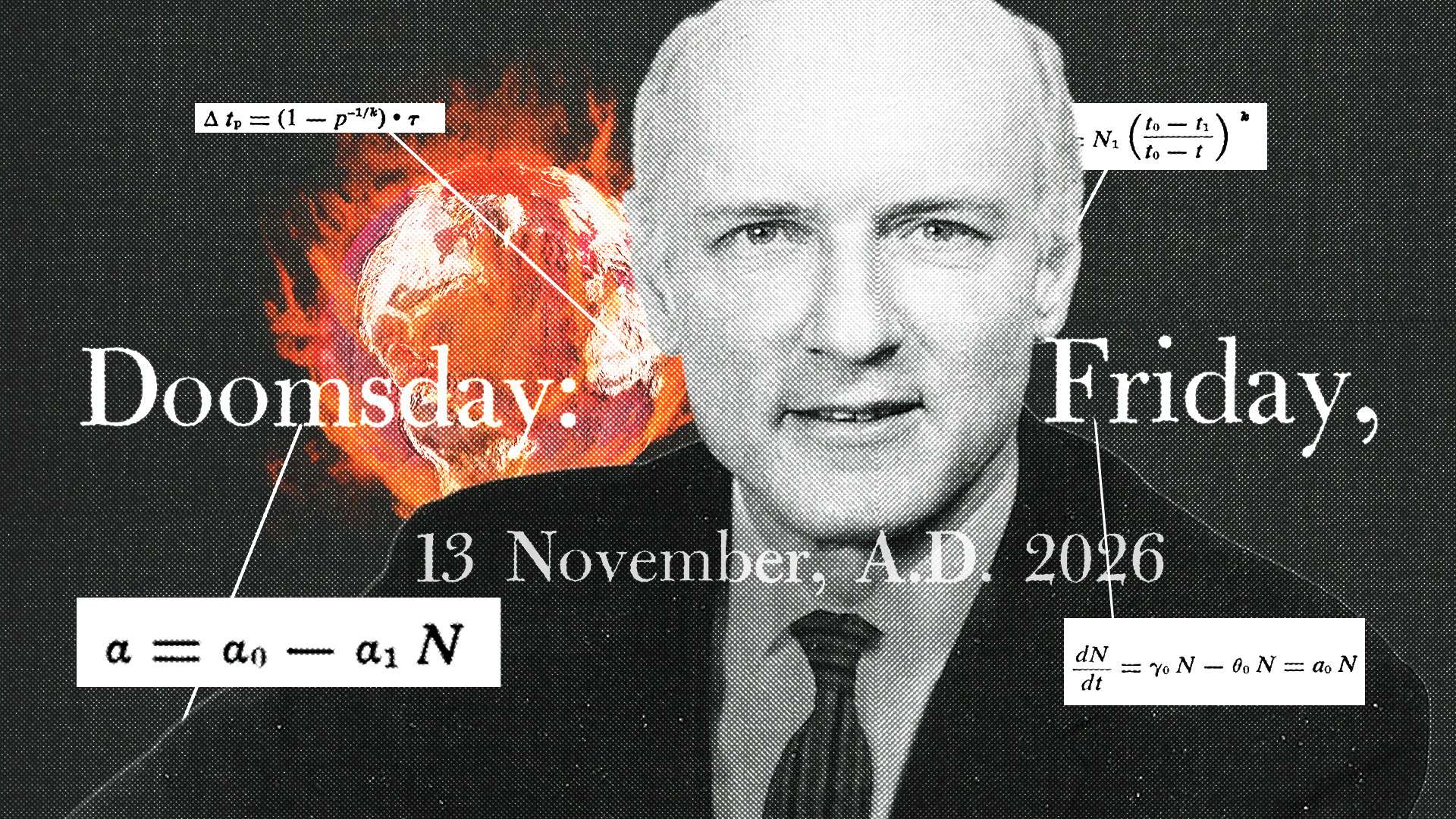
Doomsday study calculated humanity's end on Friday 13 November 2026

Read the original at Euronews ↗
Cite

Drews, P. (2026, November 12). Doomsday study calculated humanity's end on Friday 13 November 2026. Euronews. https://www.euronews.com/2026/11/12/doomsday-study-calculated-humanitys-end-on-friday-13-november-2026

Dated from the outlet's own feed. Check the original for its byline.

Euronews · collected 2026-11-12 · by Patrick Drews

Quick Summary

In 1960, Austrian-American physicist Heinz von Foerster and his team calculated that if the world's population growth rate remained constant, humanity would reach an infinite value on Friday, 13 November 2026. Published in the journal Science, this study used historical data to project a mathematical "doomsday" scenario due to overpopulation, though it was largely intended to draw attention to the issue rather than be taken literally. However, actual population growth rates have slowed significantly since the 1990s, and the United Nations now predicts a peak of around 10.3 billion people in the mid-2080s, followed by a decline.
Written by AI on 2026-11-13, from this article's own text only (the story summary below draws on all the coverage).

AI analysis

Story summary

A 66-year-old study published in the journal Science predicted that humanity would reach an infinite population value on Friday, 13 November 2026. The research, led by Austrian-American physicist Heinz von Foerster and his team in 1960, utilized a mathematical formula to project human population growth. By analyzing historical data from the past two millennia, the researchers fitted a growth curve to the world population. They concluded that if the growth rate at that time continued unchanged, the curve would reach an infinite point on the specified date. This calculation meant that, purely in mathematical terms, humanity would "crush" itself by multiplying to infinity. Because the study is now considered outdated, the predicted "doomsday" has passed without the mathematical collapse occurring.

Written for “Humanity's end date study” on 2026-11-18, grounded in this article and the 0 other(s) covering the same event.

Compared with similar articles

This article reads unscored and hedges 16% of its claims. Each row says how that neighbour differs.
Reason
Centre Hedges 2 of 24 claims Outlet record 67/100
“The articles refer to the same 1960 study predicting the end of humanity on November 13, 2026, but describe different times - Article A discusses the day before the predicted event, while Article B discusses the day of the predicted event and its non-occurrence.”
Euronews
Hedges 5 of 33 claims Outlet record 60/100
“While both articles discuss the same Doomsday study predicting the end of the world on November 13, 2026, they describe different moments in time - one on the actual date (November 13) and one the day before (November 12).”

Story

Humanity's end date study
Science · 1 article(s) covering the same event.
How this article was measured signals, leaning charts, publisher record, byline, topics and claims

Signals How these are calculated →

Claims extracted
32
sentences that state something as happening or true
Uncertain
16%
5 of 32 hedged ("reportedly", "may", "according to")
Leaning
not political
takes no side on a contested political question
Publisher signals
60/100
Euronews's corrections and hedging, across everything collected from it. Not a measure of accuracy.
Outlets on this story
1
Science
Same framing elsewhere
1
articles that frame the event the way this one does
Analyzed 2026-11-13 · how these are computed

How this is being covered How these are calculated →

Article leaning vs. publisher reliability
Source leaning vs. consistency

Publisher

Euronews · 1478 article(s) · 1 correction(s) detected
Running correction rate · 1 correction(s)

Who wrote this

Patrick Drews
3 article(s) here · 1 carrying a prediction
That sounds dramatic and would seem urgent, if the study were not already "outdated", yet it is still intriguing.
It sounds dramatic and would be quite urgent – if the study were not already "outdated".
Also by Patrick Drews
Nothing else under this byline is closely related to this article, so these are simply their most recent.

Topics

Austrian Mayan Science the United Nations

Subjects

Heinz von Foerster PERSON · 2× Austrian NORP · 1× Mayan NORP · 1× Science ORG · 1× the United Nations ORG · 1×

Narrative

The article with the provocative title "Doomsday: Friday, 13 November, A.D. 2026" was written by Austrian-American physicist Heinz von Foerster and his research team and published in the prestigious journal Science (source in German).
framing: assertive · carried by 1 article(s) · first seen 2026-11-13
It sounds dramatic and would be quite urgent – if the study were not already "outdated".
2026-11-13 · Euronews
Doomsday study calculated humanity's end on Friday 13 November 2026 · assertive framing

Claims (32 extracted, 5 hedged)

According to a study, the end of the world was supposed to come on 13 November. uncertain
end → accord → November
It sounds dramatic and would be quite urgent – if the study were not already "outdated". asserted
study → sound → ?
The so-called Doomsday study is already 66 years old, but it is probably the best-known study about the end of the world. asserted
it → call → world
In 1960 researchers used a mathematical formula to calculate the end of humankind for Friday 13 November 2026. asserted
researchers → use → Friday
The article with the provocative title "Doomsday: Friday, 13 November, A.D. 2026" was written by Austrian-American physicist Heinz von Foerster and his research team and published in the prestigious journal Science (source in German). asserted
article → write → German
The researchers analysed historical data on the world population over the past two millennia and fitted a growth curve to it. asserted
researchers → analyse → it
Their projection was that if the then current growth rate of humans on Earth were extrapolated unchanged into the future, the curve would reach an infinite value in November 2026. asserted
curve → extrapolate → November
So by tomorrow, Friday, people would have multiplied to infinity. asserted
people → multiply → infinity
The mathematicians' logical conclusion was that on this day humanity would, purely in mathematical terms, "crush" itself through overpopulation. asserted
humanity → crush → overpopulation
The study caused a worldwide stir at the time, and that was exactly the intention. asserted
that → cause → time
By pinning the date to a Friday the 13th, Heinz von Foerster mainly wanted to draw attention to the issue of overpopulation, which was being intensely debated then. asserted
which → pin → overpopulation
Until the early 1990s the curve matched the actual figures remarkably well. asserted
curve → match → figures
After that global population growth slowed significantly, which is why current projections tend to expect stabilisation at around 10 billion people. asserted
projections → slow → people
Why the "end of the world" is not happening The world population is still growing, but more and more slowly. asserted
population → happen → world
At first the number of people increased sharply because fewer were dying. asserted
fewer → increase → people
Later families around the world began having fewer children. asserted
families → begin → children
By 2020 this growth had fallen to below one per cent. asserted
growth → fall → cent
According to estimates by the United Nations (UN), the number of people on Earth will peak in the mid-2080s at about 10.3 billion. uncertain
number → accord → billion
After that the world population will slowly start to decline again. asserted
population → start → that
Friday is not the first predicted end of the world As early as 1910 there was widespread panic about Halley's Comet. asserted
Friday → predict → Comet
Newspapers warned of poisonous gases in its tail that could wipe out all life. uncertain
that → warn → life
Some traders exploited this fear and sold gas masks, protective pills or "comet umbrellas". asserted
traders → exploit → masks
But the comet passed and nothing happened. asserted
nothing → pass → ?
A US radio preacher predicted Judgement Day for 21 May 2011. uncertain
preacher → predict → May
On 21 December 2012 a cycle of the Mayan calendar ended, which many also interpreted as the end of the world. asserted
many → end → world
In 1972 the study "Limits to Growth" warned that we would soon run out of vital raw materials. asserted
we → warn → materials
But people found new sources and solutions, and many commodities even became cheaper. asserted
commodities → find → sources
The problem with such predictions is always the same: past trends are simply projected into the future. asserted
trends → project → future
This overlooks the fact that people respond to problems and adapt. asserted
people → overlook → problems
That also applies to 13 November 2026. asserted
That → apply → November
Humanity has developed differently from what was calculated 66 years ago. asserted
what → develop → ?
So if you are now thinking you can finally tell your boss what you really think because everything will be over on Friday anyway, you might want to think again. uncertain
you → think → Friday

Give feedback · no sign-in needed

No sign-in needed for now. Your note is sent without a name, so it cannot be answered.

History Support