Photo via Toronto Star

Here’s how Mark Carney could harness even more of corporate Canada’s talent

Read the original at Toronto Star ↗
Cite

Delacourt, S. (2026, November 12). Here’s how Mark Carney could harness even more of corporate Canada’s talent. Toronto Star. https://www.thestar.com/politics/political-opinion/here-s-how-mark-carney-could-harness-even-more-of-corporate-canada-s-talent/article_194cac55-92ca-43ce-8014-191ba8763a87.html

Dated from the outlet's own feed. Check the original for its byline.

Toronto Star · collected 2026-11-12 · by Susan Delacourt

Quick Summary

Mark Carney’s government is recruiting private sector executives for major national projects, aligning with those who advocate for business-like governance in Ottawa. However, a 20-year-old Accountability Act imposes a five-year ban on former public office holders lobbying the government afterward, deterring corporate talent from joining public service. To address this, the Major Projects Office has initiated the Build Canada Exchange program, which secondes private sector employees to work on national projects while maintaining their original salaries and avoiding the lobbying ban. This practice echoes C.D. Howe’s use of “dollar-a-year men” during World War II, illustrating a historical precedent for blending corporate expertise with government objectives.
Written by AI on 2026-11-12, from this article's own text only (the story summary below draws on all the coverage).

AI analysis

Story summary

Mark Carney's government is recruiting corporate executives to help manage major national projects, reflecting a trend of treating the government like a business. This practice is now more prevalent under Carney, who is increasingly seen as the CEO of Canada Inc. However, the 20-year-old Accountability Act, designed to prevent conflicts of interest, imposes a five-year ban on former public office holders from lobbying the government after leaving their posts. Dominic LeBlanc, head of the Major Projects Office, has defended the government's approach, arguing that it shows Canada working efficiently. The act has limited the flow of talent between the private and public sectors, and there are calls to reassess its provisions, as even Stephen Harper has admitted some of its aspects were overly restrictive.

Written for “Mark Carney Hires Corporate Canada Talent” on 2026-11-13, grounded in this article and the 0 other(s) covering the same event.

Compared with similar articles

Nothing to compare against. No article is close enough to this one for the pipeline to have linked or judged the pair.

Story

Mark Carney Hires Corporate Canada Talent
Politics · 1 article(s) covering the same event.
How this article was measured signals, leaning charts, publisher record, byline, topics and claims

Signals How these are calculated →

Claims extracted
26
sentences that state something as happening or true
Uncertain
15%
4 of 26 hedged ("reportedly", "may", "according to")
Leaning
Leans left
of the writing, not the subject · beta estimate
Publisher signals
64/100
Toronto Star's corrections and hedging, across everything collected from it. Not a measure of accuracy.
Outlets on this story
1
Politics
Same framing elsewhere
1
articles that frame the event the way this one does
Analyzed 2026-11-12 · how these are computed

How this is being covered How these are calculated →

Article leaning vs. publisher reliability
Source leaning vs. consistency

Publisher

Toronto Star · 13874 article(s) · 29 correction(s) detected
Running correction rate · 29 correction(s)
2026-10-26
Correction
2026-10-24
Correction
2026-10-07
Correction
2026-09-24
Correction

Who wrote this

Susan Delacourt
8 article(s) here · 1 carrying a prediction
All of those who have complained for years that Ottawa should be run more like a business are certainly seeing those wishes fulfilled now, under a prime minister who’s increasingly been cast as CEO of Canada Inc. If Carney’s government is serious about increasing the traffic between the private and public sectors, it may first have to reckon with a law Stephen Harper now admits he got partly wrong.
It’s in the budget’s culture section, too, that we see a government trying to fuse populism and patriotism with some measures that will go over well with many Canadians, making admission permanently free or discounted to people under 25 at museums, galleries, parks and for rail travel.
“I say: ‘I’m not sure my mother would understand what you just said,’ ” the finance minister explains.
But she tactfully drops suggestions that maybe Carney could have been tougher with Trump in the early days.
A Globe and Mail investigation into American involvement in Alberta’s looming referendum shows that the U.S. is far more than a spectator and confirms that its interest may not be entirely in keeping our federation intact. That is definitely new, no matter how one unnamed U.S. government official, as quoted in the story, reached for the example of Bill Clinton making the pitch for federalism ahead of the 1995 Quebec referendum. But that connection only reinforces just what different territory we’re in now — Donald Trump’s America doesn’t view Canada’s sovereignty, as previous administrations have, as inviolable. It means that we should also be keeping our eyes on Quebec if the province is headed to a referendum after Monday’s election.
“If this pipeline gets built it is projected to generate 268 billion in royalties and likely hundreds of billions more in associated economic activity and revenue,” Rath declared, adding in all-capital letters: “THIS MAKES ALBERTA INDEPENDENCE THAT MUCH MORE AFFORDABLE.”
It was immediately evident, within the span of two hours, which world view would be embraced by Canada’s prime minister.
Trump said on the eve of the speech that he would decide what to make of Canada and Europe’s strengthened alliance, and mete punishment accordingly.
Also by Susan Delacourt
Nothing else under this byline is closely related to this article, so these are simply their most recent.
All 8 articles by Susan Delacourt →

Topics

Canada Inc. Liberal Ottawa The Accountability Act the Build Canada Exchange

Subjects

Carney PERSON · 4× Canada GPE · 3× Harper PERSON · 2× Howe PERSON · 2× Ottawa GPE · 2× The Major Projects Office ORG · 2× the Build Canada Exchange ORG · 2× Canada Inc. ORG · 1× Mark Carney’s PERSON · 1× Stephen Harper PERSON · 1×

Narrative

Dominic LeBlanc, who’s in charge of the Major Projects Office, accused critics of looking for a “gotcha” moment, and in a statement through a spokesperson to the Star this week asserted, “This is Canada working: experienced professionals stepping up to serve their country, putting their expertise to work to help build a stronger Canada.”
framing: assertive · carried by 1 article(s) · first seen 2026-11-12
All of those who have complained for years that Ottawa should be run more like a business are certainly seeing those wishes fulfilled now, under a prime minister who’s increasingly been cast as CEO of Canada Inc. If Carney’s government is serious about increasing the traffic between the private and public sectors, it may first have to reckon with a law Stephen Harper now admits he got partly wrong.

Claims (26 extracted, 4 hedged)

It should come as no surprise that Mark Carney’s government — the most corporate one we’ve seen in some time — is reaching into the private sector for executives to help get its major national projects off the ground. asserted
we → come → ground
All of those who have complained for years that Ottawa should be run more like a business are certainly seeing those wishes fulfilled now, under a prime minister who’s increasingly been cast as CEO of Canada Inc. If Carney’s government is serious about increasing the traffic between the private and public sectors, it may first have to reckon with a law Stephen Harper now admits he got partly wrong. uncertain
he → complain → law
The Accountability Act, now 20 years old, did a lot to curb enthusiasm in the corporate sector for doing a stint in government because of the strict fence it erected between public and private employment. asserted
it → do → employment
Under the act, designated public office holders, from ministers to staff to public servants, were made subject to a five-year ban on dealing with Ottawa afterward — and that law is still in place. asserted
law → designate → place
“We may have been somewhat zealous in making it a five-year lobbying ban. uncertain
it → make → ?
For instance, some of my former staffers wondered why they were barred from lobbying the Liberal government after ours was defeated in 2015,” Harper writes in his newly released memoir. asserted
Harper → wonder → memoir
Leaving aside how this landed with Conservatives, it is simply true that the five-year ban has been making a lot of people reluctant to put a pause on their private careers to do some public service. asserted
lot → leave → service
The Major Projects Office, as my colleague Ryan Tumilty reported this week, has found a bit of a workaround, seconding 41 people from banks, railways and energy firms under a program called the Build Canada Exchange, originally known as Interchange Canada when it was set up in 1971. asserted
it → report → 1971
As the story explained, “participants in the program, who usually earn more in the private sector than they could be paid in the public service, continue to draw salaries from their employers, who are partially reimbursed by the government.” uncertain
who → explain → government
In fact, this isn’t a 1970s-era idea — it goes back farther than that, to the Second World War, when C.D. Howe drafted influential magnates of industry to help him manage Canada’s war effort. asserted
him → go → effort
They were called “dollar-a-year men.” asserted
They → call → ?
The connection to Howe seems significant. asserted
connection → seem → Howe
Just a few weeks ago, when I was interviewing Finance Minister François Philippe Champagne, he told me that no book has helped guide him more in his current job than “C.D. Howe: A Biography,” by Robert Bothwell and William Kilbourn, published 1979. asserted
book → interview → Bothwell
He believes the parallels are there between where he finds himself today and where Howe was back in the mid-20th century. asserted
Howe → believe → century
So can we call the Build Canada Exchange this century’s version of the dollar-a-year men (and women nowadays)? asserted
we → call → men
Populists on the left and right of the political spectrum are going to have some trouble with all this injection of corporate power into the halls of government. asserted
Populists → go → government
At a Commons committee meeting last week, Conservative MP Shannon Stubbs said, “There are two worlds: one where Canadians follow the rules and count every dollar but cannot get ahead, and another where political and business insiders get a seat at the big table and make up their own rules.” asserted
insiders → say → rules
Dominic LeBlanc, who’s in charge of the Major Projects Office, accused critics of looking for a “gotcha” moment, and in a statement through a spokesperson to the Star this week asserted, “This is Canada working: experienced professionals stepping up to serve their country, putting their expertise to work to help build a stronger Canada.” asserted
professionals → ’ → Canada
The two men have a long history, but until this week, that relationship was not something that Carney openly boasted about. asserted
Carney → have → that
The two men have a long history, but until this week, that relationship was not something that Carney openly boasted about. asserted
Carney → have → that
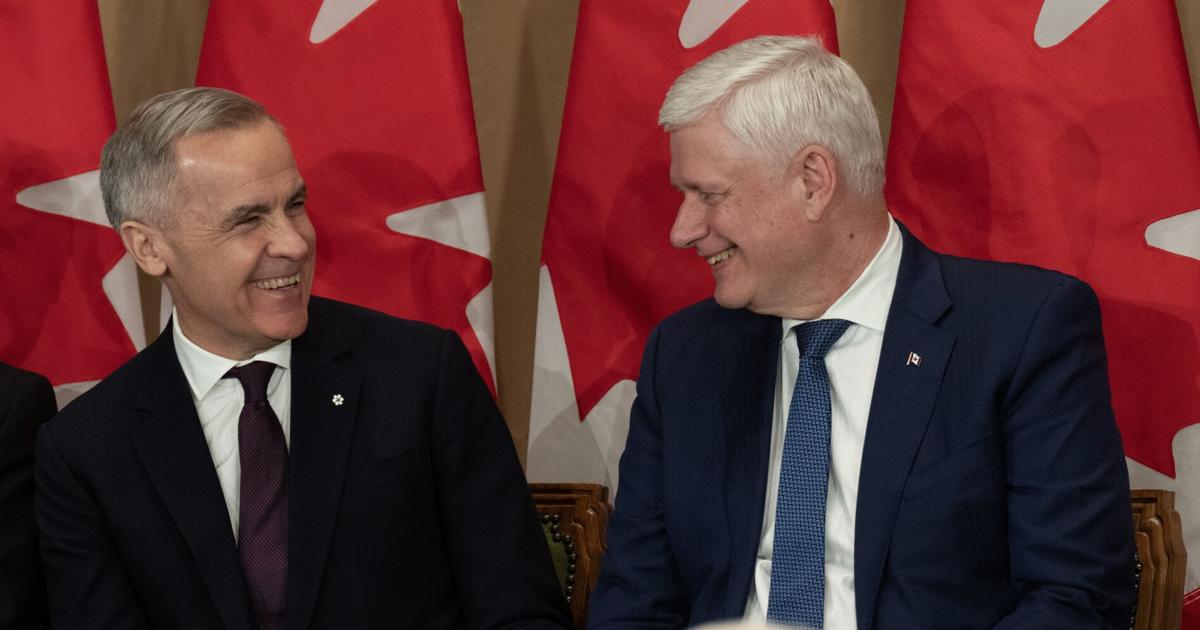
Carney has made no secret of the fact that he consults with Harper from time to time and even asked him to be the keynote at the big investment summit in Toronto in September — another bridge-building exercise between government and corporate Canada. asserted
he → make → government
Perhaps Carney might want to consult with Harper on where the Accountability Act needs to be tweaked, to take account of the fact that we’re not living in 2006 anymore. uncertain
we → want → 2006
That was when Harper rode to power on a backlash against what Conservatives saw as Liberal Ottawa getting too cosy with business interests (a result of the sponsorship scandal that dominated the end of the Jean Chretien-Paul Martin era). asserted
that → ride → era
Inside the Major Projects Office, with its 41 borrowed executives and analysts, Carney is already doing a workaround — not around the Accountability Act itself, but around the spirit of some measures that drove it. asserted
that → borrow → it
Harper has himself now admitted that perhaps that was overly “zealous.” asserted
that → admit → ?
So maybe it’s time to dust off the act for amendment and make it more possible for people in all kinds of industries — not just major-project ones — to do some work with government without a five-year sentence for it. asserted
people → ’ → it

Give feedback · no sign-in needed

No sign-in needed for now. Your note is sent without a name, so it cannot be answered.

History Support