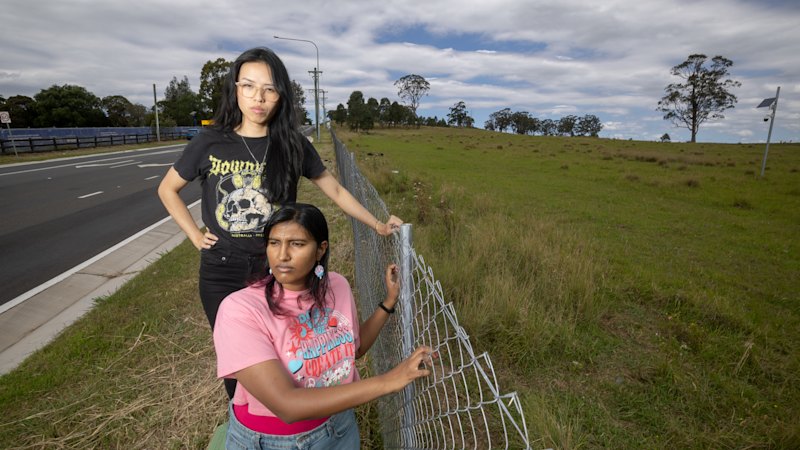
Photo via The Sydney Morning Herald

‘Stop the slop’: Meet the young people fighting western Sydney’s data centre rush

Read the original at The Sydney Morning Herald ↗
Cite

Busby, E. (2026, November 12). ‘Stop the slop’: Meet the young people fighting western Sydney’s data centre rush. The Sydney Morning Herald. https://www.smh.com.au/national/nsw/stop-the-slop-meet-the-young-people-fighting-western-sydney-s-data-centre-rush-20261112-p61cvr.html?ref=rss&utm_medium=rss&utm_source=rss_feed

Dated from the outlet's own feed. Check the original for its byline.

The Sydney Morning Herald · collected 2026-11-12 · by Ellie Busby

Quick Summary

A group called "Stop the Slop," comprised mainly of young adults from western Sydney, is opposing planned data center developments in their area. Led by Christie Duong, who was inspired by similar resistance efforts in the U.S., the group uses social media to raise awareness about the impact of these projects on local communities. One proposed development involves US company AirTrunk building a facility with a power capacity equivalent to one million homes’ annual electricity use on 52 hectares near Kemps Creek, which has raised concerns among residents and led to community protests.
Written by AI on 2026-11-12, from this article's own text only (the story summary below draws on all the coverage).

AI analysis

Story summary

A group of young activists from western Sydney, calling themselves Stop the Slop, is mobilizing residents to oppose the rapid expansion of data centers in the area. The group, which consists of eight core members, has been using social media to raise awareness and rally support against planned developments in suburbs from Marsden Park to Kemps Creek. Christie Duong, one of the founders, was inspired by data center resistance movements in the US and has since connected with other young residents to form a broader coalition. Dozens of data centers are either operating or proposed for the western Sydney region, leading to concerns about the impact on local communities.

Written for “Data Centre Rush Protest” on 2026-11-13, grounded in this article and the 0 other(s) covering the same event.

Compared with similar articles

Nothing to compare against. No article is close enough to this one for the pipeline to have linked or judged the pair.

Story

Data Centre Rush Protest
Environment · 1 article(s) covering the same event.
How this article was measured signals, leaning charts, publisher record, byline, topics and claims

Signals How these are calculated →

Claims extracted
34
sentences that state something as happening or true
Uncertain
0%
0 of 34 hedged ("reportedly", "may", "according to")
Leaning
withheld
no quote in the article backed the model's score
Publisher signals
61/100
The Sydney Morning Herald's corrections and hedging, across everything collected from it. Not a measure of accuracy.
Outlets on this story
1
Environment
Same framing elsewhere
1
articles that frame the event the way this one does
Analyzed 2026-11-12 · how these are computed

How this is being covered How these are calculated →

Article leaning vs. publisher reliability
Source leaning vs. consistency

Publisher

The Sydney Morning Herald · 6974 article(s) · 15 correction(s) detected
Running correction rate · 15 correction(s)

Who wrote this

Ellie Busby
15 article(s) here · 1 carrying a prediction
“The reason why we’re focusing on western Sydney in particular is the fact that it’s perceived to be a data centre hub with a few data centres already existing there, and how they will continue to pop up,” she said.
I’m Ellie Busby, and I will be bringing you the news as it happens this morning.
In Parramatta, there’s a shared feeling of frustration: some are angry about it being the fifth increase this year, and many are worried about how it will affect mortgage repayments and the cost of living.
Campbelltown City Council Mayor Darcy Lound said there was still great interest in the ghost of Fred Fisher.
A report will be prepared for the information of the Coroner.
2026-10-31 · assertive framing · Two dead, one injured in three-car crash on North Coast
Armed with fake luggage and a keen eye for bus routes, the Herald’s western Sydney reporters set a challenge to see who could make it to the airport the quickest via public transport for a real flight.
A long-awaited plan to build a new public swimming pool in Sydney’s south-west is a step closer, despite concerns the $62 million project could face further delays after the architecture firm that designed it collapsed.
Intended to become a space where the community could come together, mingle and grow vegetables, the three small gardens scattered across the Penrith local government area have sparked objections from the council, which plans to remove the garden beds next week.
“The administrators will provide further updates to customers, employees, creditors, subcontractors and other stakeholders as the administration process progresses.
Two weeks ago, administrator Teneo stood down 213 of the company’s staff and announced construction on many of its projects would come to a halt.
Also by Ellie Busby
Nothing else under this byline is closely related to this article, so these are simply their most recent.
All 15 articles by Ellie Busby →

Topics

Kemps Creek Marsden Park NSW Stop the Slop Sydney

Subjects

Sydney GPE · 9× Duong PERSON · 4× Kemps Creek GPE · 2× NSW GPE · 2× Stop the Slop ORG · 2× AirTrunk ORG · 1× Australian NORP · 1× Christie Duong PERSON · 1× Instagram ORG · 1× Marsden Park GPE · 1×

Narrative

I think, as it’s been shown, visibility is important, but I think there are other things in the background that make things fall through, and we really want to be strategic about how we target [data centres] as well, and what it means for western Sydney as a data centre hub
framing: assertive · carried by 1 article(s) · first seen 2026-11-12
“The reason why we’re focusing on western Sydney in particular is the fact that it’s perceived to be a data centre hub with a few data centres already existing there, and how they will continue to pop up,” she said.
2026-11-12 · The Sydney Morning Herald
‘Stop the slop’: Meet the young people fighting western Sydney’s data centre rush · assertive framing

Claims (34 extracted, 0 hedged)

As the battle against data centres in NSW rages on, a new contender has emerged to take on the major industrial developers: an emerging group mostly of 20-somethings from western Sydney. asserted
contender → rag → Sydney
Stop the Slop, made up of a core group of eight people, has been rallying residents to oppose the developments planned for Sydney’s west, which is fast becoming a data centre hub. asserted
which → make → west
Dozens of data centres are operating or proposed for suburbs stretching from Marsden Park to Kemps Creek. asserted
Dozens → operate → Creek
Christie Duong, who started the group, said the data centre resistance in the US inspired her to learn more about the developments proposed in her own community. asserted
resistance → start → community
After that, Duong said, the floodgates opened. asserted
floodgates → say → that
She discovered the scale of the data centres planned for western Sydney, connected with other young people from across the region, and they began campaigning against these projects on social media. asserted
they → discover → media
The response was positive: their posts gained the attention of a younger audience, and many were excited there was finally movement in Sydney’s west against the projects. asserted
many → gain → projects
“The reason why we’re focusing on western Sydney in particular is the fact that it’s perceived to be a data centre hub with a few data centres already existing there, and how they will continue to pop up,” she said. asserted
she → focus → centres
“We want to knock out all of [the data centres] because they’re just shady in general.” asserted
they → want → centres
The group has been advocating against the $7 billion plan for a data centre development in Kemps Creek, located near three schools. asserted
group → advocate → schools
If approved, it would see US technology company AirTrunk develop data hall buildings across 52 hectares of vacant land. asserted
AirTrunk → approve → land
The facility would have a power capacity of 1.2 gigawatts, which is roughly equivalent to the annual electricity consumption of about one million Australian homes. asserted
which → have → homes
In a video posted on Instagram, Duong explains the scale of the project would be the equivalent of 52 football fields. asserted
scale → post → fields
One comment asks: “wtf why have we got this epidemic of data centres?” asserted
we → ask → centres
Duong said: “I feel like if this gets approved, then what does it mean for the others? asserted
it → say → others
Like, how far can [data centres] push this?” asserted
centres → push → this
Project manager Plan PM said in a statement they had undertaken extensive stakeholder engagement, received feedback and were actively working with the relevant bodies to find solutions to the matters raised. asserted
they → say → matters
Amendments to the project were submitted in July, and included reducing it from six buildings to three. asserted
Amendments → submit → three
There has been recent success in communities taking on industrial property giants and winning. asserted
communities → take → giants
Goodman Group abandoned plans for a hyperscale data centre on Sydney’s north shore in September following outrage among residents. asserted
Group → abandon → residents
An application for a data centre in the Blue Mountains was withdrawn in June after significant community backlash. asserted
application → withdraw → backlash
This month, a proposal for an AI data centre on the banks of the Cooks River was scrapped. asserted
proposal → scrap → River
Duong had been inspired as residents across NSW banded together to stop these developments, but she believed the “organising landscape” in western Sydney required a different approach. “ asserted
landscape → inspire → approach
I think, as it’s been shown, visibility is important, but I think there are other things in the background that make things fall through, and we really want to be strategic about how we target [data centres] as well, and what it means for western Sydney as a data centre hub asserted
it → think → hub
,” she said. She says Stop the Slop members, who range in age between 21 and 32, are hopeful they can have similar success by hosting education sessions and continuing to reach people through social media. asserted
they → say → media
Campaigns against data centres in western Sydney have ramped up recently, with the $1.1 billion Project Pluto data centre in Guildford West the latest to receive significant pushback from residents. asserted
centre → ramp → residents
The development, which would be built next door to a sports ground and operate 24 hours a day, didn’t receive any submissions from the public, with many in the community saying they weren’t notified of the plans. asserted
they → build → plans
A petition to stop the project, which was approved in July, has been signed by more than 5000 people. asserted
which → stop → people
Goodman Group was contacted for comment. asserted
Group → contact → comment
Data centres have become a major political flashpoint. asserted
centres → become → ?
A NSW parliamentary inquiry last week said the government should plan for large-scale data centre development in precincts, supported by shared energy and water infrastructure, rather than as isolated developments. asserted
government → say → developments
Deputy Prime Minister Richard Marles this week said the suburbs were “not a place where you would have data centres”. asserted
you → say → centres
As Stop the Slop grows in supporters, Duong wants governments to pay attention. asserted
governments → grow → attention
“I think it is the time, it is important that they listen,” she said. asserted
she → think → ?

Give feedback · no sign-in needed

No sign-in needed for now. Your note is sent without a name, so it cannot be answered.

History Support