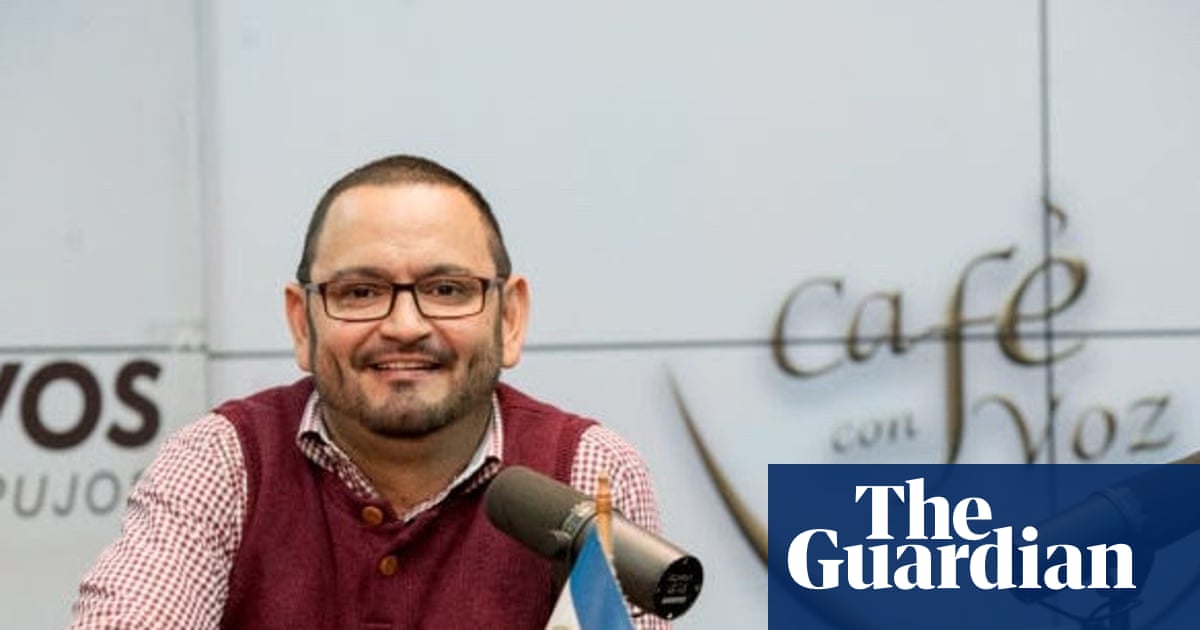
Veteran journalist Luis Galeano, one of at least 94 Nicaraguans whom the Ortega Murillo regime has stripped of citizenship in recent years for opposing the government, has been detained by US Immigration and Customs Enforcement (ICE).
asserted
regime → strip → Enforcement
Galeano, who has continued critically reporting on the Sandinista government online through his platform, Café con voz, since shortly after arriving in the US in 2018, has had an asylum application pending for about seven years, according to his wife, Daykel Santamaría.
uncertain
application → continue → wife
He also has a work permit and a social security number, she said.
asserted
she → have → permit
Nonetheless, shortly after beginning his second job driving Lyft on Monday morning in Florida, ICE agents pulled him over.
asserted
agents → begin → him
As of Wednesday, Galeano was detained at Krome detention center in Miami.
asserted
Galeano → detain → Miami
He has an immigration court date scheduled for 2 October, Santamaría said.
asserted
Santamaría → have → October
“Deporting [Galeano] to Nicaragua would be a death sentence,” said Javier Melendez, a sociologist who has been friends with the journalist for more than 30 years.
asserted
who → deport → years
The Sandinista government also stripped Melendez of his citizenship; he’s now a US citizen, living in Washington DC.
asserted
he → strip → DC
The denaturalization order also affected acclaimed novelist Sergio Ramírez and poet and writer Gioconda Belli.
asserted
order → affect → Ramírez
Ice has been contacted for comment.
asserted
Ice → contact → comment
Melendez called the situation facing his friend “a double trauma – he escaped from his country because of his work and then the place where he sought refuge detains him due to their domestic politics”.
Galeano fled Nicaragua in December, 2018, days after police raided 100% Noticias, the outlet where he worked, and issued an order for his arrest.
asserted
he → call → arrest
He arrived in Miami shortly thereafter and petitioned for asylum, according to Santamaría.
uncertain
He → arrive → Santamaría
Santamaría said she didn’t know if her husband was, effectively, a man without a country due to the 2023 measure denaturalizing him as a Nicaraguan.
asserted
husband → say → Nicaraguan
Meanwhile, on Tuesday, the House Foreign Affairs Committee had a two hour-plus hearing on “Confronting the Totalitarian Ortega-Murillo Regime.”
asserted
Committee → have → Regime
Florida Rep. María Elvira Salazar, committee chairperson, opened the hearing by denouncing how Daniel Ortega and Rosa Murillo “have spent years dismantling democracy”, and warned that “the Administration is paying attention, and Ortega and Murillo should consider themselves warned.”
asserted
themselves → open → attention
The disjunction between the US government locking up a journalist targeted by the Nicaraguan government for reporting on its totalitarian tendencies, while at the same time denouncing those same tendencies is an example of “the serious and profound contradictions” in the Trump administration when it comes to Nicaragua, said Ana María Méndez Dardón, Central America director at the Washington Office on Latin America.
asserted
Dardón → lock → America
Galeano’s detention is one example many of “how due process is missing from the right to asylum” under the Trump administration, she added.
asserted
she → miss → administration
Salazar issued a statement after Galeano’s detention saying: “America must always know the difference between a criminal and a political exile.”
asserted
America → issue → criminal
Queries from the Guardian to the committee and several of its members were not answered.
asserted
Queries → answer → members
Galeano’s detention has also been denounced by Salazar’s GOP colleague in Florida, Rep. Mario Díaz-Balart, who posted a statement on X saying, “The United States has long been a beacon of freedom for those persecuted by tyranny.
asserted
States → denounce → tyranny
We must uphold that tradition…”
asserted
We → uphold → tradition
The Committee to Protect Journalists and the Inter American Press Association called for Galeano’s release.
asserted
Committee → call → release
Although Galeano escaped Nicaragua under threat of arrest in late 2018, records of him being targeted for his reporting date at least as far back as 23 Feb., 2011, when Amnesty International issued a bulletin titled, “Urgent Action,” warning that his life was in danger after “an unknown individual called [him] on his mobile phone and said ‘You have 72 hours to change your mind about what you’ll publish, otherwise your family won’t see you anymore.’”
asserted
family → escape → you
The caller referred to Galeano’s reporting for El Nuevo Diario on government misuse of around $20m between 2004 and 2008.
asserted
caller → refer → 2004
Recently, the journalist had been seeing ICE agents in the streets of Miami with increasing alarm while driving Lyft.
asserted
journalist → see → Lyft
“He called me like a week ago, asking if I could help with a new journalism project he had in mind, a morning news program on the region [of Latin America],” said Melendez, who founded Expediente Abierto, a think tank on Central America.
uncertain
who → call → America
“He wanted to get off the streets, seeing the raids everywhere,” Melendez said.
asserted
Melendez → want → raids
Santamaría, Galeano’s wife, said the two had spoken often about what would happen if one or the either was detained.
asserted
one → say → ?
Plans included calling their lawyer, alerting the media, trying to stay calm.
asserted
Plans → include → media
“We prepared ourselves mentally for this moment,” she said.
asserted
she → prepare → moment
“We’ve already lived through going into exile, having an order of arrest – these are situations that make you more mature,” she said.
asserted
she → live → arrest
Galeano spoke with his wife several times Wednesday.
asserted
Galeano → speak → wife
She described him as calm, telling her, “If God got me out of Nicaragua, he’ll get me out of here.”
asserted
he → describe → me
She said she has faith the US government will see what she called “a very well-documented asylum case”.
asserted
she → say → what
 The Aporia