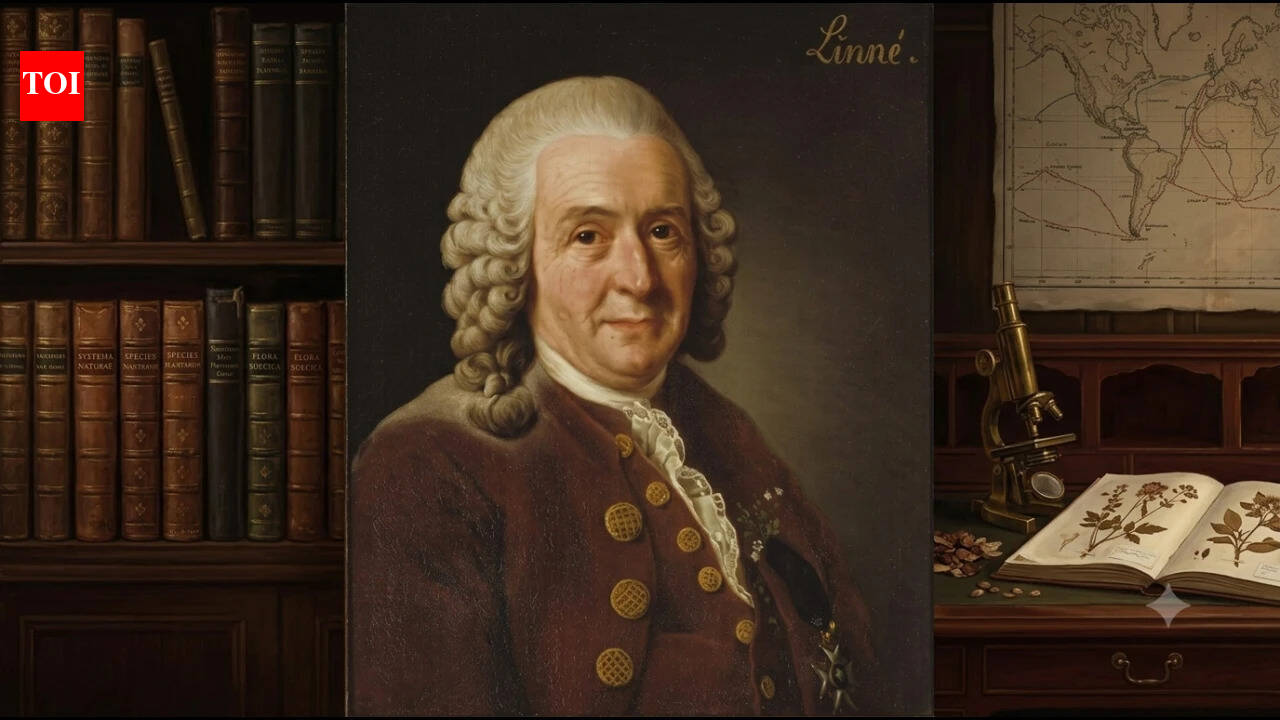
Quote of the day by Carl Linnaeus: "Human beings, having, above..."

World News, Today World News, Latest International News, World Breaking News, Trending News of World - Times of India · collected 2026-08-20 · by TOI Science Desk
Read the original at World News, Today World News, Latest International News, World Breaking News, Trending News of World - Times of India ↗

Summary

The article presents a quote by Carl Linnaeus, a Swedish botanist and zoologist from the 18th century, discussing human beings' unique relationship with nature due to their ability to reason. Linnaeus argues that this consciousness brings responsibility with it, as humans are capable of making choices that impact the natural world. The article notes that humans can alter landscapes, extract resources, and transform ecosystems, but also emphasizes that awareness should lead to responsible action towards nature.
Written by the local model on 2026-08-20, using this article's own text rather than the other coverage of the same event (that is the story summary below).

Signals How these are calculated →

Claims extracted
30
claim-shaped sentences
Uncertain
7%
2 of 30 hedged
Leaning
not scored
needs a local LLM pass
Publisher trust
94.0
red-flag proxy, not a credibility rating
Outlets on this story
1
Science
Narrative spread
1
articles carrying this framing
Analyzed 2026-08-20 · how these are computed

AI analysis (generated at analysis time, not now)

Story summary

Carl Linnaeus, a Swedish botanist and zoologist, made a quote that still matters today about humanity's place in nature. He said "Human beings, having, above all creatures, received the power of reason, need to be aware where nature is unaware". This idea suggests that humans have a unique ability to think critically and understand the world around them, which sets us apart from other living things. According to Linnaeus, nature reaches its culmination in humans, but human consciousness has its own limitations. Despite being made over 250 years ago, this quote remains relevant today because it highlights humanity's responsibility to consider the future and the impact of our actions on the natural world.

Written for “Carl Linnaeus Quote” on 2026-08-31, grounded in this article and the 0 other(s) covering the same event.
Why this leaning score
The article's own words the score was based on. Each is quoted verbatim and was checked against the article text before being stored, so you can find it in the original.
Score +0.60 Confidence high
Leaning score +0.60 for article 1471 (high confidence, 1 verified quote) · logged 2026-08-21

Story

📰 Carl Linnaeus Quote
Science · 1 article(s) covering the same event. This is the one the site leads with.

How this is being covered How these are calculated →

Article leaning vs. publisher reliability
Source leaning vs. consistency

Compared with similar articles

Nothing to compare against. No article is close enough to this one for the pipeline to have linked or judged the pair.

Publisher

World News, Today World News, Latest International News, World Breaking News, Trending News of World - Times of India · 97 article(s) · 0 correction(s) detected
SignalValueWeight
Correction rate 0.000 0.4
Uncertainty density 0.121 0.25
Assertive mismatch rate 0.000 0.35
No corrections detected for this publisher. That may mean careful reporting, or simply that nothing has been checked.

Who wrote this

TOI Science Desk
19 article(s) here · 1 carrying a prediction
🔮 A surface may be able to radiate heat towards the sky, but if it absorbs too much sunlight during the day, the solar heating can cancel much of that benefit.
🔮 High above the ice in Antarctica, a group of enormous balloons was quietly tracking a phenomenon that could not be seen from the ground.
🔮 If the current phase works as expected, the scale will change rapidly.
🔮 What if the rocks beneath our feet could one day be turned into a giant hydrogen factory, not by drilling up an existing fuel reserve, but by sending controlled bursts of electricity deep underground?
🔮 When Apollo 15 astronauts David Scott and James Irwin explored the Moon in 1971, they were looking for rocks that could reveal how the lunar surface formed.
🔮 Air voids replace white pigments The researchers built on earlier work showing that simple polymers such as acrylic, silicone and PET can be effective heat radiators and could be used for PDRC.
🔮 Such regions can be especially important during adaptation because genetic variants introduced through interbreeding may provide useful traits in changing environments.
🔮 Domestic cattle would have indicated contact between Ireland’s Mesolithic communities and Neolithic farming societies elsewhere in Europe.
🔮 A 2023 presentation to the Seismological Society of America described the upper-crustal low-velocity zone as the primary magma reservoir, with estimates suggesting it may contain roughly 10% to 12% partial melt.
🔮 Water vapour in the stratosphere can affect how the atmosphere handles radiation, so adding such a large amount was never expected to be climatically neutral.
Wire or desk byline, not an individual reporter.
Also by TOI Science Desk
In 2022, MIT researchers built a 4-inch cooler that kept food fresh without electricity
2026-08-28 · World News, Today World News, Latest International News, World Breaking News, Trending News of World - Times of India
Nasa sent 20 balloons over Antarctica in 2013 to track particles from space
2026-08-28 · World News, Today World News, Latest International News, World Breaking News, Trending News of World - Times of India
Scientists turn wood waste into foam that replaces plastic and decomposes in soil within months
2026-08-28 · World News, Today World News, Latest International News, World Breaking News, Trending News of World - Times of India
In 2025, a US startup used ‘underground lightning’ to crack rock and unlock hydrogen
2026-08-27 · World News, Today World News, Latest International News, World Breaking News, Trending News of World - Times of India
Nothing else under this byline is closely related to this article, so these are simply their most recent.
All 19 articles by TOI Science Desk →

Topics

Swedish

Subjects

Carl Linnaeus PERSON · 3× Linnaeus PERSON · 3× Swedish NORP · 1×

Narrative

They can envision the future and can ponder about what a climate change will mean for future generations; what the loss of a species will result into, and whether some actions should be undertaken just because they are possible. Why this quote still matters today Linnaeus existed many centuries ago when environmental sciences had not been invented yet, but his quote is relevant to the present-day issues of humanity.
framing: assertive · carried by 1 article(s) · first seen 2026-08-20
🔮 Consciousness changes how we see our place in the world Humans have the capability of being aware of themselves and hence can think about not only what is happening right now, but also what will happen in the future.
2026-08-20 · World News, Today World News, Latest International News, World Breaking News, Trending News of World - Times of India
Quote of the day by Carl Linnaeus: "Human beings, having, above..." · assertive framing

Claims (30 extracted, 2 hedged)

Throughout time, man has always searched for his rightful place within nature. asserted
man → search → nature
Man is one and the same biological entity as every other living thing, but he possesses unique capabilities of reasoning and questioning which distinguish him from all other species and give him a special vantage point within nature. asserted
which → live → nature
This idea was examined by Carl Linnaeus in the following quotation: “Man is the only animal endowed with reason, and should therefore know where nature does not. asserted
nature → examine → reason
In man nature attains its highest degree, but in man’s consciousness there is nothing essential either of himself or nature.” asserted
nature → attain → himself
Carl Linnaeus (1707-1778) was a Swedish botanist, zoologist and physician best known for developing the system of biological classification and the two-part scientific naming system still widely used today. asserted
Linnaeus → know → classification
His work gave scientists a common framework for identifying and organising living organisms and earned him a lasting place in the history of natural science. asserted
work → give → science
Quote of the day by Carl Linnaeus “Human beings, having, above all creatures, received the power of reason, need to be aware where nature is unaware. asserted
nature → receive → reason
Nature reaches its culmination in humans, but human consciousness has not its essence in itself or nature”What asserted
consciousness → reach → itself
does this quote mean? asserted
quote → mean → ?
Linnaeus suggests that human beings occupy a distinctive position in nature because we possess the ability to reason about the world around us. uncertain
we → suggest → us
Other organisms respond to their environments, but humans can consciously study those processes, question them and consider their consequences. The quote therefore presents consciousness not merely as a privilege, but as something that carries responsibility. Humans can observe the world that made them There is something remarkable about being part of nature while also being able to study it. asserted
that → respond → it
Humans can examine their own bodies, trace the evolution of species and investigate the laws governing distant stars. asserted
Humans → examine → stars
We can stand inside a forest and simultaneously think about how that forest functions as an ecosystem. asserted
forest → stand → ecosystem
This ability to step back and reflect gives us a unique relationship with the natural world. asserted
ability → step → world
Reason brings responsibility with it Knowing more also means being capable of making choices. asserted
Knowing → bring → choices
Humans can alter landscapes, redirect rivers, breed plants and animals, extract resources and transform entire ecosystems. asserted
Humans → alter → ecosystems
Because we understand at least some of the consequences of these actions, Linnaeus' argument can be read as a reminder that awareness should lead to responsibility. asserted
awareness → understand → responsibility
The ability to understand nature should not become a licence to exploit it without limits. asserted
ability → understand → limits
Nature does not need to explain itself to exist A tree does not need to understand photosynthesis to carry it out. asserted
tree → need → it
A bird does not need to study migration before flying thousands of kilometres. asserted
bird → need → kilometres
Nature operates through processes that existed long before humans developed scientific explanations for them. asserted
humans → operate → them
Linnaeus' reflection highlights the unusual position of humanity: we are capable of asking why these processes occur, even though the natural world itself simply continues to function. asserted
world → highlight → humanity
The more we understand nature, the more connected we become to it Scientific knowledge has repeatedly challenged the idea that humans exist completely apart from the rest of life. asserted
humans → understand → life
Biology shows our connections with other species, genetics reveals shared ancestry and ecology demonstrates how dependent human societies are on healthy natural systems. asserted
societies → show → systems
Understanding nature therefore does not necessarily place us above it. asserted
Understanding → understand → it
In many ways, it reveals how deeply we are embedded within it. asserted
we → reveal → it
Consciousness changes how we see our place in the world Humans have the capability of being aware of themselves and hence can think about not only what is happening right now, but also what will happen in the future. asserted
what → change → future
They can envision the future and can ponder about what a climate change will mean for future generations; what the loss of a species will result into, and whether some actions should be undertaken just because they are possible. Why this quote still matters today Linnaeus existed many centuries ago when environmental sciences had not been invented yet, but his quote is relevant to the present-day issues of humanity. asserted
quote → envision → humanity
On one hand, people have a rare gift of comprehending nature and changing it according to their needs; on the other hand, there is always a price for the above-mentioned abilities. uncertain
people → have → abilities
In order to emphasize the responsibility of humans toward the environment, Linnaeus urges people to recognize that reason is not only a sign of human supremacy but also an indication of the awareness of being a part of the environment. asserted
reason → emphasize → environment

💬 Give feedback
🕘 History 🎫 Support