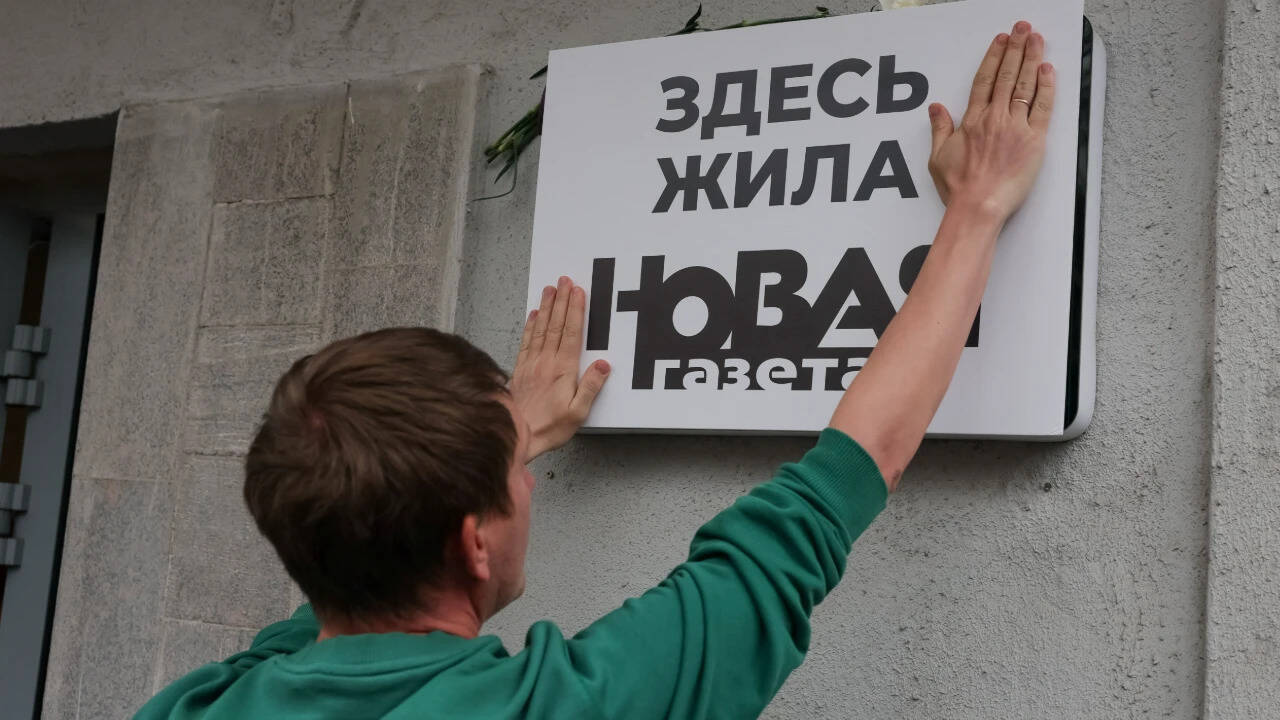
Outside a five-story office building on Potapovsky Lane in Moscow, a group of journalists took down a metal plaque and installed a plastic one in its place: Novaya Gazeta Lived Here.
asserted
Gazeta → take → place
White carnations, the flower that Russians associate with mourning, were placed on top of it.
asserted
Russians → associate → it
Novaya Gazeta, Russia’s most daring independent newspaper for decades, closed its doors Monday, the latest blow to Russians who value freedom of expression and human rights.
asserted
who → close → expression
Its forced closure is emblematic of the Kremlin’s erasure of opinions, ideas and people that do not conform to its views.
asserted
that → force → views
That process has been under way for years, but it has dramatically accelerated since Russia launched its full-scale invasion of Ukraine in 2022.
asserted
Russia → accelerate → 2022
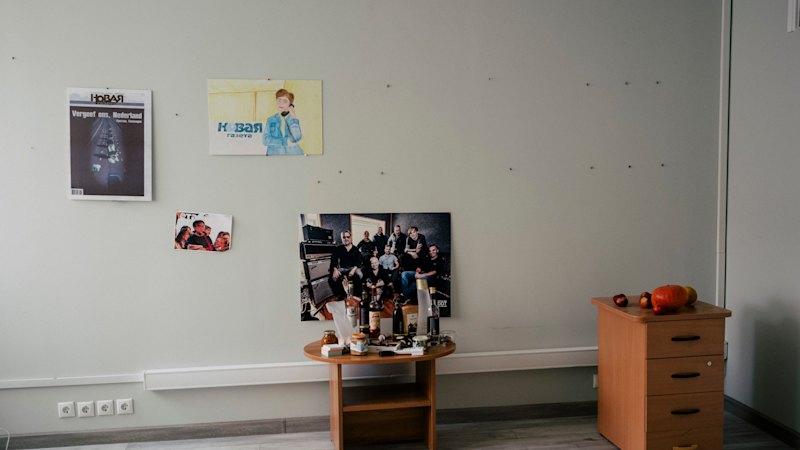
Novaya Gazeta’s journalists were packing up their offices when I visited Monday.
asserted
I → pack → offices
Its co-founder Dmitri A. Muratov, who shared the Nobel Peace Prize in 2021 for defending press freedom, was giving away personal items to colleagues and well-wishers.
asserted
who → share → colleagues
He handed his emerald banker’s lamp to one of the paper’s last recruits, a video journalist.
asserted
He → hand → recruits
He kept for himself a fire evacuation floor plan, on which he asked staff members to sign their names where their offices had been.
asserted
offices → keep → names
The office once occupied by Anna Politkovskaya, an investigative journalist and Kremlin critic who was gunned down on President Vladimir Putin’s birthday in 2006, had already been cleared out.
asserted
who → occupy → 2006
Her computer, eyeglasses and notebooks, left in place for 20 years after her murder, are now in storage.
asserted
computer → leave → storage
In many ways, it was a miracle that the newspaper had survived for as long as it had.
asserted
it → survive → ways
After its start in 1993, less than two years after the fall of the Soviet Union, Novaya Gazeta chronicled Russia’s chaotic 1990s, its consumerist 2000s, its increasingly repressive 2010s and Putin’s near-total consolidation of power in the 2020s.
asserted
Gazeta → chronicle → 2020s
It carried on even as six of its journalists were killed and others violently attacked.
asserted
others → carry → journalists
It kept publishing after its website was blocked, its media license revoked, its printing press seized and one of its journalists detained.
asserted
one → keep → journalists
But it could not, at least in its current form, outlast Russia’s war in Ukraine.
uncertain
it → outlast → Ukraine
The double death blows came last month, when its landlord refused to renew the lease and the banks that had processed reader donations, the paper’s sole form of income, said they would stop doing so.
asserted
they → come → income
None of the journalists consider this a coincidence.
asserted
this → consider → journalists
“No one is in shock here,” one of the paper’s journalists, Tatiana Britskaya, said as she walked the halls amid the boxes and plastic wrap.
asserted
she → say → boxes
“The process of silencing us started many years ago.”
asserted
process → silence → us
The journalists had tried to adapt to Russia’s wartime reality.
asserted
journalists → try → reality
They did not report about what was happening on the frontlines because censorship laws passed in March 2022 had made it a crime to use anything but government sources for such reports.
asserted
it → report → reports
Internally, they debated whether it made sense to keep operating under those conditions, and the newsroom had been divided about it, said Britskaya, 43.
asserted
Britskaya → debate → it
But she said their readers overwhelmingly wanted them to continue, even if they had to abide by the new laws.
asserted
they → say → laws
“They said, ‘Continue, because many of us are post-Soviet people, and our entire lives were spent reading between the lines.
asserted
lives → say → lines
What matters to us is that you stay with us,’” Britskaya said.
asserted
Britskaya → matter → us
The paper published front pages with the word “war” blurred out.
asserted
paper → publish → war
But its journalists wrote unflinchingly about lives that were taken or forever damaged by the conflict.
asserted
that → write → conflict
With philanthropy and activism at the core of its mission, Novaya Gazeta also encouraged readers to help those in need of assistance and organised fundraisers of its own.
asserted
Gazeta → encourage → own
The paper made its anti-war position eminently clear, withstanding the pressure until it became insurmountable.
asserted
it → make → pressure
At noon on Monday, the journalists gathered for their final editorial meeting, as dozens of reporters — mostly foreigners — filmed the scene.
asserted
dozens → gather → scene
The editor-in-chief, Sergei Sokolov, listed the articles and columns that would run in the final issue.
asserted
that → list → issue
‘We definitely will return because Novaya Gazeta is not a newspaper, not a website — it is an idea.
asserted
it → return → ?
There was an investigation into an orphan rescued from an abusive psychiatric hospital, who was subsequently drafted and killed in the war.
asserted
who → be → war
An article about teenagers who had fallen prey to scammers.
asserted
who → fall → scammers
A report on representatives from the anti-war Yabloko party taking office in the parliament of Nizhny Novgorod, the only region of Russia that allowed the party to field candidates.
asserted
party → take → candidates
After announcing that Novaya Gazeta’s website and social media channels would stop being updated with new content at midnight, Sokolov recalled the words of exiled Orthodox priest Andrei Kordochkin, a columnist for the paper who was stripped of his Moscow congregation because of his anti-war position.
asserted
who → announce → position
Despondency, Kordochkin had said, is the seventh sin.
asserted
Kordochkin → say → ?
Slowly, the journalists took down portraits of their six slain colleagues that had watched over every editorial meeting: Igor Domnikov, Yuri Shchekochikhin, Stanislav Markelov, Anastasia Baburova, Natalia Estemirova and Politkovskaya.
asserted
that → take → meeting
“We are not saying goodbye,” Sokolov said.
asserted
Sokolov → say → ?
…and 27 more, not listed.
 The Aporia