
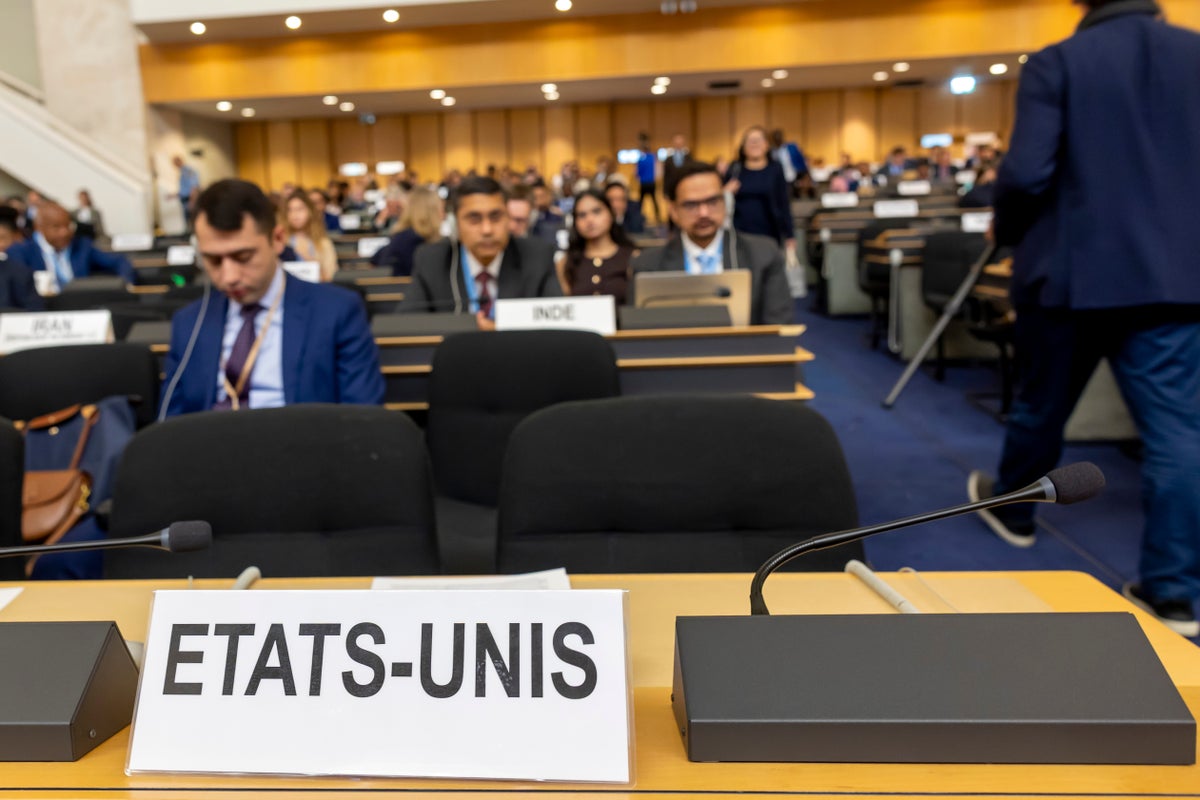
Photo via NPR

U.S. boycotts U.N. human rights review for second year running

Read the original at NPR ↗
Cite

Foulkes, I. (2026, November 10). U.S. boycotts U.N. human rights review for second year running. NPR. https://www.npr.org/2026/11/10/nx-s1-6034998/un-human-rights-us-geneva

Dated from the outlet's own feed. Check the original for its byline.

NPR · collected 2026-11-10 · by Imogen Foulkes

Quick Summary

The United States skipped its second consecutive Universal Periodic Review at the United Nations in Geneva, becoming the first country ever to do so twice. The review, which occurs every four to five years and involves peer evaluation of each member state’s human rights record, was scheduled for this week but saw no U.S. representation. Critics like the American Civil Liberties Union argue that the Trump administration's policies violate human rights, especially concerning immigrants, student protesters, and LGBTQ+ communities. The State Department justified the absence by referencing the U.S.’s withdrawal from the UN Human Rights Council last year.
Written by AI on 2026-11-10, from this article's own text only (the story summary below draws on all the coverage).

AI analysis

Story summary

As of November 10, 2026, the United States is set to become the first country to fully shun its scheduled review by the United Nations Human Rights Council, marking two decades since the body's establishment. Under President Donald Trump, the U.S. withdrew from the council in 2025, citing anti-U.S. and anti-Israel bias and alleging that the council fails to uphold human rights values it promotes. The State Department has stated it will not participate due to a lack of credibility in the organization. Rights groups criticize this decision, noting an increase in human rights violations under Trump's policies, including strong-arm deportations and targeted killings of alleged drug-runners. This review was initially postponed from November 2025 with hopes that the U.S. might reconsider, but those efforts failed.

Written for “US Skips UN Human Rights Review” on 2026-11-10, grounded in this article and the 7 other(s) covering the same event.
Why this leaning score
The article's own words the score was based on. Each is quoted verbatim and was checked against the article text before being stored, so you can find it in the original.
Reading Leans strongly left (beta estimate) Confidence high 1 quote(s) discarded as not found in the article
Leaning: leans strongly left for article 142612 (high confidence, 3 verified quotes) · logged 2026-11-10

Story

US Skips UN Human Rights Review
Politics · 8 article(s) covering the same event. See how they differ ↓

Compared with similar articles

This article reads leans strongly left and hedges 8% of its claims. Each row says how that neighbour differs.
The Independent
Hedges 3 of 18 claims Outlet record 59/100
How this article was measured signals, leaning charts, publisher record, byline, topics and claims

Signals How these are calculated →

Claims extracted
24
sentences that state something as happening or true
Uncertain
8%
2 of 24 hedged ("reportedly", "may", "according to")
Leaning
Leans strongly left
of the writing, not the subject · beta estimate
Publisher signals
60/100
NPR's corrections and hedging, across everything collected from it. Not a measure of accuracy.
Outlets on this story
8
Politics
Same framing elsewhere
1
articles that frame the event the way this one does
Analyzed 2026-11-10 · how these are computed

How this is being covered How these are calculated →

Article leaning vs. publisher reliability
Source leaning vs. consistency

Publisher

NPR · 1189 article(s) · 3 correction(s) detected
Running correction rate · 3 correction(s)

Who wrote this

Imogen Foulkes
1 article(s) here · 1 carrying a prediction
Rights groups would like the U.N. to hold the review anyway, and take evidence about alleged violations in the U.S.
The only article under this byline in the corpus.

Topics

GENEVA Switzerland U.N. U.S. Washington

Subjects

U.N. ORG · 10× U.S. GPE · 9× GENEVA GPE · 3× Washington GPE · 3× ACLU ORG · 1× Dakwar PERSON · 1× Jamil Dakwar PERSON · 1× Switzerland GPE · 1× The United States GPE · 1× United Nations ORG · 1×

Narrative

Human rights groups see Washington's stance as part of a pattern of disengagement and even active opposition to multilateral organizations, pointing to U.S. sanctions on the International Criminal Court and the decision to leave the World Health Organization.
framing: assertive · carried by 1 article(s) · first seen 2026-11-10
Rights groups would like the U.N. to hold the review anyway, and take evidence about alleged violations in the U.S.

Claims (24 extracted, 2 hedged)

U.S. boycotts U.N. human rights review for second year running GENEVA, Switzerland — asserted
U.S. → boycott → year
The United States has left an empty chair at a key United Nations human rights review for the second year running, becoming the only U.N. member state ever to do so. asserted
States → leave → year
The review, known as the universal periodic review, is meant to be just that: universal. asserted
review → know → review
Each state is reviewed every four to five years by fellow member states. asserted
state → review → states
The aim is to ensure that every country, however powerful, undergoes a peer review of its human rights record. asserted
country → ensure → record
As well as diplomats from countries under review, civil society groups are allowed to submit evidence too. asserted
groups → allow → evidence
Several made the trip to Geneva, led by the American Civil Liberties Union. asserted
Several → make → Union
Jamil Dakwar, the ACLU's human rights director, told journalists that the current U.S. administration was continuing to violate human rights "unabashed," citing the treatment of immigrants, student protesters and the LGBTQ community as examples. asserted
administration → tell → examples
Dakwar said the U.N. must hold the U.S. accountable, warning that the Trump administration wanted to "dismantle human rights." asserted
administration → say → rights
In a written response, the State Department pointed out that Washington had already formally withdrawn from the U.N. Human Rights Council, accusing it of "pushing anti-American rhetoric." asserted
Washington → write → rhetoric
In fact, leaving the council, which has 47 elected members, does not mean the U.S. can easily get out of the review process, which is obligatory for all 193 U.N. member states. asserted
which → leave → states
Human rights groups see Washington's stance as part of a pattern of disengagement and even active opposition to multilateral organizations, pointing to U.S. sanctions on the International Criminal Court and the decision to leave the World Health Organization. asserted
groups → see → Organization
So what happens now? asserted
what → happen → ?
The U.N. has few sanctions against a country that does not cooperate with the review process. asserted
that → have → process
Israel skipped one review back in 2013 in protest at what it said was anti-Israel bias, but returned nine months later after the U.N. rescheduled. asserted
U.N. → skip → protest
Until today's no-show by the U.S., no country has ever failed to turn up twice. asserted
country → fail → U.S.
Rights groups would like the U.N. to hold the review anyway, and take evidence about alleged violations in the U.S. asserted
U.N. → like → U.S.
Member states had already drawn up a list of questions for Washington's diplomats, including questions about the use of the death penalty and restrictions on abortion. asserted
states → draw → abortion
But U.N. insiders fear that holding the review when there is no one to answer those questions could set a risky precedent. uncertain
holding → fear → precedent
Even authoritarian regimes such as North Korea take part in the review process. asserted
regimes → take → process
If the U.N. allows a review to go ahead without U.S. participation, it could encourage other member states to stay away, too, leaving rights groups to present their evidence, as one put it, "in a vacuum." uncertain
one → allow → vacuum
For now, the U.N. has decided to postpone tricky deliberations about how to react until early next year. asserted
U.N. → decide → year
In the meantime, a process regarded as a last resort for the victims of human rights violations is not available to U.S. citizens. asserted
process → regard → citizens
It is, one rights activist said in Geneva, "a crisis of accountability." asserted
activist → say → accountability
Give feedback · no sign-in needed

No sign-in needed for now. Your note is sent without a name, so it cannot be answered.

History Support