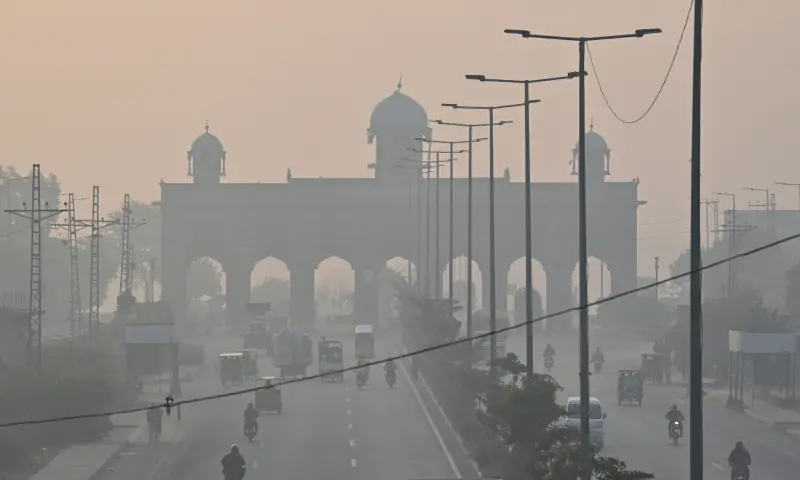
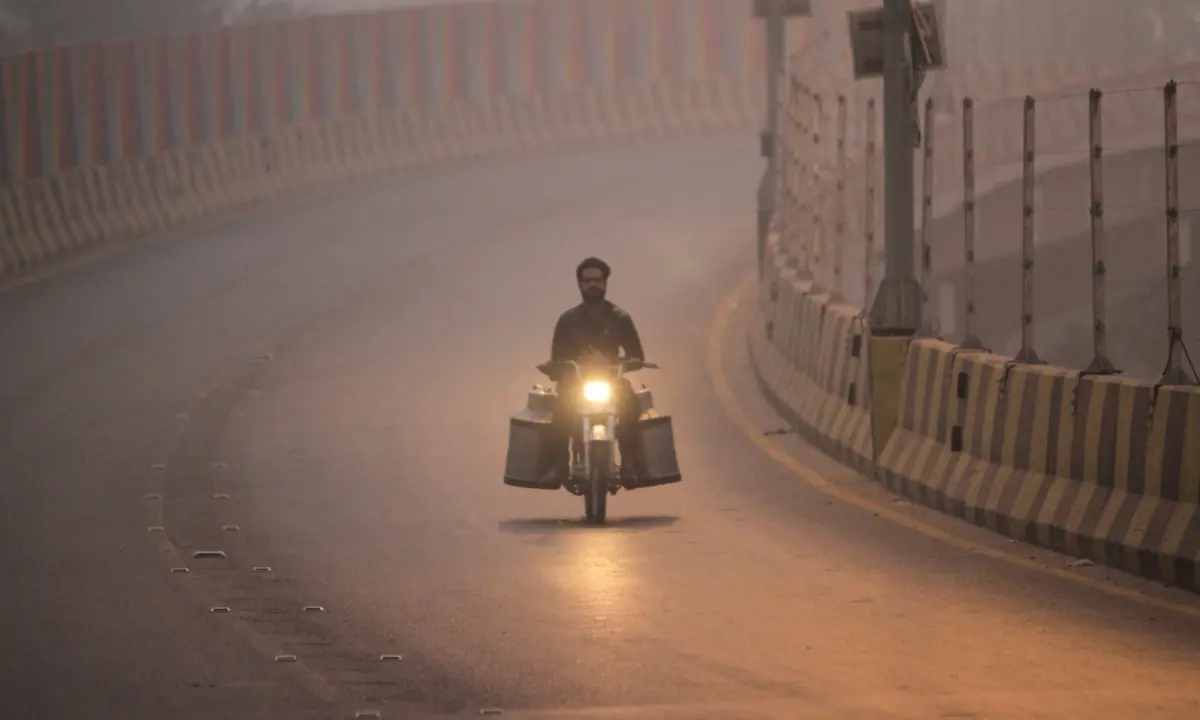
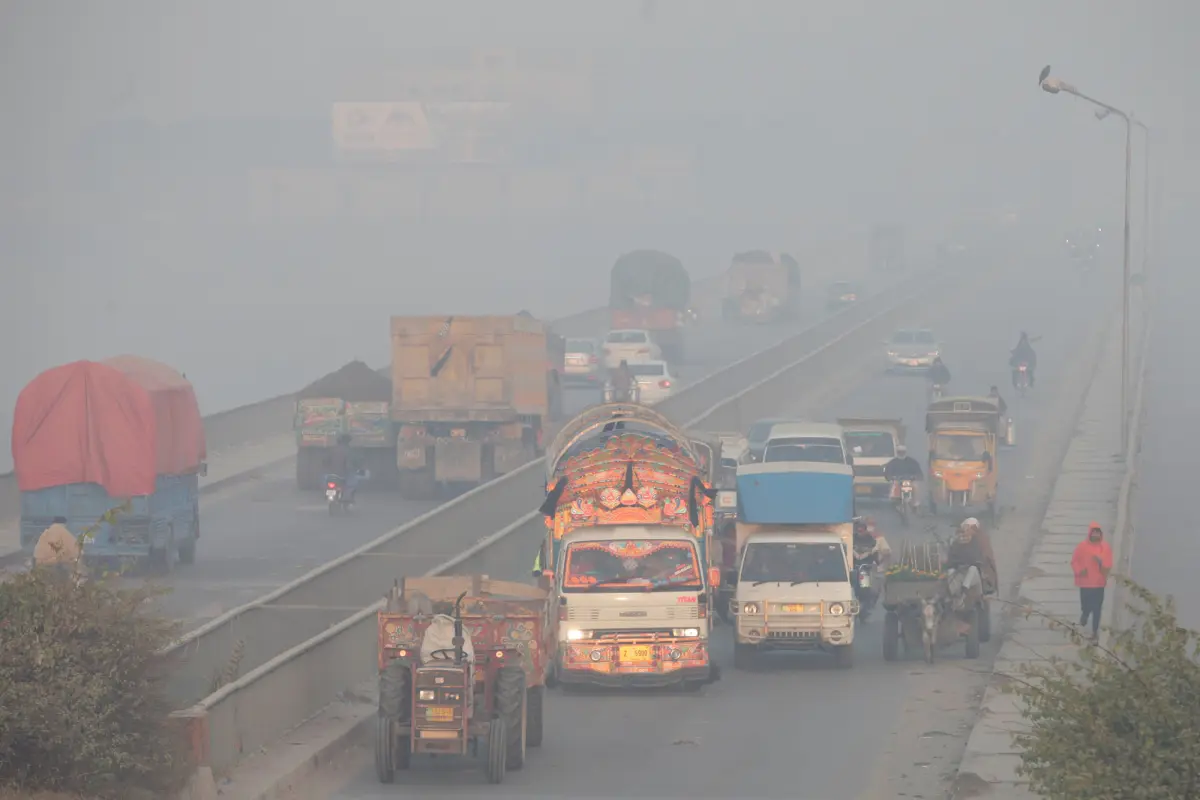
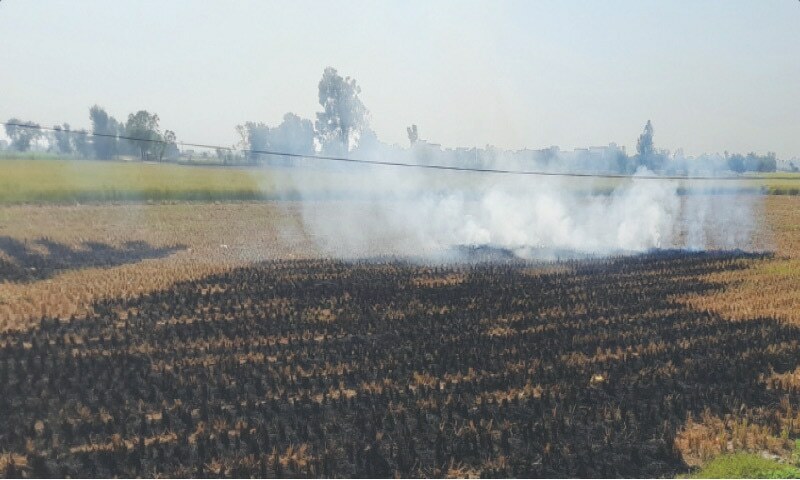
Satellite data detected 16,714 likely crop-residue fires in Punjab between Oct 1 and Nov 9, while Lahore’s average PM2.5 concentration was eight times the World Health Organisation’s (WHO) guideline value, according to a report by the Pakistan Air Quality Initiative (PAQI) that questioned the link between Diwali fireworks in India and the city’s pollution.
uncertain
that → detect → pollution
The report, released on Tuesday, said the number of likely crop-residue fires in Punjab, Pakistan, remained almost unchanged from the corresponding period last year.
asserted
number → release → period
Lahore’s average PM2.5 concentration stood at 126 micrograms per cubic metre during the period, exceeding the 24-hour National Environmental Quality Standards (NEQS) on all 40 days for which valid data were available.
asserted
data → stand → which
Satellite instruments detected 18,825 fires across Punjab, Pakistan, 89 per cent of which were classified as likely crop-residue burning.
asserted
cent → detect → burning
The highest daily count was recorded on Nov 1, with 1,102 detections.
asserted
count → record → detections
The 24-hour National Environmental Quality Standards (NEQS) were exceeded on all 40 days for which valid data were available.
asserted
data → exceed → which
Sheikhupura recorded the highest number of fires at 2,559, followed by Jhang (2,192), Okara (2,062), Hafizabad (1,893) and Gujranwala (1,417).
asserted
Sheikhupura → record → Jhang
The five districts accounted for 54pc of the total detections.
asserted
districts → account → detections
The report found a positive correlation between upwind fire activity and PM2.5 levels in Lahore.
asserted
report → find → Lahore
On days when air trajectories passed over areas where burning was taking place, the average concentration reached 175 micrograms per cubic metre, compared with 93 micrograms on other days.
asserted
concentration → pass → days
A similar pattern was observed in Multan, where average PM2.5 levels reached 203 micrograms on days influenced by fires, compared with 88 micrograms on other days.
asserted
levels → observe → days
However, the report cautioned that the association did not establish the precise contribution of crop-residue burning to urban pollution, as stagnant weather conditions and reduced atmospheric dispersion also contributed to the accumulation of pollutants.
asserted
conditions → caution → pollutants
The number of likely crop-residue fires in Punjab, Pakistan, was 8pc above the 2020-2025 average, although the comparable satellite record showed a 1pc decline from 2025.
asserted
record → show → 2025
The assessment also examined whether fireworks during Diwali celebrations in India on Nov 8 had contributed to deteriorating air quality in Punjab.
asserted
fireworks → examine → Punjab
It found that easterly winds carried air from Indian territory towards Pakistan during the night.
asserted
winds → find → night
Of the 48 back trajectories arriving in Lahore, Kasur and Sialkot between 9pm on Nov 8 and midnight on Nov 10, 45 had passed over Indian territory within the preceding 12 hours, most frequently near Tarn Taran, Amritsar and Jammu.
asserted
45 → arrive → Taran
However, the report said the available evidence did not support attributing Lahore’s poor air quality after Diwali to fireworks across the border.
asserted
evidence → say → border
Lahore’s average PM2.5 concentration between 6pm on Nov 8 and 1am on Nov 10 was 234 micrograms per cubic metre, 10pc higher than the average recorded during the same hours over the preceding seven days.
asserted
concentration → record → days
In comparison, the average concentration in Kasur increased by 27pc and in Sialkot by 33pc, while Narowal recorded a 2pc decline.
asserted
Narowal → increase → decline
Faisalabad, located 130 kilometres from the border, recorded a 40pc increase, while Multan, 180km away, also saw a 40pc rise.
asserted
Multan → locate → rise
The average increase in the four border cities — Lahore, Kasur, Sialkot and Narowal — was 36 micrograms per cubic metre, compared with 85 micrograms in Faisalabad and Multan.
asserted
increase → compare → Faisalabad
The report noted that pollution transported from across the border would be expected to cause a greater increase in border areas than in cities farther inland.
asserted
pollution → note → cities
However, the observed pattern did not support that explanation.
asserted
pattern → observe → explanation
Sialkot was an exception, recording a 37pc increase in PM2.5 during the night after Diwali, with air trajectories passing over the Jammu area.
asserted
trajectories → record → area
The assessment also found that emissions from New Delhi had not reached Lahore during the period analysed.
asserted
emissions → find → period
Air from Delhi entered Pakistan near Rahim Yar Khan and Bahawalpur only after 3am on Nov 10, with its closest approach to Lahore remaining 266 kilometres away.
asserted
approach → enter → Lahore
The report said distinguishing between emissions from fireworks and smoke from agricultural fires required chemical analysis of particulate matter, including elements such as potassium, strontium and barium, which Pakistani monitoring stations did not measure.
asserted
stations → say → which
Air quality improves
Meanwhile, the Punjab Environment Protection and Climate Change Department (EPCCD) reported an improvement in Lahore’s air quality on Monday following emergency mitigation and enforcement operations.
asserted
Department → improve → operations
The city’s average air quality index (AQI) reading, recorded at 489 at 9am, fell to 232 by 3pm — a reduction of 257 points, or approximately 53pc — according to the department’s monitoring network.
uncertain
reading → record → network
Data from all 11 monitoring stations showed a decline in AQI readings during the period.
asserted
Data → show → period
Egerton Road recorded the biggest improvement, with its reading falling from 500 to 167, followed by GT Road, where the AQI dropped from 500 to 172.
DHA Phase 6, Shahdara, Barki Road and Punjab University also recorded improvements, as did Wagah Border, Gulberg III, Kahna Nau, Safari Park and Multan Road.
asserted
Border → record → improvements
The department said multiple anti-smog guns had been deployed along high-traffic corridors and at dust-prone locations and pollution hotspots, while mist-sprinkling operations covered around 640 kilometres of designated routes.
asserted
operations → say → routes
The government had earlier warned of deteriorating air quality in Lahore, Kasur and adjoining border districts on Nov 9 and 10, identifying Diwali fireworks, agricultural residue burning in Indian Punjab, easterly winds and stagnant atmospheric conditions as potential contributing factors.
asserted
government → warn → factors
A special assessment issued on Nov 8 had cited 2,347 incidents of crop-residue burning in Indian Punjab up to Nov 4.
asserted
assessment → issue → Nov
Of these, 1,081 were recorded in the districts of Tarn Taran, Ferozepur and Amritsar.
asserted
1,081 → record → Taran
It had also warned that smoke from Diwali fireworks could reach Lahore within five to 13 hours, depending on wind conditions.
uncertain
smoke → warn → conditions
EPCCD Secretary Silwat Saeed said the department was responding to deteriorating air quality through coordinated enforcement, real-time environmental monitoring and targeted field interventions.
asserted
department → say → enforcement
She said the department was using its monitoring infrastructure and Punjab Climate Watch data to identify pollution hotspots and direct operational teams to areas requiring immediate action.
asserted
department → say → action
Environment Protection Agency (EPA) Director General Abdullah Nayyar Sheikh said the department had adopted a zero-tolerance approach towards major sources of air pollution.
asserted
department → say → pollution
He said Quick Response Units were responding to satellite-detected fire anomalies and reports of crop-residue burning, with field teams being dispatched to extinguish fires and take action against those responsible.
asserted
teams → say → those
…and 9 more, not listed.
 The Aporia