The News
Washington wants to make it harder for US solar firms to rely on China.
asserted
firms → want → China
A panel factory in Texas shows how that’s already happening — but why weaning them off entirely could be harder than it looks.
uncertain
it → show → them
The industry is bracing for one of its biggest shocks in years: In December, new Commerce Department rules will require panel manufacturers to pay a fixed minimum price and a tariff of up to 15% for cells and certain other specialized components they import from abroad.
asserted
they → brace → cells
The rules, under a provision called Section 232, are designed to finally quash a cat-and-mouse game US trade officials have been playing with China for years, in which Chinese solar makers shift between factories in various Asian or African locales to stay one step ahead of American tariffs.
asserted
makers → call → tariffs
One of the companies navigating this change is the Texas-based panel manufacturer T1 Energy, which has roots linked to China but is now racing toward greater independence.
asserted
which → navigate → independence
Because the new rules will drive up panel prices, some solar installers are panicking; at least 1 gigawatt worth of large-scale solar projects has been cancelled in recent months because of 232-related price adjustments, according to solar research firm Anza.
uncertain
worth → drive → Anza
But T1 CEO Daniel Barcelo can’t wait.
asserted
Barcelo → wait → ?
The rules “will really level the playing field” against Chinese rivals, he told me.
asserted
he → level → me
“Building something in America still takes longer and costs more than building it in most countries.”
asserted
Building → build → countries
Tim’s view
US President Donald Trump may not be a big fan of solar, but it’s the country’s fastest-growing source of power generation.
uncertain
it → ’ → generation
Standing up an independent domestic solar supply chain is critical to the country’s energy security and AI ambitions, and to lowering power prices, especially as Beijing moves to restrict the export of some key solar technologies.
asserted
Beijing → stand → technologies
But, although it may be wise to raise trade barriers that push more China-affiliated solar components out of the US market, China’s role in global solar supply chains is so pervasive that instantly severing all ties could kill many US solar manufacturing efforts in the crib.
uncertain
severing → raise → crib
Future growth for this industry depends on a more nuanced trade policy that gives US companies the space to benefit from China’s world-leading solar expertise while the next phase of home-grown plants gets built.
asserted
phase → depend → plants
At this point, the US imports almost no solar cells or other core components from China, and imports of panels from anywhere recently hit a seven-year low now that more US module assembly factories are cropping up.
asserted
factories → import → low
But even T1, like many of its peers, still needs China for some vital aspects of its operations.
asserted
T1 → need → operations
And when I visited the company’s factory, it was clear that achieving a full divorce between the American and Chinese solar industries could be more complex than many in Washington appreciate.
uncertain
many → visit → Washington
T1 operates a sprawling, cutting-edge solar module factory on the outskirts of Dallas, and is a few months away from finishing a second factory to manufacture its own cells based on technology that was first developed for the Chinese firms it’s looking to supplant.
asserted
it → operate → firms
Last month, the company was granted special permission from Commerce to continue importing cells from Asian suppliers without being penalized for stockpiling ahead of the 232 deadline.
asserted
company → grant → deadline
It is also awaiting a verdict on a second Commerce waiver that would allow it to dodge the 232 tariffs altogether while it completes its onshoring investments.
asserted
it → await → investments
The company was born from the clean tech trade wars that have engulfed the US, Europe, and China in recent years.
asserted
that → bear → years
In the early 2020s Barcelo, whose background is in global oil and gas finance, was working to set up an EV battery factory in Norway.
asserted
background → work → Norway
But that company, Freyr, got pushed by intense competition from Chinese rivals — and simultaneously pulled westward by inducements in Biden’s Inflation Reduction Act.
asserted
company → push → Act
The company’s first plan was to build a $2.5 billion battery factory in Georgia.
asserted
plan → build → Georgia
But that was scrapped after Barcelo spotted a better deal in solar, where there were only a few domestic manufacturers at a moment when demand was exploding and Chinese firms, who could see a US crackdown coming, were looking to pull up stakes.
uncertain
crackdown → scrap → stakes
He pivoted, and agreed in December 2024 to a $621 million deal to buy the Dallas factory, along with supply contracts and other assets, from Changzhou-based Trina Solar, one of the world’s biggest producers, which had just completed building it.
asserted
which → pivot → it
A wave of similar US takeovers swept the industry around that time, including some in which Chinese firms retained a minority stake.
asserted
firms → sweep → stake
Indeed, more than 40% of the 66 GW of operational US module manufacturing capacity today originated as facilities owned by Chinese manufacturers or joint ventures involving Chinese firms, according to Wood Mackenzie analyst Elissa Pierce.
uncertain
% → manufacture → Pierce
In T1’s case, Trina dropped its stake entirely.
asserted
Trina → drop → stake
But T1’s relationships with Trina and other Chinese firms remained essential: A Trina executive briefly came over to serve as the new venture’s chief strategy officer.
asserted
executive → remain → officer
The factory’s anchor customer became Trina itself, which committed to buy 1 GW of panels per year, one-fifth of the factory’s capacity; on the day I visited, robotic arms were gingerly packaging panels into Trina-branded boxes.
asserted
arms → become → boxes
T1 inherited Trina’s polysilicon supply contract from a Michigan company called Hemlock, which is minority owned by a Chinese chemical firm.
asserted
which → inherit → firm
The first thing I saw on the factory floor was a stack of specialized glass from a company in Zhejiang.
asserted
I → see → Zhejiang
Other Asian countries are essential, too: T1 imports cells and other components from a range of suppliers in Southeast Asia and elsewhere.
asserted
T1 → import → Asia
In July, it paid $135 million to a Singaporean solar firm for intellectual property behind the cell and module technology that Trina and others use.
asserted
Trina → pay → that
Russell Gold, a veteran Wall Street Journal energy journalist who is now T1’s spokesperson, said that although the company now feels “pretty comfortable running this factory by ourselves,” it still works closely with outside contractors, including some from China, to maintain equipment and train its workers on what is essentially a Chinese factory floor plopped in East Texas.
asserted
what → say → Texas
Chinese solar manufacturing equipment, Gold said, is still “the best in the world.”
asserted
Gold → manufacture → world
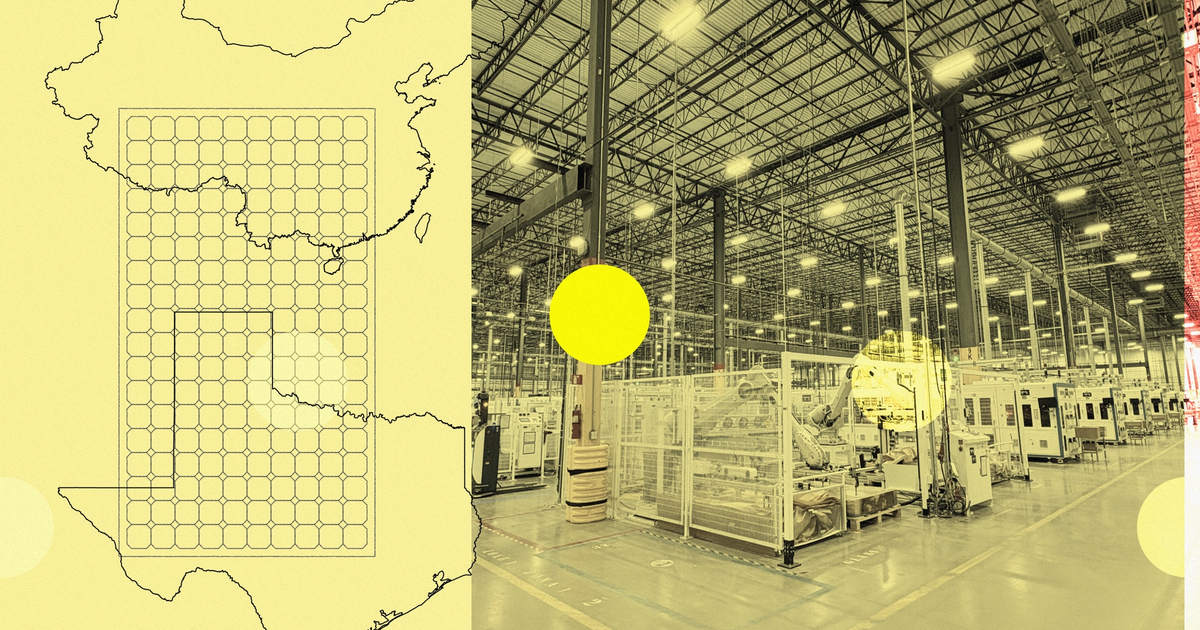
Inside a gleaming warehouse the width of a few Manhattan avenues, a succession of machine arms, conveyor belts, and ovens press cells onto dinner-table-sized panels, more than 17,000 every day.
asserted
succession → gleam → panels
Several hundred humans are needed to keep things moving and ensure quality control.
asserted
humans → need → control
A few autonomous robots roll around moving heavy stuff while playing Darth Vader’s Imperial March to signal their approach.
asserted
robots → roll → approach
The staff reflects the diversity of the strong immigrant communities in Dallas: I met workers, at least half of whom seemed to be women, from Equatorial Guinea, Mexico, Peru, and Venezuela.
asserted
half → reflect → Guinea
…and 15 more, not listed.
 The Aporia