- Published
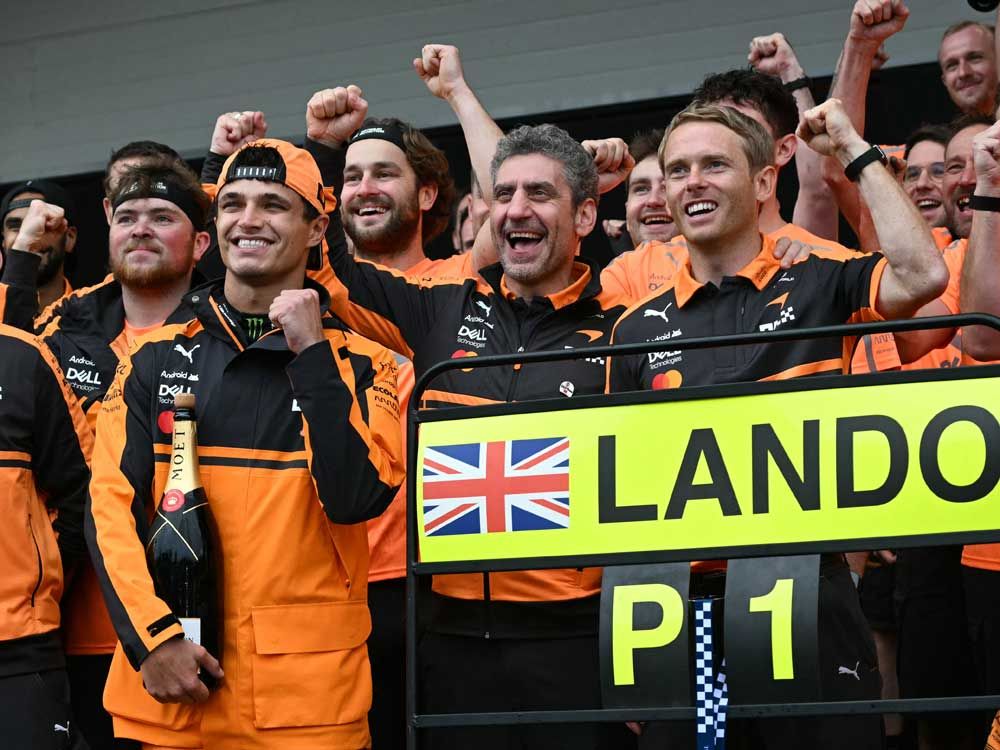
McLaren's Lando Norris converted pole position into a race win at a wet-dry-wet Sao Paulo Grand Prix on Sunday.
asserted
Norris → publish → Sunday
Max Verstappen came through the field to take second after starting at the back of the grid because of an engine penalty, while his Red Bull team-mate Isack Hadjar was on the podium in third.
Mercedes sealed the constructors' championship for the first time since 2021 at Interlagos following a fourth-place finish for George Russell and fifth for new world champion Kimi Antonelli.
asserted
Mercedes → come → Antonelli
Here BBC F1 correspondent Andrew Benson answers your latest questions.
asserted
Benson → answer → questions
Lewis Hamilton has just completed his 400th F1 grand prix, with more than 100 of these races having him on pole position.
asserted
100 → complete → position
There are drivers with a better pole percentage than this, so just how good is he and for how much longer can he stay at the top?
asserted
he → be → top
He's tied with Michael Schumacher for the most championships with seven, and many would - and do - argue he should have eight, given the controversy of the mishandled final race of the 2021 season.
Greatness as an F1 driver is about more than raw statistics, but even so Hamilton has consistently proved to be at the very highest level, with a series of outstanding drives in races that will go down in history as some of the greatest ever.
Examples of those would be the 2008 British Grand Prix and the 2021 Brazilian Grand Prix, along with many others.
asserted
Examples → tie → others
All of this should go without saying.
He's also won races in nearly all his seasons - the only exceptions being 2022, 2023 and 2025.
There is no question that, within the context of his remarkable career, Hamilton struggled relatively in the era of 'ground-effect' cars from 2022-25.
asserted
Hamilton → go → 2022
He was beaten by Mercedes team-mate George Russell in two of their three seasons together, and looked a shadow of his usual self against Charles Leclerc in 2025.
asserted
He → beat → 2025
Those performances led some to question why a driver formerly famed and lauded for his adaptability did not seem as able to adapt to the driving style required of those cars.
asserted
driver → lead → cars
And that, in turn, led to questions as to whether the fact he apparently could not was related to his age - he is now 41.
uncertain
he → lead → age
But with this year's cars, Hamilton is back in much more familiar territory, is performing extremely well again and is neck-and-neck with Leclerc.
asserted
Hamilton → perform → Leclerc
Those questions about the four years from 2022-25 will remain just that, but there is no doubt Hamilton is sensitive to them.
asserted
Hamilton → remain → them
He has referenced them a number of times this year, including last weekend in Brazil, when the topic of his 400th race came up.
asserted
topic → reference → race
"I never ever thought that I would be reaching numbers like that," he said.
asserted
he → think → that
"It's crazy because I still feel young, and regardless of the things that people say, you saw my pole last week, I still have the pace, I still have the speed and I still have the dedication, which is most important and the focus.
asserted
which → feel → dedication
Longevity in sport depends on many factors, and each athlete is different.
asserted
athlete → depend → factors
On the face of it, however, there is no obvious reason why, on an age front, Hamilton cannot continue for a good few more years - Fernando Alonso is 45 and is still performing at an extremely high level, as he proved yet again in Brazil at the weekend.
asserted
he → be → weekend
Hamilton has said he wants to race at least until F1 returns to Africa, which will not be until 2030 at the earliest, when he, too, will be 45.
asserted
he → say → earliest
For that, he will need at least one new contract, as his current one with Ferrari is believed to end next year.
asserted
one → need → Ferrari
We heard, and saw, a lot of 'yo-yo racing' in the first half of the season.
asserted
We → hear → season
This seems to have reduced.
asserted
This → seem → ?
What has changed?
asserted
What → change → ?
- Ali
'Yo-yo racing' was a term coined at the start of this year for a new character of on-track battle in which cars swapped positions multiple times over a series of laps.
asserted
cars → coin → laps
This was caused by the new power-units introduced this year, which have a near 50-50 split between internal combustion and electrical power and are fundamentally energy starved.
asserted
which → cause → combustion
The operations of these engines included 'overtake' and 'boost' modes.
asserted
operations → include → modes
'Boost' is a facility for a driver to demand extra electrical energy whenever he wants, as long as the battery has charge.
asserted
battery → demand → charge
'Overtake' mode gives a driver following within one second of a car in front an extra 0.5MJ of energy recovery and deployment capability per lap.
asserted
mode → give → lap
At the start of the season, this - combined with the teams' and drivers' relative unfamiliarity with the new technology - led to a number of examples of yo-yo racing in the early grands prix.
asserted
this → combine → prix
This is where one driver has more electrical energy available, uses it to overtake, whereupon the driver behind now has more and overtakes back, and so on.
asserted
driver → have → more
This has been less prevalent recently and there are two reasons for that.
asserted
This → be → that
Primarily, the tracks in recent weeks have been less 'energy-starved'.
asserted
tracks → starve → weeks
And the more energy-starved a car is at a track, the more likelihood there is for yo-yo racing.
asserted
likelihood → starve → racing
The overtaking comes from the variation in energy levels, and being at tracks where drivers can't use all the energy they want all the time.
asserted
they → come → energy
On top of that, drivers and teams have now been using the engines for a season and are much more on top of how to use them, and therefore how not to leave themselves vulnerable.
asserted
drivers → use → themselves
At the same time, rule changes have been introduced since the start of the season to reduce the impact of energy starvation, such as imposing energy limits on tracks where it is a major issue.
asserted
it → introduce → tracks
This flattens out the peaks and troughs in energy availability.
asserted
This → flatten → availability
And into next year and beyond further steps are being taken to make the engines more "normal" in operation - by changing the energy split to 60-40 in two steps by 2028.
asserted
engines → take → 2028
This is almost certainly going to lead to the frequency of overtaking reducing, while the drivers become happier with how the cars feel to drive.
asserted
cars → go → overtaking
Whether the audience perceives that as better or worse racing remains to be seen.
asserted
perceives → perceive → racing
What is the reason a driver like Esteban Ocon would want to stay in F1 as a reserve driver rather than commit to race elsewhere in a different series?
asserted
driver → want → series
…and 33 more, not listed.
 The Aporia