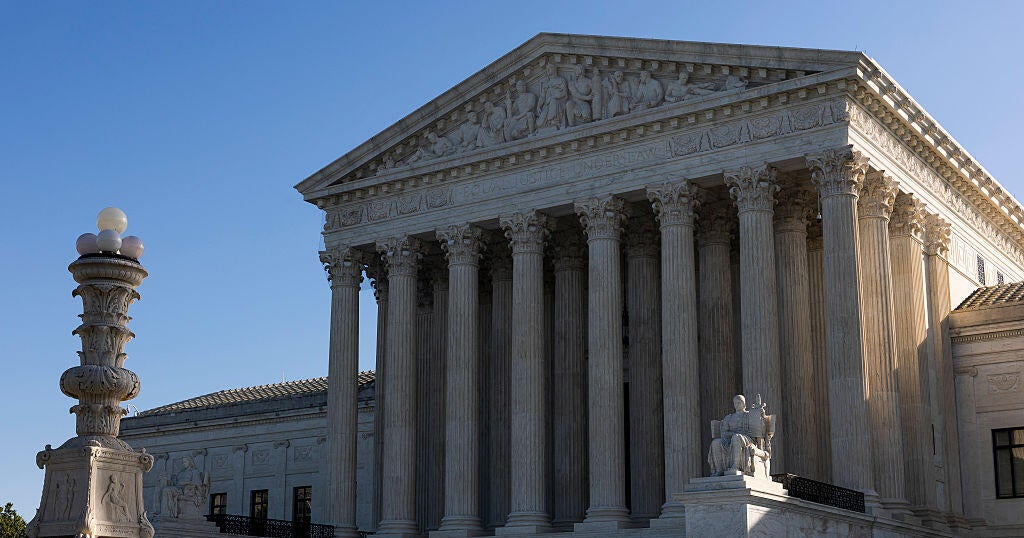
The Supreme Court on Monday cleared the way for the Trump administration to resume building a border wall and other infrastructure through a remote area of West Texas while litigation over the project moves forward.
asserted
litigation → clear → project
In an unsigned decision, the high court agreed to lift a district court's injunction that temporarily stopped construction of the wall and related infrastructure in the Bend Bend sector, which covers more than 500 miles of the southern border and includes Big Bend National Park.
asserted
which → agree → Park
Justice Ketanji Brown Jackson said she would have denied the Justice Department's request for emergency relief.
asserted
she → say → relief
In its decision, the Supreme Court said in part that the lower court's order delays construction of the border barrier and roads in the Big Bend region and "impedes the Government from advancing its 'compelling interests' in border security and integrity."
asserted
order → say → security
The Trump administration had asked the Supreme Court last month to
over the border wall in the Big Bend region and argued that the halt ordered by U.S. District Judge Kathleen Cardone frustrated its ability to combat illegal border crossings in the area.
asserted
halt → ask → area
Stopping construction of the wall and roads along that portion of the U.S.-Mexico border would have serious consequences, Solicitor General D. John Sauer warned, including "disruption of the government's ability to secure a quarter of the southern border against cartel incursions, drug trafficking, and illegal entry; creation of a massive vulnerability in border protection that risks funneling illegal entry and trafficking into the unsecured Big Bend Sector; and irreversible delays, costs, and operational harms from halting already-begun construction.
asserted
that → stop → construction
"
But an environmental nonprofit, a professional riverboat guide and a religious organization, which filed a lawsuit challenging the project, argued that allowing the Trump administration to resume construction of roads and the wall would permanently alter an "irreplaceable landscape" that includes Big Bend National Park, Big Bend Ranch State Park, and nearly 200 miles of the Rio Grande Wild and Scenic River corridor.
asserted
that → file → corridor
"Once habitat is destroyed, vegetation cleared, historic resources damaged, livelihoods and private property destroyed, and wilderness landscapes fragmented by roads, barriers, and associated infrastructure, no final judgment can restore the status quo," lawyers for the plaintiffs wrote in a Supreme Court filing.
asserted
lawyers → destroy → filing
President Trump has promised to build a wall along the U.S.-Mexico border for more than a decade and has made the 30-foot barrier a cornerstone of his plan to tackle illegal immigration.
asserted
barrier → promise → immigration
To speed up construction of the wall and other barriers along the southern border in Texas, the secretary of Homeland Security — first Kristi Noem and then Markwayne Mullin — issued a total of three waivers for project areas in the Big Bend region beginning in February.
asserted
secretary → speed → February
The federal government would typically have to ensure compliance with federal environmental protection and historical preservation laws before moving forward with construction.
asserted
government → have → construction
But the Department of Homeland Security invoked a 1996 federal immigration law that gives the secretary the authority to waive all legal requirements deemed necessary to ensure "expeditious" construction of barriers and roads near the southern border.
asserted
that → invoke → border
In response to the move, the plaintiffs filed their lawsuit to stop the Trump administration from building new 30-foot bollard walls and other infrastructure in the Big Bend region.
asserted
plaintiffs → file → region
The waivers issued by DHS, they said, would "authorize massive projects that would cleave through the Chihuahuan Desert, sever public and wildlife access to iconic sections of the Rio Grande, and mark one of the final—and most consequential — steps towards completing 'the Wall.'"
asserted
that → issue → Wall
Separate from the litigation, the president's planned wall
from Republican and Democratic lawmakers, cattle ranchers and local law enforcement in Texas when photos and videos shared to social media in August showed bulldozers arriving at Big Bend National Park.
asserted
bulldozers → plan → Park
In response to the backlash, Customs and Border Protection Commissioner Rodney Scott announced that not cut through Big Bend National Park, but other infrastructure would, including more than 200 miles of patrol roads and roughly 17 miles of a vehicle-barrier system, according to CBP.
uncertain
Scott → announce → CBP
Scott has said that the proposed 30-foot border wall willConstruction of a 47-mile-long stretch of wall in Hudspeth County, which is part of the Big Bend region, began in September, according to immigration agencies.
uncertain
which → say → agencies
But last month, Cardone, the district judge, granted a preliminary injunction that barred the Trump administration from building border barriers or related infrastructure, or engaging in "any construction or ground disturbing activities" in the Big Bend sector.
asserted
that → grant → sector
Cardone found that the secretary of homeland security exceeded his authority when issuing the waivers that allowed construction of the wall to proceed.
asserted
construction → find → wall
The Trump administration and the challengers to the project were at odds over whether the Big Bend sector is an area of "high illegal entry" requiring additional border barriers.
asserted
sector → require → barriers
The government has argued that immigration officers apprehended more than 89,000 people trying to cross into the U.S. illegally in that area between 2021 and 2025.
asserted
officers → argue → 2021
But the plaintiffs said that Big Bend ranks last for apprehensions compared to the other six sectors along the southern border.
asserted
Bend → say → border
While the area covers more than 25% of the U.S.-Mexico border, annual apprehensions in the Big Bend Sector ranged between 0.3% and 2.2% of total border-wide apprehensions, according to court filings.
uncertain
apprehensions → cover → filings
 The Aporia