Vibe coding has escaped the terminal

Read the original at Platformer ↗
Cite

Newton, C. (2026, August 19). Vibe coding has escaped the terminal. Platformer. https://www.platformer.news/glaze-app-raycast-vibe-coding-review/

Dated when The Aporia collected the article, usually within hours of publication. Check the original for its exact date and byline.

Platformer · collected 2026-08-19 · by Casey Newton

Quick Summary

The author's fiancé works at Anthropic and they have used various tools for coding, but were put off by their lack of polish. The article reports on the author's experience with Glaze, an all-in-one vibe-coding app for Mac that allows users to build desktop apps, which has 1 free tier credit bundle and a $20/month Pro subscription offering 200 credits. The author built three productivity-related apps in their first month using Glaze, including one called Nightwing, a comic book reader app.
Written locally by qwen2.5:14b on 2026-08-19, using this article's own text rather than the other coverage of the same event (that is the story summary below).

AI analysis runs on qwen2.5:14b, locally

Story summary

Casey Newton, an author, has been working on various coding projects this year, including building a personal website and tools for creating daily briefings and journaling companions. He initially prioritized functionality over aesthetics, but was drawn to Raycast's new app, Glaze, which allows users to build desktop apps with a more user-friendly interface. Glaze is designed specifically for building and sharing desktop applications, making it appealing to Newton, who works primarily on his laptop.

Written for “Vibe Coding Escapade” on 2026-10-16, grounded in this article and the 0 other(s) covering the same event.

Story

📰 Vibe Coding Escapade
Technology · 1 article(s) covering the same event.

Compared with similar articles

This article reads unscored and hedges 7% of its claims. Each row says how that neighbour differs.
BBC News
⚖️ Leans right 🔴 14% hedged 3 of 21 📰 publisher trust 72
“Article A describes an AI agent hacking a gym to get its user a spot in pilates class, while Article B mentions building tools with AI but does not mention the gym or pilates class incident”
Platformer
⚖️ leaning not scored 🔴 14% hedged 11 of 77 📰 publisher trust 96
“The articles describe different personal experiences of AI development, one discussing job threats and another about creating personal tools”
Platformer
⚖️ leaning not scored 🔴 7% hedged 11 of 167 📰 publisher trust 96
“Article A describes the author's personal project of building tools, while Article B interviews Dan Shipper about his website and product lab, without mentioning any connection to the author's project”
How this article was measured signals, leaning charts, publisher record, byline, topics and claims

Signals How these are calculated →

Claims extracted
101
sentences that state something as happening or true
Uncertain
7%
7 of 101 hedged ("reportedly", "may", "according to")
Leaning
not political
takes no side on a contested political question
Publisher signals
96/100
Platformer's corrections and hedging, across everything collected from it. Not a measure of accuracy.
Outlets on this story
1
Technology
Same framing elsewhere
1
articles that frame the event the way this one does
Analyzed 2026-08-19 · how these are computed

How this is being covered How these are calculated →

Article leaning vs. publisher reliability
Source leaning vs. consistency

Publisher

Platformer · 32 article(s) · 0 correction(s) detected
No corrections detected for this publisher. That may mean careful reporting, or simply that nothing has been checked.

Who wrote this

Casey Newton
27 article(s) here · 1 carrying a prediction
🔮 While these cases against OpenAI may be the most significant to date, they are far from the first: there are now dozens of private suits against the company, and governments are taking notice as well.
2026-10-15 · assertive framing · The states come for OpenAI
🔮 The other is recent blog posts from OpenAI and Anthropic outlining their progress toward recursive self-improvement: AI systems that can research and train their successors, leading to ever-faster releases and increased risk that the systems will escape their control.
2026-10-07 · assertive framing · Does intelligence need a hard cap?
🔮 Writing on his blog, Gates predicted that the age of apps was coming to an end.
2026-09-30 · assertive framing · OpenAI connects the Dots
🔮 At the time, Silicon Valley had been consumed by an interest in bots, which its boosters hoped would shift more and more internet activity to messaging apps.
2026-09-25 · assertive framing · Can Muse make us forget the metaverse?
🔮 Once a fringe obsession of Bay Area rationalists, existential risk is suddenly all anyone is talking about Frontier labs make for lousy messengers on AI safety — but it would be foolish to ignore them
2026-09-23 · assertive framing · Muse is having a moment
🔮 When Kevin and I pitched Hard Fork in 2021, Silicon Valley was in the throes of crypto mania, and we assumed that the podcast would cover the effort to rebuild our existing internet on the blockchain.
2026-09-18 · assertive framing · What was Hard Fork?
🔮 “Jacob is correct here—we really do earnestly believe AI could kill all humans!” Hubinger wrote.
2026-09-11 · assertive framing · The AI safety vibe shift
🔮 Maybe we should listen?
2026-09-09 · assertive framing · The AI warnings are coming from inside the lab
🔮 Once a fringe obsession of Bay Area rationalists, existential risk is suddenly all anyone is talking about Frontier labs make for lousy messengers on AI safety — but it would be foolish to ignore them The AI industry is begging for a slowdown.
2026-09-04 · assertive framing · Google gets away with it
🔮 (“If we had posted this as a story on LessWrong,” wrote the rationalist blogger Zvi Mowshowitz, “it would have been dismissed as too on the nose, the humans too blind and stupid, the AIs too idealized and doing strange decision-theoretic and absurd-maximizing things we didn’t train them to do.”)
2026-09-03 · assertive framing · The Hugging Face attack was worse than we thought
Also by Casey Newton
The states come for OpenAI
2026-10-15 · Platformer
Does intelligence need a hard cap?
2026-10-07 · Platformer
OpenAI connects the Dots
2026-09-30 · Platformer
Can Muse make us forget the metaverse?
2026-09-25 · Platformer
Nothing else under this byline is closely related to this article, so these are simply their most recent.
All 27 articles by Casey Newton →

Topics

Anthropic Glaze Platformer Raycast Squarespace

Subjects

Raycast ORG · 2× Anthropic ORG · 1× Batman PERSON · 1× Eugenia Kuyda PERSON · 1× Marvel ORG · 1× Robin PERSON · 1× Squarespace ORG · 1× Wabi ORG · 1× YouTube ORG · 1× the App Store ORG · 1×

Narrative

What people are saying: “We did want to talk about circumvention, but we kept on being told that that wasn’t part of the actual trial,” Colm Gannon, an advisor on a 2025 trial that ran before the ban took effect and the Australia CEO of the International Centre for Missing & Exploited Children, told Reuters.
framing: assertive · carried by 1 article(s) · first seen 2026-08-19
🔮 It includes a free tier with a one-time bundle of credits that will let you build an app or two; after that you'll need a Pro subscription — $20 a month at launch — which refreshes with 200 credits monthly and lets you buy more if you run out.
2026-08-19 · Platformer
Vibe coding has escaped the terminal · assertive framing

Claims (101 extracted, 7 hedged)

My fiancé works at Anthropic. asserted
fiancé → work → Anthropic
I began the year with a flurry of vibe-coding projects: starting by canceling my Squarespace account and building a new personal website, and proceeding to build a suite of tools for creating daily briefings, a journaling companion, and a Platformer archive. asserted
I → begin → briefings
The projects were so useful, and so easy to create, that initially I did not spend much time thinking about how unattractive they were. asserted
they → create → time
I’ve continued to use those tools intermittently. asserted
I → continue → tools
Over time, though, their lack of polish came to nag at me. asserted
lack → come → me
And so I took notice when, in March, Raycast announced Glaze — an all-in-one vibe-coding app for the Mac. asserted
Raycast → take → Mac
Where most coding tools are programming generalists, Glaze was built with the express purpose of building (and sharing) desktop apps. asserted
Glaze → cod → apps
It was not the first to this idea — Wabi, whose founder Eugenia Kuyda I interviewed here last month, does the same thing for mobile apps — but as someone who does most of my work on a laptop, I found Glaze more immediately appealing. asserted
Glaze → interview → laptop
Particularly given Raycast’s track record — its launcher app is one of my favorite and most-used pieces of software. asserted
app → give → software
I added my name to the waitlist and forgot about it. asserted
I → add → it
Then, at the beginning of June, my invitation showed up in my inbox. asserted
invitation → show → inbox
Last week, Glaze opened up to all users. asserted
Glaze → open → users
It includes a free tier with a one-time bundle of credits that will let you build an app or two; after that you'll need a Pro subscription — $20 a month at launch — which refreshes with 200 credits monthly and lets you buy more if you run out. asserted
you → include → more
In my first month, I built three apps that I’ve been using to accomplish various tasks. asserted
I → build → tasks
All of them involve productivity in one sense or another, though only one has any practical utility that extends beyond what was already available in the App Store. asserted
what → involve → Store
Still, I have found the process of making Mac apps delightful, even when what I have made is extremely silly. asserted
made → find → what
And while ultimately my conclusions about the next generation of vibe coding don’t extend far beyond “it’s fun to make things” … it’s fun to make things! asserted
it → extend → things
And that has made me modestly more confident that there is a future for hyper-personalized software, at least in the short term. asserted
me → make → term
So with that, here are a few notes on my early efforts to usher in the SaaS-pocalypse. asserted
notes → usher → pocalypse
By far the most ridiculous app I have made so far is called Nightwing, after the DC superhero. asserted
I → make → superhero
Recently, in an effort to watch less YouTube, I have begun reading a comic book or two before bed. asserted
I → watch → bed
My original comic-book phase had taken place in middle school; I hadn’t picked up a new one in 30 years. asserted
I → take → years
But something about the profusion of AI-generated slop in all my social feeds had made me desperate to see and pay for some handmade human art, and so a couple months ago I bought subscriptions to Marvel and DC’s respective comic-book apps and began digging into what I had missed. asserted
I → generate → what
One superhero whose stories I found myself enjoying was Nightwing — Batman’s original Robin, all grown up and leading a team of superheroes in various world-shaking conflicts. asserted
myself → find → conflicts
Around the time I got access to Glaze I had the amazing, terrible idea of creating a Nightwing-themed to-do app. asserted
I → get → app
To-do apps are the classic first vibe-coding project, and there is almost never any good reason to make another one. asserted
apps → cod → one
(I can’t imagine anyone meaningfully improving on Todoist.) asserted
anyone → imagine → Todoist
Still, I find myself changing to-do apps roughly every six months for aesthetic reasons, and for the relief that comes from starting fresh with a blank slate of projects. asserted
that → find → projects
Within a few minutes of using Glaze, its advantages over a pure coding app like Claude Code became apparent. asserted
advantages → use → Code
Glaze starts with a working Mac app template, which lets you skip lots of prompting and scaffolding work. asserted
you → start → prompting
It compiles and installs the app automatically — another big time saver. asserted
It → compile → app
It calls image-generation models natively, which Claude Code doesn’t. asserted
Code → call → which
And perhaps most helpfully, you can edit your app while it’s open — even drawing a circle around specific elements you want to change to guide the coding agent. asserted
you → edit → agent
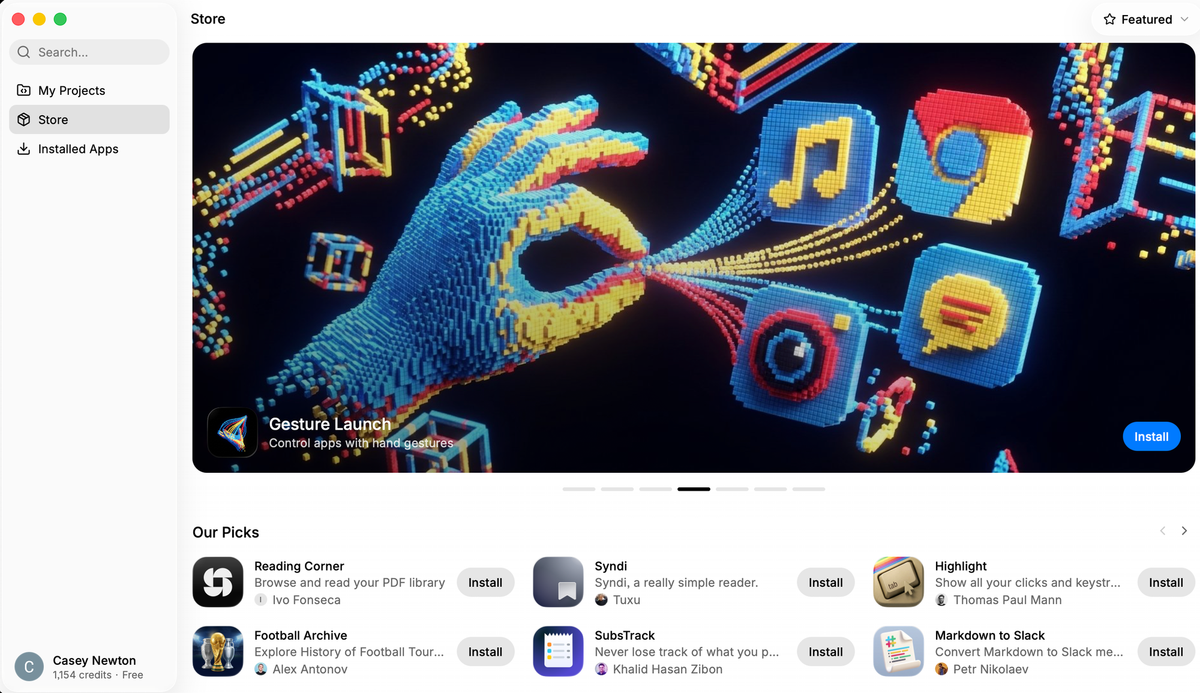
You can publish your app to Glaze’s store if you want, or browse other people’s creations to find inspiration. asserted
you → publish → inspiration
For the most part I have found apps in the store pretty boring — featured suggestions include a PDF reader, a subscription tracker, and a Claude usage monitor. asserted
suggestions → find → reader
At the click of a button, I can generate an image of a Nightwing-esque character doing any task that’s on my list: sending an email, buying groceries, getting an MRI. asserted
that → generate → MRI
When I mark it completed, comic-book-style “boom!” and “pow!” animations fly across my screen. asserted
animations → mark → screen
A widget at the bottom of the app offers a synopsis of a random issue of the Nightwing comic book, while the “issue number” at the top of the app tells me what day of the year it is. Is any of this remotely necessary? asserted
any → offer → this
Does it represent a copyright violation and an indictment of the safety guardrails of the LLM provider I am using to generate these images? asserted
I → represent → images
In the meantime, though, my little app has succeeded where no previous to-do app has to date: making my chores fun. asserted
chores → succeed → date
…and 61 more, not listed.

💬Give feedback
🕘History 🎫Support