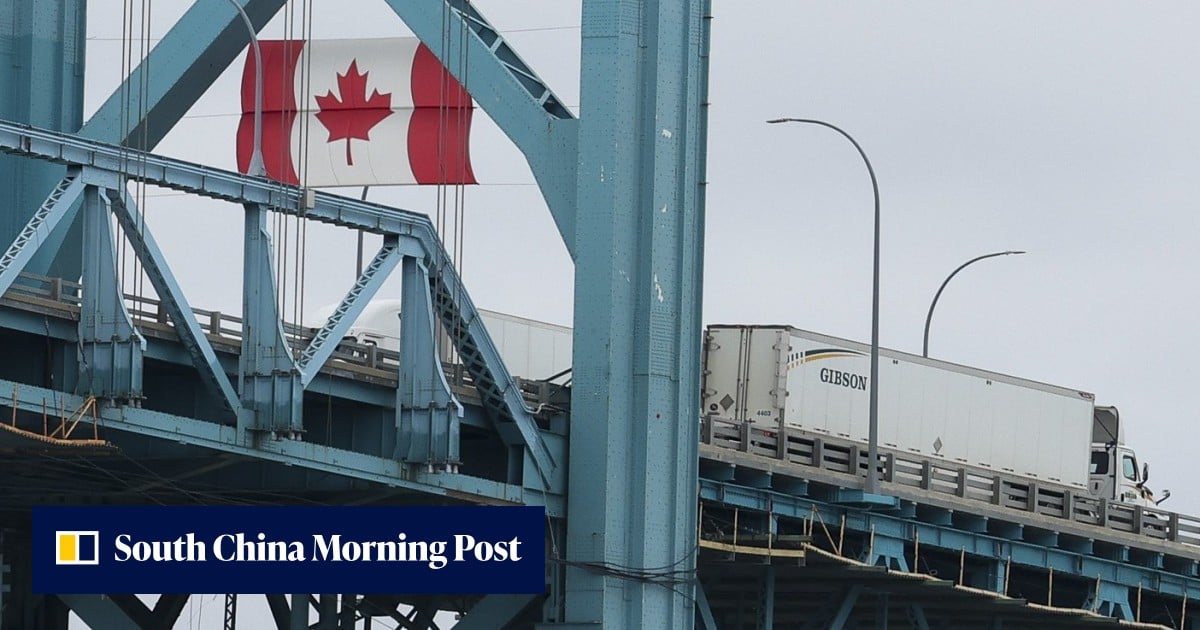
Canadians have spent nearly two years looking for an off-ramp from Donald Trump’s destructive trade war.
asserted
Canadians → spend → war
Last week, American voters finally put up a promising sign.
asserted
voters → put → sign
Democrats won control of both chambers of Congress.
asserted
Democrats → win → Congress
By Sunday, House Democratic leader Hakeem Jeffries foreshadowed action on an issue Canadians would happily see disappear from our new feeds.
asserted
Canadians → foreshadow → feeds
“We need to stop the Trump tariffs,” he told ABC’s This Week, listing them among his party’s affordability priorities.
asserted
he → need → priorities
The trouble is getting it past Mr. Veto.
asserted
trouble → get → Veto
As Ottawa weighs whether to strike a deal with the weakened but not incapacitated president, a friendlier Congress may give our leaders more people to call.
uncertain
Congress → weigh → people
It does not, however, mean they’re going to bend over backwards to help us.
asserted
they → mean → us
Carlo Dade, director of international policy and the New North America Initiative at the University of Calgary’s School of Public Policy, cautions that some of the upcoming drama will be more noise than signal.
asserted
some → caution → signal
“The Democrats will need to signal to voters that they’re taking action, that they’re being decisive,” he told The Hub.
asserted
he → need → Hub
A vote to repeal tariffs is an easy way to create those headlines.
asserted
vote → repeal → headlines
Actually delivering a repeal will be much harder.
asserted
delivering → deliver → repeal
“We have to bear in mind that the math simply isn’t there,” Dade said.
asserted
Dade → have → mind
“So looking for signal out of the noise is going to be difficult.”
Enough votes to challenge, but not enough to override
A bill must pass both the House of Representatives and the Senate before reaching the president.
asserted
bill → look → president
Passage generally requires a simple majority, although most ordinary legislation also needs 60 Senate votes to overcome a filibuster.
asserted
legislation → require → filibuster
If Trump vetoes the bill, the math becomes increasingly difficult.
asserted
math → veto → bill
Overriding him requires two-thirds of members voting in each chamber.
asserted
Overriding → override → chamber
That translates to 67 senators and 290 representatives if everyone votes.
asserted
everyone → translate → senators
Both chambers must clear the threshold.
asserted
chambers → clear → threshold
Democrats fall short in both.
asserted
Democrats → fall → both
Even if they win the two outstanding Senate races, they would still need at least 11 Republican senators to break with Trump.
asserted
senators → win → Trump
In the House, a projected 256 Democratic seats would leave them needing another 34 votes.
asserted
seats → project → votes
That assumes every single Democrat supports repeal.
asserted
Democrat → assume → repeal
House Democratic Leader Hakeem Jeffries, D-N.Y., speaks at a news conference in Washington, Wednesday, Nov. 4, 2026, as Rep. Ted Lieu, D-Calif., vice chair of the House Democratic Caucus, listens.
asserted
Lieu → speak → Caucus
Earlier efforts illustrate the gulf between winning a vote and changing policy.
asserted
efforts → illustrate → policy
In October 2025, the Republican-controlled Senate passed three measures targeting the emergency declarations underpinning Trump’s tariffs on Canada, Brazil, and imports more broadly.
asserted
Senate → control → Canada
Each attracted Republican support, but none became law.
asserted
none → attract → support
Democrats have also targeted Section 338 of the Tariff Act of 1930, another source of presidential tariff power.
asserted
Democrats → target → power
Senators Kirsten Gillibrand and Peter Welch introduced legislation in September to repeal that authority.
asserted
Gillibrand → introduce → authority
Welch tried to fast-track the bill through unanimous consent—a procedure that requires no senator to object.
asserted
that → try → senator
Republican Senator Mike Crapo objected, blocking that route.
asserted
Crapo → object → route
Control of both chambers could now help Democrats get repeal legislation to Trump’s desk.
uncertain
Democrats → help → desk
But a president who has made tariffs his economic calling card is unlikely to sign away the power to impose them.
asserted
tariffs → make → them
“President Trump is already referring to himself as President Veto and has a red ball cap to prove it!” Gitane De Silva, executive director of the University of Alberta’s Peter Lougheed School of Politics and Democracy and a former Alberta representative in Washington, wrote in an email to The Hub.
asserted
Silva → refer → Hub
The noise still matters
De Silva nevertheless sees value in making that opposition heard.
asserted
opposition → matter → value
“I think the ‘noise’ is still important because it does send a ‘signal’ to voters that the Democrats are working on an issue that matters to them: the link between tariffs and affordability.”
There’s a message for Canadians, too.
“It also demonstrates to Canada and other trading partners that not all of the U.S. supports the tariff-first approach,” she wrote.
asserted
she → think → approach
That could improve the atmosphere around negotiations and give Canada hope that tariffs will not last forever.
uncertain
tariffs → improve → hope
Canadians have seen this particular sequel before.
asserted
Canadians → see → sequel
“President Biden didn’t undo the protectionist measures that Trump implemented in his first administration, so we shouldn’t be naive,” De Silva concluded.
asserted
Silva → undo → administration
The sun rises behind the U.S. Capitol, as seen reflected in the U.S. Capitol Reflecting Pool, on Election Day, Tuesday, Nov. 3, 2026, in Washington.
asserted
sun → rise → Washington
…and 41 more, not listed.
 The Aporia