Conservative Party leader Pierre Poilievre suggested this is part of a plot to increase Canada's population to 100 million.
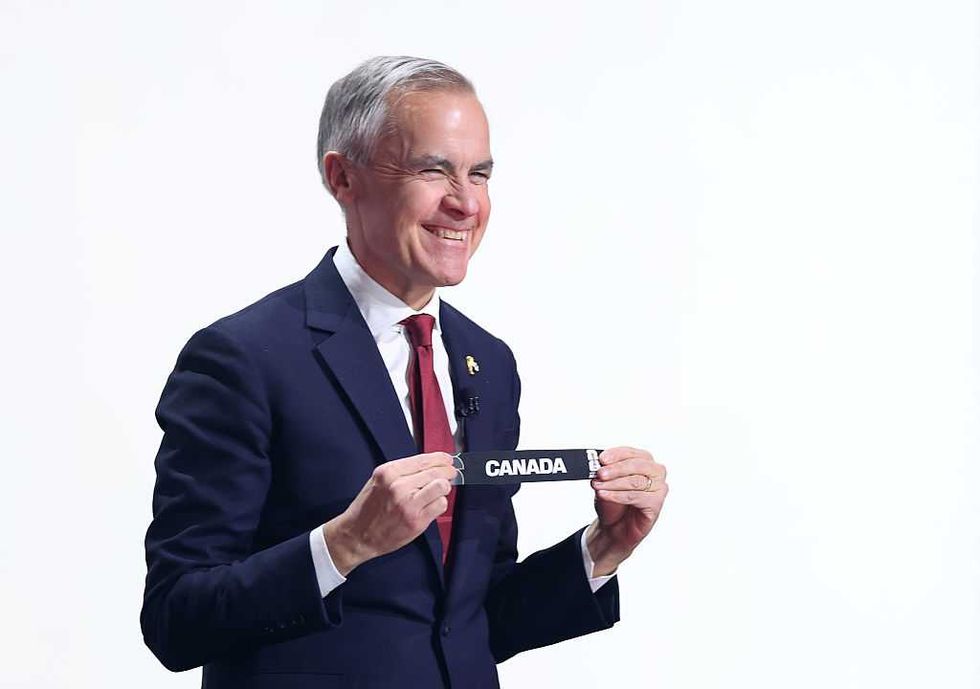
Canadian Prime Minister Mark Carney appears keen to outdo his predecessor's work of making Canada unrecognizable — and conservatives are none too pleased.
uncertain
conservatives → suggest → work
The Carney Liberal government revealed last week in its 2027-2029 Immigration Levels Plan that it intends to import 370,000 new "temporary resident arrivals" and grant permanent residency to 380,000 migrants for each of the next three years.
asserted
it → reveal → years
State media highlighted that the number of permanent residency admissions next year will actually be in the neighborhood of 660,000 as the result of multiple "one-time" measures.
asserted
number → highlight → measures
The Carney government notes in its plan for 2027 that beyond the 380,000 baseline, it will grant permanent residency to 100,000 foreign laborers already in Canada as well as to their families.
asserted
it → note → families
Additionally, the regime will "transition up to 100,000 people" in the so-called "humanitarian cohort" — largely from Ukraine and Hong Kong — to permanent residency.
asserted
regime → transition → residency
Carney, the self-identified "European" World Economic Forum regular who all but guaranteed British economic decline while governor of the Bank of England, told reporters on Friday that he believes these targets are "in line with sustainable immigration" and claimed that the one-time measures planned for 2027 were "the right thing to do."
Getty Images
asserted
measures → identify → 2027
The Conservative Party of Canada, on the other hand, emphasized that "immigration must go WAY down to give relief for our housing, jobs and hospitals."
asserted
immigration → emphasize → housing
Michelle Rempel Garner, a conservative member of the Canadian House of Commons, called for an end to "Carney's mass immigration" and noted that the permanent residency admissions planned for next year amount to "a city roughly the size of Winnipeg."
"This is insane.
asserted
This → call → Winnipeg
Population growth already outstripped housing, health care, and jobs for a decade.
asserted
growth → outstrip → decade
Criminals and terrorists have gotten in through open Liberal borders," said Conservative Party leader Pierre Poilievre.
asserted
Poilievre → get → borders
"And now Carney wants even more numbers?
asserted
Carney → want → numbers
How could Liberals make this mistake?
uncertain
Liberals → make → mistake
Poilievre noted that key individuals in Carney's orbit are involved with the Century Initiative — a movement started in 2014 with the stated aim of boosting Canada's population to 100 million people by 2100.
asserted
individuals → note → 2100
The Century Initiative — whose co-founder Mark Wiseman became Carney's ambassador to the U.S. in February — claims that its plot is about protecting Canadian sovereignty and prosperity, but Poilievre suggested another motivation: "Mass migration makes corporate brokers a lot richer."
uncertain
brokers → become → motivation
The Century Initiative criticized the Carney government's new immigration targets last week for being "below Century Initiative's long-standing benchmark of 1.15 to 1.25 per cent of Canada's population."
asserted
Initiative → criticize → population
The decision to bring millions more foreigners to a country with an estimated population of 41,798,407 — including over 8.3 million immigrants as of 2021 — was announced the same week that Statistics Canada posted a 6.7% unemployment rate and another month of job losses.
asserted
Canada → bring → losses
It also comes one year after the Canadian government released a report admitting that the influx of immigrants has in recent years "accounted for 21% of the overall increase in median house values and 13% of the increase in median rents" in 53 cities with populations exceeding 100,000.
asserted
influx → come → 100,000
Canadian census data from 2021 — the most recent publicly available — also shows that:
- immigrants accounted for 23% of the total population;
- immigrants accounted for roughly 50% of all STEM degree holders;
- migrant men had a higher employment rate and higher labor participation rate than their Canadian-born counterparts;
- immigrants are "more likely to be business owners than the Canadian-born population";
- 10 years after admission, 6.2% of all immigrants and 22.8% of refugees were still on social assistance; and
- 17.6% of the population are second-generation individuals.
According to the Canadian government, India, the Philippines, and China were the top three places of birth among immigrants to Canada.
uncertain
India → show → Canada
In addition to making up roughly 10.7% of the immigrant population, India was the top source country last year for study permit holders and foreign worker permit holders — 24.6% and 28.9%, respectively — as well as for economic permanent resident admissions and sponsored family admissions.
asserted
India → make → admissions
 The Aporia