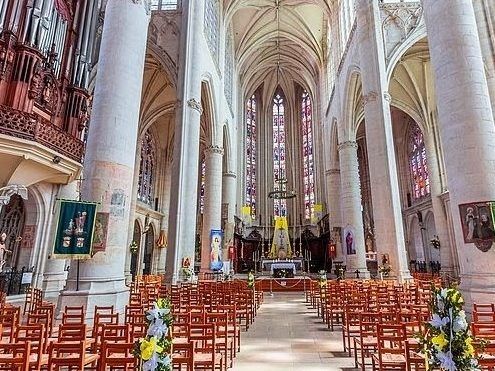
Bone fragments attributed to Saint Nicolas were stolen from a church in France, then allegedly burned and crushed.
uncertain
fragments → attribute → France
Priests at Saint Nicolas de Port, one of France's few sanctuaries to hold a relic of the saint, reported the theft of a reliquary containing a fragment of the saint's body on November 2.
asserted
Priests → hold → November
Police later arrested the suspect, who reportedly admitted acting spontaneously out of a ‘desire to destroy’ the relic because he viewed devotion to the bones as a form of idol worship.
uncertain
he → arrest → worship
Saint Nicolas, the inspiration behind Santa Claus, lived between 270 and 343 AD and is famous for inheriting money, giving it to the poor, and, in particular, for the story of how he gave three girls bags of gold to save them from a life of prostitution.
asserted
he → live → prostitution
Priests with the Saint Nicolas in Lorraine Parish said: 'The police investigation made it possible to identify and arrest the perpetrator.
asserted
it → say → perpetrator
He admitted having broken the display case, then burned and crushed the relic.
asserted
He → admit → relic
'Beyond the heritage value of this object, what touches us today is, above all, a profound attack on our history, our faith and the devotion of generations of pilgrims.'
asserted
touches → touch → pilgrims
The church desecration comes just weeks before the Feast of Saint Nicolas, which marks the anniversary of his death.
asserted
which → come → death
The incident is also the latest in a string of high-profile thefts, vandalism and arson attacks targeting Christian heritage sites across France.
asserted
incident → target → France
St Nicolas, who lived between 270 and 343 AD, is most famous for inheriting money that he gave away to the poor and specifically the story about how he gifted three girls with bags of gold to save them from a life of prostitution
Priests at Saint Nicolas de Port, one of France's few sanctuaries to hold a relic of the saint, reported the theft of a reliquary containing a fragment of the saint's body on November 2
The basilica’s main relic remains in its treasury, housed in an arm-shaped reliquary, according to a November 7 statement from the Association Connaissance et Renaissance de la Basilique, a group dedicated to preserving the building.
uncertain
relic → live → building
The fragment that was destroyed had been installed beneath a statue of Saint Nicolas in the patronal chapel in the early 2000s, the association said.
asserted
association → destroy → 2000s
The basilica is preparing for its annual torchlight procession on December 5, the evening before the Feast of Saint Nicolas.
asserted
basilica → prepare → Nicolas
Celebrated across Lorraine, Belgium and northern Europe, the December 6 festival gives the destruction added significance for communities that honor the saint.
asserted
that → celebrate → saint
That connection began with a journey from southern Italy, where Italian sailors had taken Saint Nicolas’ skeleton in 1087 after removing it from Myra, in what is now Turkey.
asserted
what → begin → Myra
In 1098, a knight named Aubert de Varangéville carried a bone fragment from Bari to Lorraine.
asserted
knight → name → Lorraine
Tradition identifies it as a finger bone from the saint’s right hand, known as the dextre bénissante, or ‘blessing right hand.
asserted
Tradition → identify → bénissante
Pilgrims flocked to the town after the relic arrived, establishing it as an important destination in medieval Europe.
asserted
relic → flock → Europe
Among those who came to pray was Joan of Arc, who visited in 1429 before traveling to Chinon to meet the Dauphin.
asserted
who → come → Dauphin
Priests with the Saint Nicolas in Lorraine Parish said: 'The police investigation made it possible to identify and arrest the perpetrator.
asserted
it → say → perpetrator
He admitted having broken the display case, then burned and crushed the relic'
asserted
He → admit → relic
St Nicolas is the inspiration behind the story of Santa Claus
The saint’s importance to Lorraine grew further after Duke René II defeated Charles the Bold at the Battle of Nancy in 1477.
asserted
II → grow → 1477
The duke named Saint Nicolas the region’s patron saint and commissioned the elaborate Gothic basilica to accommodate his relics.
asserted
duke → name → relics
The basilica endured the Thirty Years’ War, the French Revolution and both world wars.
asserted
basilica → endure → War
During the revolution, its gold reliquaries were melted down and the building was temporarily converted into a ‘Temple of Reason.’
asserted
building → melt → Reason
The history of its sacred relics stretches back to modern-day Turkey, where Saint Nicolas is traditionally believed to have been buried after he died in 343 AD.
asserted
he → stretch → AD
In 2022, researchers announced that excavations beneath St Nicolas Church in Demre had revealed what they believed was the location of his original tomb.
asserted
they → announce → tomb
The Byzantine church (pictured) built over the ancient foundation was a place of worship for Orthodox Christians between the 5th and 12th centuries
The discoveries included flooring from an earlier church beneath the surviving Byzantine building, offering a glimpse of the sanctuary associated with the saint’s lifetime.
asserted
discoveries → picture → lifetime
Osman Eravsar, then head of the provincial cultural heritage preservation board in Antalya, told Demirören News Agency at the time: ‘The first church was submerged with the rise of the Mediterranean Sea, and some centuries later, a new church was built above.
‘Now we have reached the remains of the first church and the floor on which Saint Nicolas stepped,’ he noted.
asserted
he → tell → which
‘The tiling of the floor of the first church, on which Saint Nicolas walked, has been unearthed.’
asserted
Nicolas → walk → which

 The Aporia