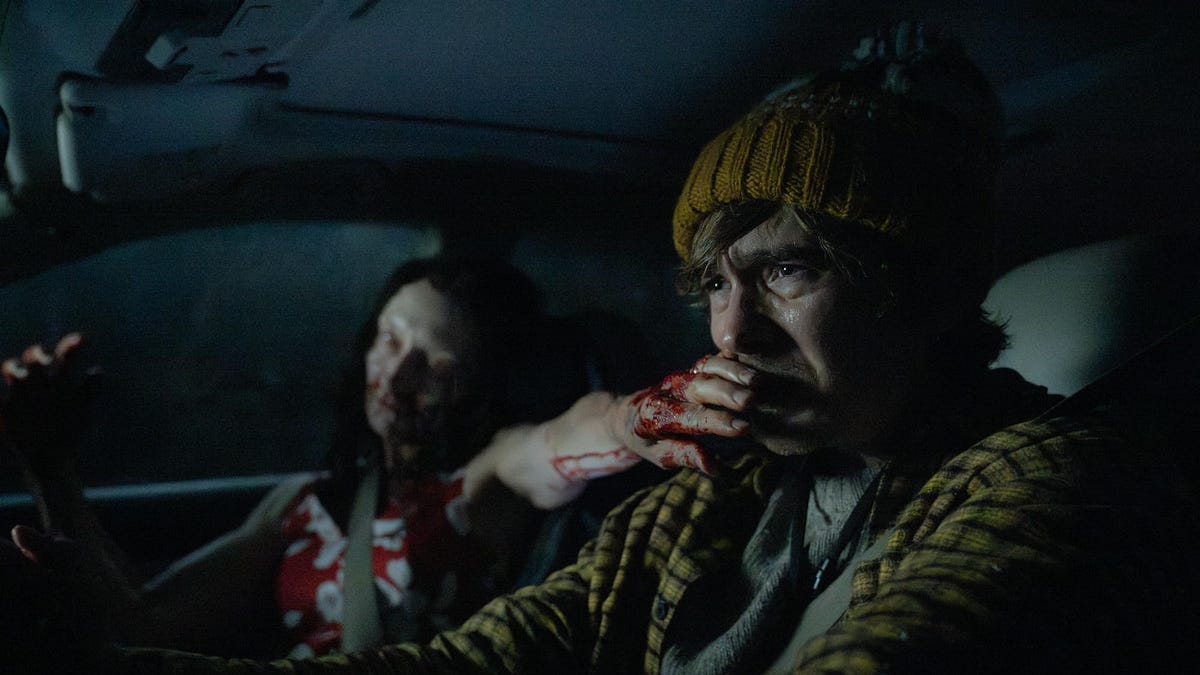
This review discusses the new Resident Evil film directed by Zach Cregger and starring Austin Abrams as Bryan, a medical courier caught in a zombie outbreak. The movie is noted for its gameplay-like structure, where the protagonist's actions mimic those of a novice player trying to survive in a video game. While it lacks complex plotting, the film excels at creating intense action sequences and introduces a terrifying new monster that adds depth to the horror element.
Written by the local model on 2026-09-16,
using this article's own text rather than the other coverage of the
same event (that is the story summary below).
I’VE ALWAYS HAD A SOFT SPOT for the Resident Evil movie series anchored by Milla Jovovich and (often) directed by her husband, Paul W.S. Anderson, even while recognizing that it’s not particularly good.
asserted
it → have → husband
These movies are silly and they have some amusing performances and Anderson has always had a way around a good fight scene or shoot-’em-up sequence, but no one would ever confuse them for high art.
asserted
one → have → art
I don’t know that anyone will confuse Zach Cregger’s new take on the series with high art either—though Caravaggio never had the stones to imagine an acid-vomiting zombie, to his detriment—but Cregger is attempting something relatively audacious.
asserted
Cregger → know → something
He has put together a film based on a video game that feels pretty explicitly like playing that game.
asserted
that → put → game
Which is to say that the action comes at regular, and relentless, intervals, all while our stand-in for the audience, medical courier Bryan (Austin Abrams), does all the things a novice game player would do.
asserted
player → say → things
Shooting in frustration at a padlock you can’t find the key for?
asserted
you → shoot → key
(I don’t think Bryan ever figures out that mechanic in this film-game.)
asserted
Bryan → think → game
Trying to determine how a zombie’s powers work in order to keep from getting killed in unexpectedly horrifying ways?
asserted
powers → try → ways
This is not a movie overly concerned with plotting: In the early moments, we hear Bryan discussing a pregnancy with his girlfriend and this is as close to a motivating factor for him to survive beyond general joie de vivre; a bit later on, we learn what’s in that bag and why the Umbrella Corporation’s doctors need it.
asserted
doctors → hear → it
Mostly, though, we just watch Bryan trying to survive, an effort that becomes increasingly desperate after he’s bitten midway through the film by one of the most disturbing movie monsters I’ve ever seen.
asserted
I → watch → monsters
No spoilers, but it’s pretty horrifying on both a visual and a visceral and an emotional level.
asserted
it → ’ → visual
You’ll notice I’ve mentioned terms like “Raccoon City” and “Umbrella Corporation,” but rest assured that this is not a movie that indulges in too much lore
asserted
that → notice → lore
; one of the problems with Jovovich’s series is that, by the end of it, it was kind of impossible to keep track of who had double-crossed what and when.
asserted
who → keep → what
Here all you need to know is that there’s a zombie outbreak and Bryan’s headed toward the middle of it, trying to stay a tentacle’s-length out of reach at all times.
asserted
Bryan → need → times
Between this, 2022’s Barbarian, and last year’s Weapons, Cregger has demonstrated two things amazingly well.
asserted
Cregger → demonstrate → things
One is that he has a perfect sense for comic-horror timing, that emotional rollercoaster that gorehounds need to ride to keep from getting burned out on thrills and chills.
asserted
gorehounds → have → thrills
Like the previous two entries in his oeuvre, this is a deeply funny movie, and Abrams is perfectly cast as the in-over-his-head Bryan, muttering to himself precisely as a gamer mutters to himself when he’s stuck on a hard level.
asserted
he → cast → level
Just a steady stream of grunts and murmured “shits” and “fucks” and “how do you like thats” to keep from going mad.
asserted
you → murmur → s
Adding to the laughs are top-tier character actors like Paul Walter Hauser and the great Zach Cherry (Severance).
asserted
actors → add → Hauser
The second is that Cregger has mastered the fine art of shooting scenes in the dark in a way that allows us to understand what’s going on.
asserted
what → master → way
This sounds easy but it’s shockingly difficult; so much of modern filmmaking is shot in murky blacks that swallow the action or via the unfortunate use of “day-for-night” tints and filters and color grading.1
asserted
that → sound → tints
Cregger is pretty committed to shooting in darkness with just enough light from naturalistic sources like outdoor streetlights or spotlights on the sides of houses to keep the illumination levels up.
asserted
Cregger → shoot → levels
It’s really appreciated.
asserted
It → appreciate → ?
Just to return, briefly, to this film’s aping of game mechanics: I do think it’s interesting that both this and Exit 8 so explicitly make mimicking authentic gameplay part of the point of the film.
asserted
mimicking → return → film
(It is also, perhaps, telling that both films feature man-child protagonists propelled by news that they may soon be fathers.)
uncertain
they → feature → news
I don’t have a grand theory about this quite yet, except that it’s both a melding of storytelling media and a play on audience expectations/desires.
asserted
it → have → desires
We have reached the point in video game adaptations where the game’s plot matters less than how closely the visuals make it feel like we’re watching a friend play on the couch next to us.
asserted
friend → reach → us
And while we’ve seen this sort of thing in spurts before—e.g., the first-person-shooter sequence in Doom (2005) or the disastrous Hardcore Henry (2016)—it does feel like the emphasis in these adaptations has changed in favor of something approaching “authenticity.”
asserted
emphasis → see → authenticity
God help us when the Leisure Suit Larry series gets greenlit.
asserted
series → help → us
 The Aporia