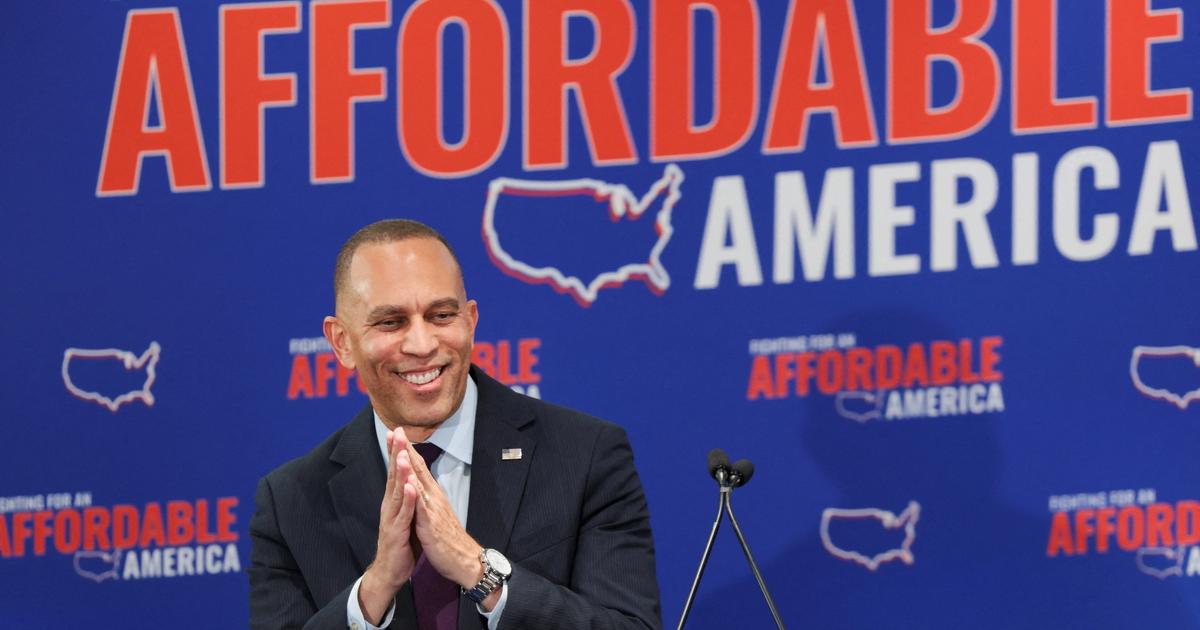
DEMOCRATS HAVE SIGNALED a broad legislative agenda to turn their stunning midterm victory into policy and law.
asserted
DEMOCRATS → signal → policy
Minority Leader Hakeem Jeffries—the presumptive speaker of the House when the Democrats take control in January—has said that the Democratic agenda will include, among other things, reinstating the enhanced Affordable Care Act premium subsidies, reversing Medicaid cuts, limiting the president’s ability to impose global tariffs, and restoring congressional power over trade policy.
asserted
agenda → take → policy
Two glaring problems: First, of course, is the high likelihood that none of it will become law in the face of Donald Trump’s inevitable use of his veto power.
asserted
none → become → power
Second, as ambitious as Jeffries’s legislative agenda may be, it would not significantly rein in a furious Trump who, having lost the ability to act through Congress, will have to rely almost exclusively on the exercise of unilateral presidential actions in order to do anything.
uncertain
who → rein → anything
Trump, who is addicted to attention and being perceived as dominating the national (and world) narrative, has already signaled that he will double down on his promiscuous, norm-busting, and often illegal attempts to push the boundaries of presidential power.
asserted
he → perceive → power
His appointment of Stephen Miller as his new chief of staff is a declaration of war, a middle finger to those who naïvely hope that Trump might have learned something from his midterm shellacking.
uncertain
Trump → hope → shellacking
Miller, the ultimate Trump loyalist, is, as the New York Times put it with considerable understatement, “in a prime position to continue his longtime pursuit of limiting checks on executive power.
asserted
Times → put → power
Congress must now act promptly to limit Trump’s abuse of presidential powers over the next two years, and to rein in future presidents as well.
asserted
Congress → act → presidents
Over the course of decades, Congress has ceded many of its core powers to the executive branch by giving the president broad, undefined emergency powers that might be well suited for a “normal” president, but that give a president with an authoritarian streak arguably legal cover to wreak holy hell on the nation by doing, in Trump’s own words, “whatever I want.”
uncertain
I → cede → whatever
As I wrote a year ago, there oughta be a law.
asserted
I → write → ?
And now that the Democrats have won control of Congress, there can be.
asserted
Democrats → win → Congress
The laws granting emergency authorities to the executive branch were intentionally written in broad, nonprescriptive language, to give presidents the flexibility to respond to unanticipated and unplanned-for events that a slow-moving Congress was not equipped to handle.
But a key lesson from the Trump era is that strategic ambiguity in the granting of emergency powers to the executive branch is dangerous.
asserted
ambiguity → grant → branch
there was a time for it, that time has passed: Trump has turned what once may have been a virtue into undeniably a vice.
uncertain
what → be → vice
Granting presidents the power to declare an “emergency” without ever defining the term, and without being specific about what actions a president may or may not take when he declares an emergency, no longer works.
uncertain
he → grant → emergency
And it has to be reversed by the new Congress—and fast—to put some boundaries on Trump during the next two years.
asserted
it → have → years
This isn’t just a matter of some high-concept concern about the decline of democracy, erosion of the balance of powers, and creeping authoritarianism, although it is certainly all of that.
asserted
it → creep → that
Trump’s exercises of questionable emergency and war-making powers—such as his arbitrary imposition of tariffs to settle scores and bully friends and enemies alike and his unilateral commencement of a war in Iran that shortly turned into a regional war with no end in sight—have had a direct impact on the everyday lives of Americans.
asserted
end → settle → Americans
They have created inflation and exacerbated an affordability crisis that was largely under control when Trump took office.
asserted
Trump → create → office
They have made Americans less safe by undermining our nation’s soft power, giving license to bad actors like Putin, and alienating friends like Canada and virtually all of Europe.
asserted
Americans → make → Europe
They have even led some allies to debate acquiring their own nuclear weapons, and to seek additional nuclear protection from European powers, because they no longer feel confident they can rely on the American nuclear umbrella.
asserted
they → lead → umbrella
You’re already here.
asserted
You → ’re → ?
You’re already reading.
asserted
You → read → ?
You already know what we’re about.
asserted
we → know → what
So why not make it official?
asserted
it → make → ?
Join the side you’re already on.
asserted
you → join → side
WHAT CONGRESS GAVE to the executive branch, it can—and must—take away.
asserted
it → gave → branch
At the very least, Congress must place meaningful boundaries around the ambiguously defined emergency powers it has granted to the president.
asserted
it → place → president
First, it must place reasonable limits on the circumstances under which a president can declare a national emergency.
asserted
president → place → emergency
Put simply, it must define what constitutes an “emergency” and what doesn’t.
asserted
what → put → emergency
Second, it must then be clear about what sorts of actions a president can—and cannot—take once an emergency has been declared.
asserted
emergency → take → actions
Congress can do all of that by passing a single law that I’ll call the Emergency Powers Reform Act (“EPRA”)—but you might think of it as the No Kings Act.1
The first order of business for the EPRA—clarifying the circumstances under which a president can and cannot declare a national emergency—can be accomplished by amending the National Emergencies Act.
uncertain
president → do → Act
The National Emergencies Act grants the president the authority to declare a national emergency to trigger the emergency powers granted by Congress in “any provisions of law conferring powers and authorities to be exercised during a national emergency.”
asserted
Act → grant → emergency
The problem with the existing act is that while it authorizes the president “to declare a national emergency,” it doesn’t define the term “emergency” or say anything at all about what kind of circumstances rise to the level of emergency.
asserted
kind → exist → emergency
It leaves that entirely to the president without any apparent boundaries or guardrails.
asserted
It → leave → boundaries
Would a perceived rise in distrust of election results (likely created systematically by the president himself) constitute a national emergency triggering extraordinary presidential powers?
asserted
rise → perceive → powers
Most likely yes, if the president says so.
asserted
president → say → ?
Would a perceived national malaise that the president believes is inhibiting his agenda be a national emergency?
asserted
president → perceive → agenda
Probably—who’s to say it’s not, given the lack of any definition of what constitutes an emergency and a president’s clear statutory authority to declare emergencies.
asserted
what → ’ → emergencies
Trump has already used numerous national emergency declarations to justify hundreds of actions, including immigration measures, sweeping tariffs, and energy deregulation that, without emergency powers granted to him by Congress, would have required congressional approval or lengthy regulatory review.
asserted
that → use → approval
While the courts have blocked some of the actions Trump has purported to take in response to a declared national emergency, none of the cases were decided on the basis of a finding that Trump improperly declared an emergency.
asserted
Trump → block → emergency
…and 43 more, not listed.
 The Aporia