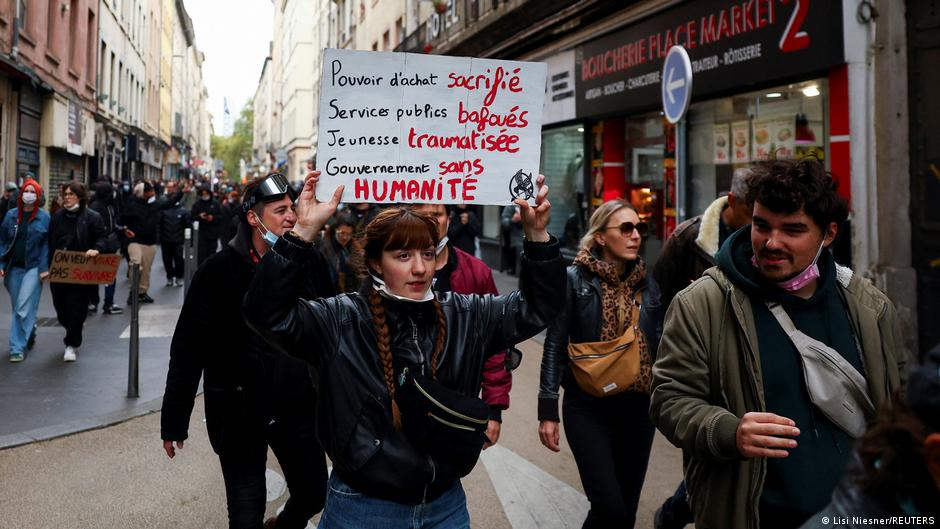
Deeply indebted, politically trapped in a standoff between extremes and led by a government without a parliamentary majority: These are the defining features of France's current predicament.
asserted
These → indebte → predicament
If, in response to nationwide protests, the government plans to provide €4 billion ($4.48 billion) in low-interest loans to renovate schools by 2030 and allocate a further €1 billion to universities by 2029, it is promising money the state simply does not have.
asserted
state → plan → money
France's public debt stands at around 120% of gross domestic product (GDP).
asserted
debt → stand → product
Germany still enjoys the highest possible AAA credit rating.
asserted
Germany → enjoy → rating
France, by contrast, is rated AA, A+ or Aa3, depending on the credit agency.
asserted
France → rat → agency
While Germany's outlook is consistently rated as stable, several agencies have assigned France a negative outlook.
asserted
agencies → rat → outlook
As a result, the French government must pay higher interest rates on its borrowing than Berlin.
asserted
government → pay → Berlin
The risk premium over German government bonds, known as the spread, is now at its highest level since the financial crisis.
asserted
premium → know → crisis
France pays nearly 1.6 percentage points more in interest than Germany on 10-year bonds.
asserted
France → pay → bonds
The spread acts as a kind of fever gauge for bond markets, explains Friedrich Heinemann, an economist at the Leibniz Center for European Economic Research (ZEW) in Mannheim.
"
asserted
Heinemann → act → Mannheim
This fever gauge then forces a change of course.
asserted
gauge → force → course
If the spread rises too sharply, France's financing conditions come under pressure, and anyone in France who needs a loan has to pay higher interest rates.
asserted
who → rise → rates
Banks then get into trouble, and the crisis escalates further," Heinemann told DW.
asserted
Heinemann → get → DW
"This could then slide towards a financial crisis, which would finally send a clear signal to everyone: Things cannot continue like this unless you are prepared to risk a genuine economic collapse," he explained.
uncertain
he → slide → collapse
Landry Charrier, a researcher at the University of Bonn's Center for Advanced Security, Strategic and Integration Studies, however, does not expect France's debt-fuelled spending spree to end anytime soon.
asserted
spree → expect → Studies
But debt remains an abstract concept if its consequences are barely felt in everyday life.
asserted
consequences → remain → life
According to INSEE (the French national statistics agency — the ed.), 56% of the population receive more in government benefits and services than they pay in taxes and social contributions.
uncertain
they → accord → taxes
The majority therefore have a tangible interest in maintaining the status quo," Charrier told DW.
asserted
Charrier → have → DW
For more than half a century, France has regularly spent more than it collects in tax revenue.
asserted
it → spend → revenue
The last time it balanced its national budget was in 1974.
asserted
it → balance → 1974
Echoes of the eurozone crisis
France last paid a similarly high-risk premium at the end of 2011, during the eurozone debt crisis.
asserted
France → pay → crisis
What is particularly striking is how quickly it has risen: Since June 2026, the spread over German government bonds has more than doubled.
asserted
spread → rise → bonds
Rather, it's the growing risk premium investors demand in response to high debt levels, political instability, large budget deficits and therecent unrest.
asserted
investors → grow → levels
The higher the interest rates, the larger the share of the national budget that must be devoted to debt servicing alone.
asserted
that → devote → servicing
France is expected to pay more than €79 billion in interest on its total public debt in 2026.
asserted
France → expect → 2026
That figure is projected to exceed €91 billion in 2027 and could reach between €125 billion and €132 billion by 2030.
uncertain
figure → project → 2030
These figures include the costs incurred by social security funds and local authorities.
asserted
figures → include → funds
The central government's interest bill alone is currently estimated at €62.6 billion by the Agence France Trésor, a French Treasury agency.
asserted
bill → estimate → Trésor
In the coming years, France will have to refinance large amounts of outstanding bonds that were issued when interest rates were at historic lows.
asserted
rates → have → lows
At the same time, the country's substantial budget deficit means it must take on additional debt.
asserted
it → mean → debt
A warning shot for Germany
The trend of rising interest costs is also affecting Germany.
asserted
trend → rise → Germany
The ZEW's Heinemann has calculated that German interest payments are likely to increase sharply by the early 2030s.
asserted
payments → calculate → 2030s
"For the federal government alone, which has so far paid around €30 billion, the figure will triple within a few years as both debt and interest rates rise.
asserted
debt → pay → years
And it won't stop there — it will exceed €90 billion.
asserted
it → stop → billion
Reaching €100 billion in annual interest payments in the federal budget is then no longer far off," warns the Mannheim-based economist.
asserted
economist → reach → budget
In France, however, economic realities seem to have little impact on political debate.
asserted
realities → seem → debate
Both the far-right National Rally (RN) and the far-left La France insoumise (LFI) are campaigning on costly promises.
asserted
Rally → campaign → promises
RN leader Marine Le Pen, for example, wants to reinstate the retirement age of 62 while promising €140 billion in savings.
asserted
Pen → want → savings
Jean-Luc Mélenchon, LFI's leader, has even suggested that government bonds held by the French central bank should be "thrown into the fire."
uncertain
bonds → suggest → fire
"Nobody will ever notice they've disappeared," he claims.
uncertain
he → notice → ?
…and 8 more, not listed.
 The Aporia