Photo via Times of India

British man’s £180,000 will on fish box and mince pie packet ruled valid

Read the original at Times of India ↗
Cite

TOI World Desk. (2026, November 3). British man’s £180,000 will on fish box and mince pie packet ruled valid. Times of India. https://timesofindia.indiatimes.com/world/uk/a-british-man-left-his-180000-estate-to-a-diabetes-charity-in-a-will-written-on-a-frozen-fish-box-and-a-mince-pie-packet-the-high-court-later-ruled-it-was-valid/articleshow/135487824.cms

Dated from the outlet's own feed. Check the original for its byline.

Times of India · collected 2026-11-03 · by TOI World Desk

Quick Summary

Malcolm Roy Chenery, a resident of York, England, wrote his will on food packaging—specifically, cardboard from a frozen fish box and a mince pie packet—and it was recently upheld by the High Court. The handwritten will, drafted shortly before Chenery’s death in May 2021, left an estate valued at approximately £180,000 to Diabetes UK. The court had to determine if two separate pieces of cardboard could legally constitute a single valid will under English law, ultimately deciding in favor of the unusual document's validity.
Written by AI on 2026-11-03, from this article's own text only (the story summary below draws on all the coverage).

AI analysis

Story summary

On November 3, 2026, the High Court in Britain ruled that a man's handwritten will, drafted on the cardboard packaging of a frozen fish box and a mince pie packet, is valid. The unusual will left £180,000 to Diabetes UK, with additional items such as ornaments and pottery going to the Hornsea Collector’s Society. Malcolm Roy Chenery, who lived in York, England, wrote his final wishes on two pieces of food packaging shortly before his death in May 2021. The will's validity was questioned due to its unconventional format, but the court decided it met legal requirements for a valid testamentary document despite being drafted on everyday objects.

Written for “British Will On Junk Mail Validated” on 2026-11-03, grounded in this article and the 0 other(s) covering the same event.
Why this leaning score
This article does not take a side on a contested political question, so it has no leaning score. That is an answer rather than a gap: a match report or a rescue can be warmly or critically written without being left or right, and scoring it anyway is how approval of a subject gets recorded as a political position.
No political leaning scored for article 125099 · logged 2026-11-03

Story

📰 British Will On Junk Mail Validated
Other · 1 article(s) covering the same event.

Compared with similar articles

Nothing to compare against. No article is close enough to this one for the pipeline to have linked or judged the pair.
How this article was measured signals, leaning charts, publisher record, byline, topics and claims

Signals How these are calculated →

Claims extracted
38
sentences that state something as happening or true
Uncertain
24%
9 of 38 hedged ("reportedly", "may", "according to")
Leaning
not political
takes no side on a contested political question
Publisher signals
59/100
Times of India's corrections and hedging, across everything collected from it. Not a measure of accuracy.
Outlets on this story
1
Other
Same framing elsewhere
1
articles that frame the event the way this one does
Analyzed 2026-11-03 · how these are computed

How this is being covered How these are calculated →

Article leaning vs. publisher reliability
Source leaning vs. consistency

Publisher

Times of India · 4006 article(s) · 4 correction(s) detected
Running correction rate · 4 correction(s)

Who wrote this

TOI World Desk
1391 article(s) here · 1 carrying a prediction
🔮 For someone passing through a cemetery, a lantern or a plant might appear to be an ordinary possession.
🔮 A British man’s handwritten will, drafted on the cardboard packaging of a frozen fish box and a mince pie packet, has been ruled valid by the High Court, clearing the way for a diabetes charity to inherit his estate worth approximately £180,000.
🔮 Instead of sweeping past to look for younger animals, they paused, took a closer look, and asked shelter staff if they could meet Herbie in person.
🔮 He realised that it could be one of the fish released as part of the competition.
🔮 When Judge Judy Sheindlin and her daughter Nicole Sheindlin launched Her Honor Mentoring in 2006, it began with a modest group of eight or nine high-school girls and a simple belief: a trusted professional woman could help a young person see a wider future for herself.
🔮 A subsequent report by Hoodline said the event included remarks from Mayor Stephen Tyler Holman, City Manager Darrel Pyle, artist Ken Hall Jr. and Derek Vosten, among others.
🔮 Those allegations could remain in the complaint as background and evidence.
🔮 His application raised a question that had not previously been tested in court on St Helena: could someone acquire government-owned land simply by occupying it for 15 years?
🔮 The restored property will take time to develop into a mature habitat, but the project offers an example of how privately owned agricultural land can contribute to biodiversity recovery.
🔮 The return of these mammals is therefore expected to benefit more than just the animals themselves.
Wire or desk byline, not an individual reporter.
Also by TOI World Desk
Nothing else under this byline is closely related to this article, so these are simply their most recent.
All 1391 articles by TOI World Desk →

Topics

British Diabetes UK York the High Court the Hornsea Collector’s Society

Subjects

Chenery PERSON · 7× Diabetes UK ORG · 3× the Hornsea Collector’s Society ORG · 3× the High Court ORG · 2× British NORP · 1× England GPE · 1× Malcolm Roy Chenery PERSON · 1× York GPE · 1× Young ORG · 1× the British Diabetic Association ORG · 1×

Narrative

A British man’s handwritten will, drafted on the cardboard packaging of a frozen fish box and a mince pie packet, has been ruled valid by the High Court, clearing the way for a diabetes charity to inherit his estate worth approximately £180,000.
framing: mixed · carried by 1 article(s) · first seen 2026-11-03
🔮 A British man’s handwritten will, drafted on the cardboard packaging of a frozen fish box and a mince pie packet, has been ruled valid by the High Court, clearing the way for a diabetes charity to inherit his estate worth approximately £180,000.

Claims (38 extracted, 9 hedged)

A British man’s handwritten will, drafted on the cardboard packaging of a frozen fish box and a mince pie packet, has been ruled valid by the High Court, clearing the way for a diabetes charity to inherit his estate worth approximately £180,000. asserted
charity → draft → estate
Malcolm Roy Chenery, who lived in York, England, recorded his final wishes on two separate pieces of food packaging shortly before his death in May 2021. uncertain
who → live → May
His estate included a three-bedroom house, money, jewellery and a large collection of ornaments and pottery. asserted
estate → include → ornaments
He named the British Diabetic Association, now known as Diabetes UK, as a principal beneficiary, while allocating his ornaments and pottery to the Hornsea Collector’s Society. asserted
He → name → Society
The unusual format prompted legal questions over whether the two pieces constituted one valid will. asserted
pieces → prompt → will
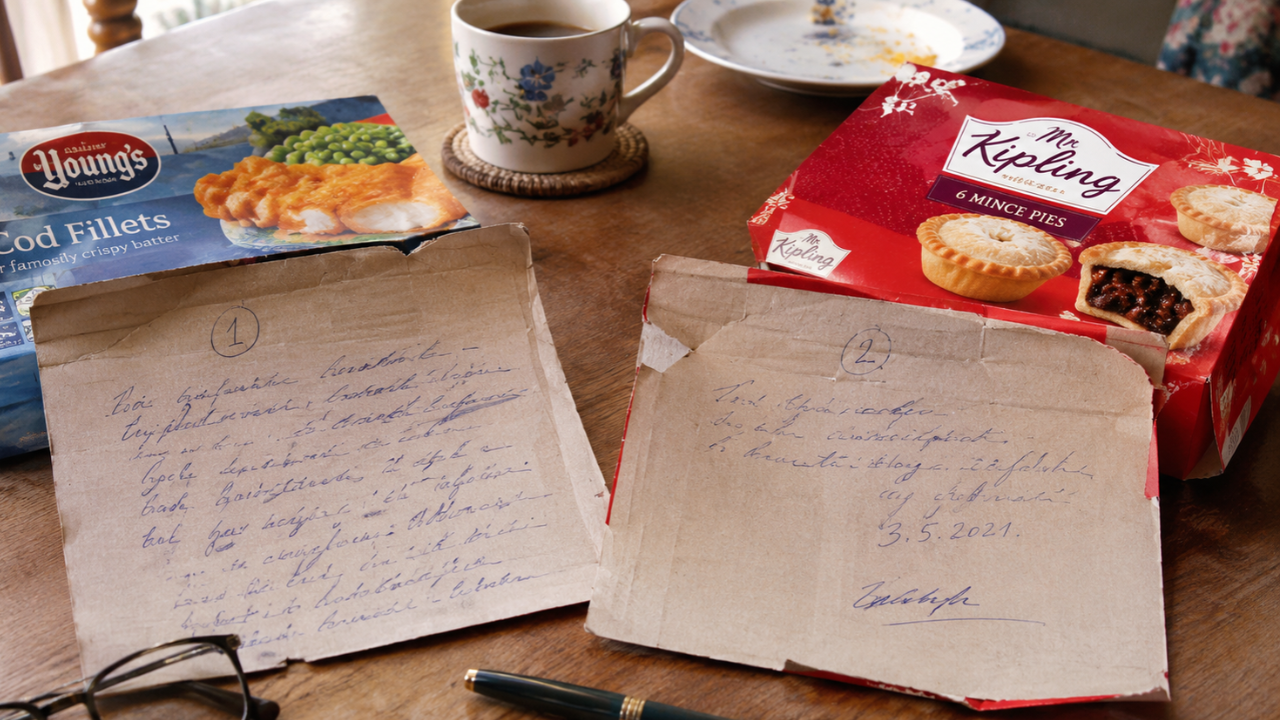
How a frozen fish box and mince pie packet became a £180,000 will Chenery wrote the first part of his will on the back of a Young’s frozen fish fillets box and the second on cardboard from a Mr Kipling mince pie packet. asserted
Chenery → become → packet
The pieces were small, measuring approximately 15 by 20 centimetres, and the writing appeared on their plain inner sides. asserted
writing → measure → sides
The first piece, marked “1”, set out instructions concerning his house, bank accounts and household contents, which he wanted to leave to the “Diabetic Society”. asserted
he → mark → Society
It also specified that his ornaments and pottery should go to the Hornsea Collector’s Society. asserted
ornaments → specify → Society
The second piece, numbered “2”, carried his signature and the date 3 May 2021. uncertain
piece → number → signature
Two neighbours also signed it as witnesses that day. asserted
neighbours → sign → witnesses
Chenery died the following day. asserted
Chenery → die → ?
What did the £180,000 estate include? asserted
estate → include → What
The estate was valued at approximately £180,000 and included Chenery’s three-bedroom house, money, jewellery and personal possessions. asserted
estate → value → house
His handwritten instructions divided the intended gifts between Diabetes UK and the Hornsea Collector’s Society. asserted
instructions → divide → UK
The charity was the principal beneficiary, while the collectors’ society was named to receive the ornaments and pottery. asserted
society → name → ornaments
The documents also recorded his wishes concerning his funeral. asserted
documents → record → funeral
Chenery requested cremation and wanted his ashes buried or scattered at York Cricket Club, a place associated with happy memories of spending time there with his mother. asserted
ashes → request → mother
Why did the unusual will end up in court? asserted
will → end → court
The dispute centred on whether the two pieces of cardboard could legally be treated as a single will. uncertain
pieces → centre → will
Although the documents were numbered consecutively and dealt with connected aspects of his estate, they came from different food packages. asserted
they → number → packages
The neighbours who witnessed the second piece could not recall seeing the first when they signed. uncertain
they → witness → first
This raised questions about whether the two pieces together met the requirements for a valid will under English law. asserted
pieces → raise → law
Diabetes UK sought to have both pieces admitted to probate as Chenery’s final will. asserted
pieces → seek → will
If the court had rejected the documents, his estate would instead have been distributed under the rules governing intestacy, which apply when someone dies without a valid will. asserted
someone → reject → will
Why did the charity argue that the two pieces belonged together? asserted
pieces → argue → ?
The charity’s barrister, Sam Chandler, argued that the two pieces were part of the same document. asserted
pieces → argue → document
Both had been written in the same pen, appeared to have been produced at the same time and contained overlapping subject matter. asserted
Both → write → matter
The claim also had support from members of Chenery’s family, some of whom explained that diabetes had affected relatives. uncertain
diabetes → have → relatives
This helped establish why the charity might have been a meaningful beneficiary for him. uncertain
charity → help → him
Although one sister had initially raised concerns about the circumstances, she later indicated that she would not actively oppose the claim and would leave the decision to the court. uncertain
she → raise → court
What did the High Court rule? asserted
Court → rule → What
On 8 November 2024, Master Katherine McQuail of the High Court’s Chancery Division ruled that the two pieces of cardboard should be admitted to probate as Chenery’s last will. asserted
pieces → rule → will
The court considered the requirements of the Wills Act 1837, including whether the documents could be treated as one testamentary document and whether the necessary formalities had been met. uncertain
formalities → consider → document
The judge accepted that the pieces were connected and reflected Chenery’s intention to distribute his possessions. asserted
pieces → accept → possessions
The court also considered the principle that a person should not be presumed to have intended to die intestate when the evidence indicates a clear intention to make a will. asserted
evidence → consider → will
It concluded that the two pieces should be admitted to probate, allowing the estate to pass in accordance with his wishes. asserted
estate → conclude → wishes
The decision was reported in November 2024 and meant Diabetes UK could proceed with the legacy. uncertain
UK → report → legacy

💬Give feedback
🕘History 🎫Support