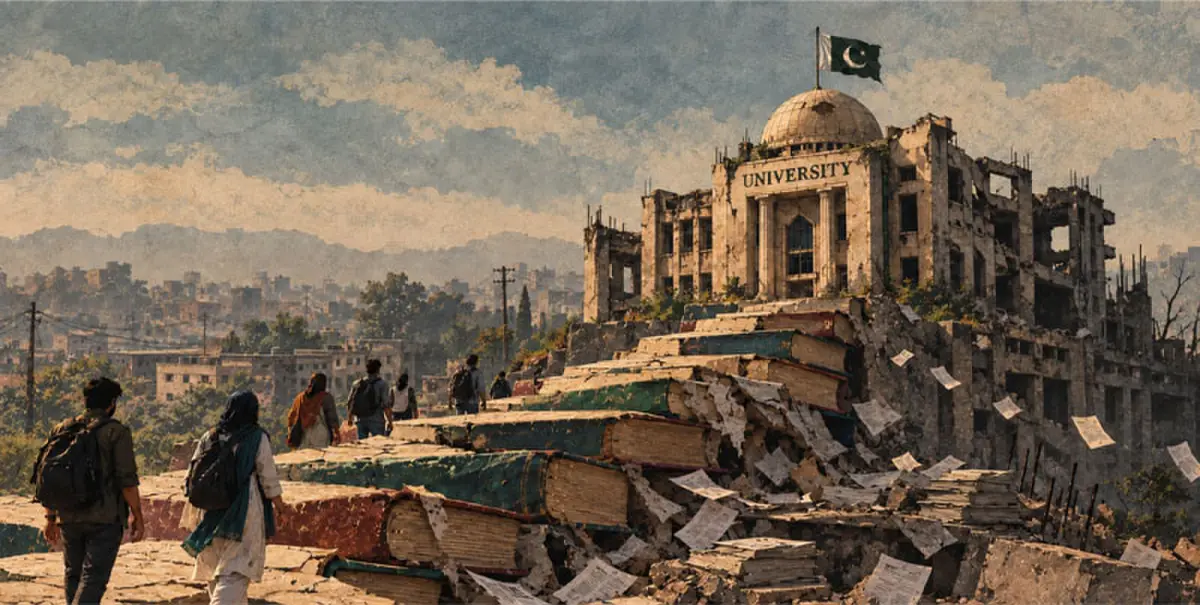
Twenty-four years ago, on September 11, 2002, Gen Pervez Musharraf signed the Higher Education Commission Ordinance that formally launched Pakistan’s ground-breaking higher education reforms.
asserted
that → sign → reforms
This legislation dissolved the University Grants Commission and, in its place, created the Higher Education Commission (HEC) with vast regulatory, financial and administrative autonomy, and an express mandate to restructure the national higher education system and set Pakistan on course to become a knowledge economy.
asserted
legislation → dissolve → course
Over the next five years, the budget allocation for higher education went up by 5,000 percent.
asserted
allocation → go → percent
Billions were poured into setting up new universities.
asserted
Billions → pour → universities
A landmark agreement was negotiated with the US to launch what was then considered the world’s largest Fulbright scholarship programme, worth $150 million.
asserted
what → negotiate → US
Some 5,000 PhD level scholarships were announced for foreign universities, the largest such programme undertaken by a developing country, as well as 3,000 indigenous scholarships.
asserted
scholarships → announce → country
A tenure track system with very competitive salaries was launched to attract and retain the finest academics.
asserted
system → launch → academics
To term these plans ‘ambitious’ would be an understatement.
asserted
term → term → plans
Other countries sat up and took notice.
asserted
countries → sit → notice
Professor C.N.R. Rao, former chairman of India’s Scientific Advisory Council, told former Indian prime minister Manmohan Singh in 2006, “Science is a lucrative profession in Pakistan.
asserted
Science → tell → Pakistan
It has tripled the salaries of its scientists in the last few years.”
asserted
It → triple → years
This was reported in the Hindustan Times and this particular story carried the by-line: “Pakistan may soon join China in giving India serious competition in science.”
uncertain
Pakistan → report → science
Launched in 2002 with unprecedented funding and ambitious reforms, Pakistan’s higher education experiment once attracted international attention.
asserted
experiment → launch → attention
Today, Pakistan has nearly 280 universities, millions of students and a rapidly expanding research output.
asserted
Pakistan → have → students
Yet, beneath the impressive statistics lies a system struggling with mounting debts, poor educational outcomes and questionable scholarship.
asserted
system → lie → debts
What has gone wrong?
asserted
What → go → ?
Large-scale academic delegations from Bangladesh have visited Pakistan frequently over the last two years, touring our universities, building institutional ties and doing homework for their own reforms.
asserted
delegations → visit → reforms
In 2025, Bangladesh’s Ministry of Education released the draft Higher Education Commission Ordinance, explicitly modelled on our framework.
asserted
Ministry → release → framework
It was an auspicious start, but it was not to last.
asserted
it → last → ?
Within a decade, the HEC’s autonomy was challenged and higher education funding was dramatically slashed.
asserted
funding → challenge → decade
In an earlier piece, we tracked the collapse of Pakistan’s tenure track system and the mass exodus of Pakistan’s best and brightest academics.
asserted
we → track → academics
Now, as our higher education experiment enters its 25th year — its silver jubilee — it is time to ask the big questions: where do we stand today? What have we accomplished? What mistakes have we made?
asserted
we → enter → mistakes
And, most importantly, how do we move ahead?
asserted
we → move → ?
Here is a look at the good, the bad and the ugly in the wide-ranging landscape of our higher education system today.
asserted
look → range → system
LET A THOUSAND UNIVERSITIES BLOOM
asserted
UNIVERSITIES → let → BLOOM
As per HEC data, in 2001-2002, we had a total of 58 higher education institutions in the country.
asserted
we → have → country
This count almost doubled to 116 in 2005-2006 and crossed the 200 mark in 2017-2018.
asserted
count → double → 2017
As per the Pakistan Economic Survey 2025-26, we now have 278 universities, an increase of almost 400 percent, an unprecedented achievement.
asserted
we → have → percent
Leading Pakistani institutions now routinely feature in international university rankings.
asserted
institutions → lead → rankings
Exact positions tend to fluctuate year by year — and we seem unable to break into the global top-350 universities category — but it is most definitely a win.
asserted
it → tend → category
Student enrolments have similarly skyrocketed, from around 276,000 in 2001-2002 to more than two million in 2023-2024, an increase of more than 600 percent.
asserted
enrolments → skyrocket → percent
Moreover, in 2002, student enrolments were split with 63 percent males to 37 percent females.
asserted
enrolments → split → females
By 2025, this gender gap had almost hit parity, with 52 percent males versus 48 percent females.
asserted
gap → hit → females
Another very remarkable milestone is that in our first 54 years of Independence (up to 2002, when our higher education reforms were launched), Pakistan had produced almost 3,000 PhDs.
asserted
Pakistan → launch → PhDs
Now we produce more than 3,000 PhDs in a single year.
asserted
we → produce → year
This also reflects in our academic publication count, which has simply exploded.
asserted
which → reflect → count
Our global academic publication count ranking has climbed from 51 to 26 in 25 years.
asserted
ranking → climb → years
As per the SCImago database, Pakistan’s indexed publications increased from approximately 1,600 in 2002 to over 45,000 in 2025.
asserted
publications → index → 2025
This March, the HEC formally honoured over a thousand Pakistani researchers featured in a list (curated by Stanford University) of the world’s top two percent scientists.
asserted
HEC → honour → scientists
Very few countries can claim such incredible progress in so short a period of time.
uncertain
countries → claim → time
…and 127 more, not listed.
 The Aporia