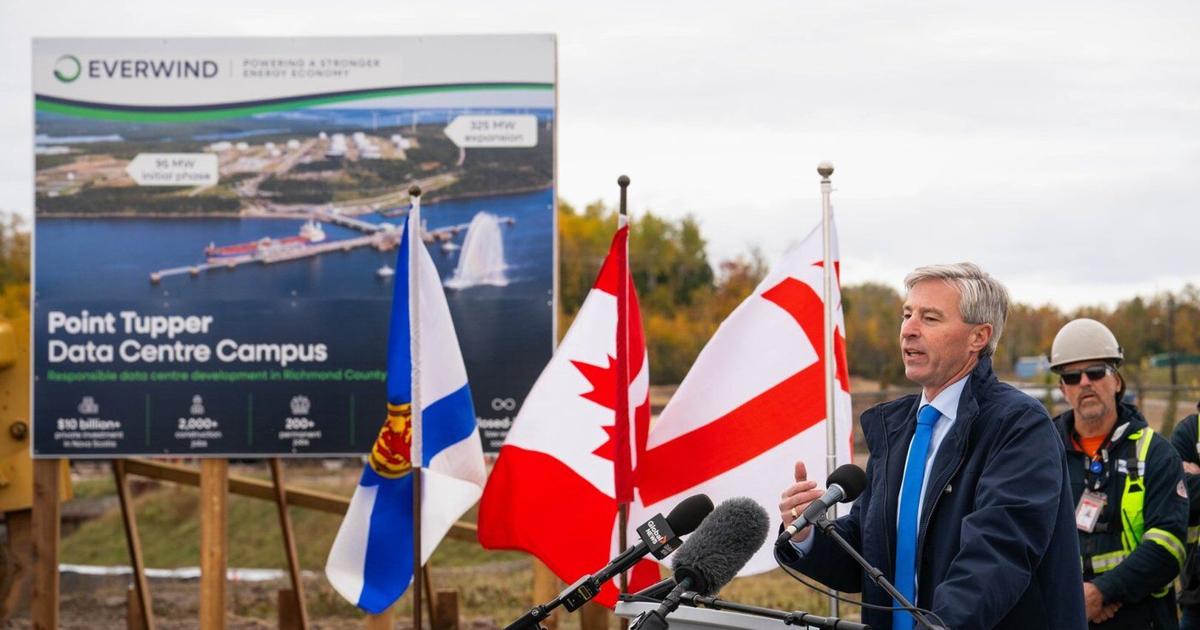
Photo via CBC News

Companies building AI data centres in communities are promising big economic benefits. Will they deliver?

Read the original at CBC News ↗
Cite

Lam, A. (2026, November 2). Companies building AI data centres in communities are promising big economic benefits. Will they deliver? CBC News. https://www.cbc.ca/news/canada/nova-scotia/data-centres-economic-benefits-9.7397675?cmp=rss

Dated from the outlet's own feed. Check the original for its byline.

CBC News · collected 2026-11-02 · by Andrew Lam

Quick Summary

Companies planning AI data centre campuses in Canada are promising significant economic benefits such as job creation and tax revenue. EverWind Fuels forecasts 115 permanent jobs and $1.5 billion in taxes over 20 years from a proposed data centre in Nova Scotia, while Bell projects hundreds of jobs from an expansion in Saskatchewan. However, academic research suggests these promises may be overstated, with actual benefits modest and unevenly distributed across urban and rural areas. A study by Daniel Yue at Georgia Institute of Technology found employment increases of about 3.5% and wage gains of around 5% over five years but noted limited impact on rural economies.
Written by AI on 2026-11-02, from this article's own text only (the story summary below draws on all the coverage).

AI analysis

Story summary

Companies building AI data centres in Canadian communities are promising significant economic benefits, including job creation and increased tax revenue. For instance, EverWind Fuels forecasts 115 permanent jobs and $1.5 billion in provincial corporate income tax over a 20-year period for its proposed 420-megawatt data centre campus in Nova Scotia. However, academics like Georgia Institute of Technology assistant professor Daniel Yue warn that the economic benefits may be spread across a broader region while costs such as power usage and land use disproportionately affect local communities. This raises questions about the realism of these companies' promises regarding immediate economic gains for the specific areas where these data centres are built.

Written for “AI Data Centre Promises Economic Benefits” on 2026-11-03, grounded in this article and the 0 other(s) covering the same event.
Why this leaning score
The model judged this article politically coded and scored it -0.35, but none of the 2 quote(s) it offered could be found in the article text, so the score is not published.
Written under an earlier scoring contract, which gave a paragraph rather than checkable quotes. Re-analysing this article replaces it.
Leaning score withheld for article 123721: no verified evidence · logged 2026-11-02

Story

📰 AI Data Centre Promises Economic Benefits
Economy/Business · 1 article(s) covering the same event.

Compared with similar articles

This article reads unscored and hedges 13% of its claims. Each row says how that neighbour differs.
CBC News
Hedges 0 of 23 claims Outlet record 74/100
“Article A discusses criticism of a professor's comments about an AI data centre, while Article B focuses on economic promises made by companies building such centres.”
Washington Examiner
Hedges 2 of 2 claims Outlet record 70/100
“The articles discuss different aspects of AI's economic impact without referencing the same specific incident or time.”
Semafor
⚖️ Leans left Hedges 0 of 5 claims Outlet record 59/100
“The articles discuss different aspects of AI and data centers; one focuses on voter sentiment towards regulation in the US, while the other examines economic promises of AI data centers in Canada.”
National Post
⚖️ Leans right Hedges 5 of 25 claims Outlet record 60/100
“The articles discuss different aspects of AI, one focusing on national security threats and the other on economic benefits from AI data centers.”
Toronto Star
⚖️ Leans left Hedges 6 of 61 claims Outlet record 64/100
“The articles discuss different aspects of data center construction and impact, with Article A focusing on a political debate before midterm elections in the US, while Article B focuses on economic benefits promised by AI data centers being built in Canada.”
Semafor
⚖️ Leans left Hedges 0 of 3 claims Outlet record 59/100
“The articles discuss different topics related to AI investments and data centers in Canada, but do not describe the same specific incident.”
New York Post
⚖️ Leans strongly right Hedges 3 of 55 claims Outlet record 66/100
“The articles discuss different perspectives on AI data centers, with Article A focusing on the broader implications of shunning or embracing them and comparing to the UK, while Article B focuses specifically on economic promises made by companies building data centers in Canada.”
Al Jazeera
⚖️ Leans left Hedges 5 of 65 claims Outlet record 60/100
“The articles discuss different companies and locations regarding electricity contracts for nuclear power and economic benefits of AI data centers, respectively.”
Toronto Star
Hedges 4 of 67 claims Outlet record 64/100
“While both articles discuss the same company and data center plans, they are not reporting on the exact same incident or time frame.”
Mother Jones
⚖️ Leans strongly left Hedges 6 of 34 claims Outlet record 60/100
“The articles discuss different aspects of AI data centers; one covers a political debate and heckling incident, while the other discusses economic promises made by companies building such centers.”
How this article was measured signals, leaning charts, publisher record, byline, topics and claims

Signals How these are calculated →

Claims extracted
31
sentences that state something as happening or true
Uncertain
13%
4 of 31 hedged ("reportedly", "may", "according to")
Leaning
withheld
no quote in the article backed the model's score
Publisher signals
74/100
CBC News's corrections and hedging, across everything collected from it. Not a measure of accuracy.
Outlets on this story
1
Economy/Business
Same framing elsewhere
1
articles that frame the event the way this one does
Analyzed 2026-11-02 · how these are computed

How this is being covered How these are calculated →

Article leaning vs. publisher reliability
Source leaning vs. consistency

Publisher

CBC News · 1815 article(s) · 5 correction(s) detected
Running correction rate · 5 correction(s)

Who wrote this

Andrew Lam
1 article(s) here · 1 carrying a prediction
🔮 What economic benefits could AI data centres bring to Canadian communities?
The only article under this byline in the corpus.

Topics

Canada Canadian EverWind Fuels Nova Scotia U.S.

Subjects

Yue PERSON · 6× Wright PERSON · 4× Canadian NORP · 2× Meta ORG · 2× Nova Scotia GPE · 2× U.S. GPE · 2× Bell ORG · 1× Canada GPE · 1× EverWind Fuels ORG · 1× Saskatchewan GPE · 1×

Narrative

To get an idea of how realistic these kinds of promises are, CBC News spoke with academics who have studied the economic benefits of data centres in the United States. "The benefits tend to be spread across a region through tax revenue and jobs, while the costs, such as power, water, land use and noise, fall on the people who live closest to the site," said Georgia Institute of Technology assistant professor Daniel Yue in an email.
framing: assertive · carried by 1 article(s) · first seen 2026-11-02
🔮 What economic benefits could AI data centres bring to Canadian communities?

Claims (31 extracted, 4 hedged)

What economic benefits could AI data centres bring to Canadian communities? uncertain
centres → bring → communities
More research is needed on the impact of large-scale data centres, academic says Amid a boom in planned "hyperscale" AI data centres in Canada, the companies building them are making big promises about the economic benefits they will bring. EverWind Fuels, the company behind recently announced plans for a proposed 420-megawatt data centre campus in Nova Scotia, forecasts about 115 permanent, on-site data centre positions. It is also projecting $1.5 billion in provincial corporate income tax over an initial 20-year term. In Saskatchewan, Bell says there could be hundreds of permanent operations and management jobs created from a massive, planned AI data centre expansion. uncertain
Bell → need → expansion
To get an idea of how realistic these kinds of promises are, CBC News spoke with academics who have studied the economic benefits of data centres in the United States. "The benefits tend to be spread across a region through tax revenue and jobs, while the costs, such as power, water, land use and noise, fall on the people who live closest to the site," said Georgia Institute of Technology assistant professor Daniel Yue in an email. asserted
Yue → get → email
In April, Yue and a colleague published a paper with the results of a study that compared counties in the U.S. that got their first data centre in the last 20 years with similar counties that did not. asserted
that → publish → counties
The economic gains "are modest, but real," Yue said, "and they build over time. asserted
they → say → time
The study found gains in employment, wages and the number of businesses after the first few years. asserted
study → find → years
Over a longer period of five years or more after the first data centres arrive, Yue said employment increases by about 3.5 per cent and wages by about five per cent. asserted
employment → arrive → cent
In terms of permanent jobs, Greg Wright, a senior fellow with the Brookings Institution, says data centres create "very few" of them, relative to the size of the investment needed to build them. asserted
centres → say → them
Wright co-authored a study for the American think tank that examined the employment impacts of 1,500 U.S. data centre facilities. asserted
that → co → facilities
"A lot of the people are specialists in data centre management, and so they'll be people who are brought in from the outside," said Wright, also an associate professor of economics at the University of California, Merced. asserted
Wright → bring → California
Positions for things like security and maintenance, however, "will probably draw from the local community." Yue, meanwhile, found economic benefits are not equally distributed. asserted
benefits → draw → community
He said the largest difference observed was between metropolitan and rural areas. asserted
difference → say → areas
"In non-metropolitan counties, we can't detect any change in employment, wages or construction activity," Yue said, noting that applying the study's results to Canadian provinces requires extrapolation. asserted
applying → detect → extrapolation
According to Yue, rural jurisdictions did see some benefits, including household income gains and lower unemployment. uncertain
jurisdictions → accord → gains
But the estimates are less precise because there are fewer rural data centres in the data studied. asserted
estimates → be → data
A possible explanation for those results is that urban areas already have the economy and workforce to support the needs of a data centre, so more spending stays local. asserted
spending → have → centre
Protesters and counter-protesters clash at a protest against a proposed Meta artificial intelligence data centre in Morinville, Alta., on Aug. 2, 2026. asserted
Protesters → clash → Aug.
Meta has proposed building a one-gigawatt artificial intelligence data centre in Sturgeon County. asserted
Meta → propose → County
Wright says one of the primary benefits of building a data centre comes in the form of tax revenue, which can then fund public services and infrastructure. asserted
which → say → services
"These data centres will pay a lot of tax to the local community," Wright said. asserted
Wright → pay → community
However, "historically, part of the problem is that communities have also been giving concessions to those data centre companies," such as tax breaks, which offset the economic gains. asserted
which → give → gains
He says the Nova Scotia data centre proposal is an example of a new approach from the industry. asserted
proposal → say → industry
One of the promises from the proponent EverWind is to establish a community development program with money for local communities on top of tax payments. asserted
One → establish → payments
"There’s huge backlash against data centres and so these operators kind of realize that they need to kind of sweeten the pot," Wright said. asserted
Wright → realize → pot
On Thursday, Nova Scotia Finance Minister John Lohr told reporters the province has not ruled out providing tax breaks. asserted
province → tell → breaks
According to Wright, more research needs to be done on the economic impacts of data centres. uncertain
research → accord → centres
He adds that many newer data centres are built on a much larger scale. asserted
centres → add → scale
Your questions answered asserted
questions → answer → ?
Supersized data centres are coming to Canada. asserted
centres → come → Canada
One province is at the epicentre Wright says communities will need to be vigilant about whether data centre developers follow through on their commitments and promises. asserted
developers → say → commitments
"Over the next few years we're going to see that ... and hopefully the story is a good one." asserted
story → go → that

💬Give feedback
🕘History 🎫Support