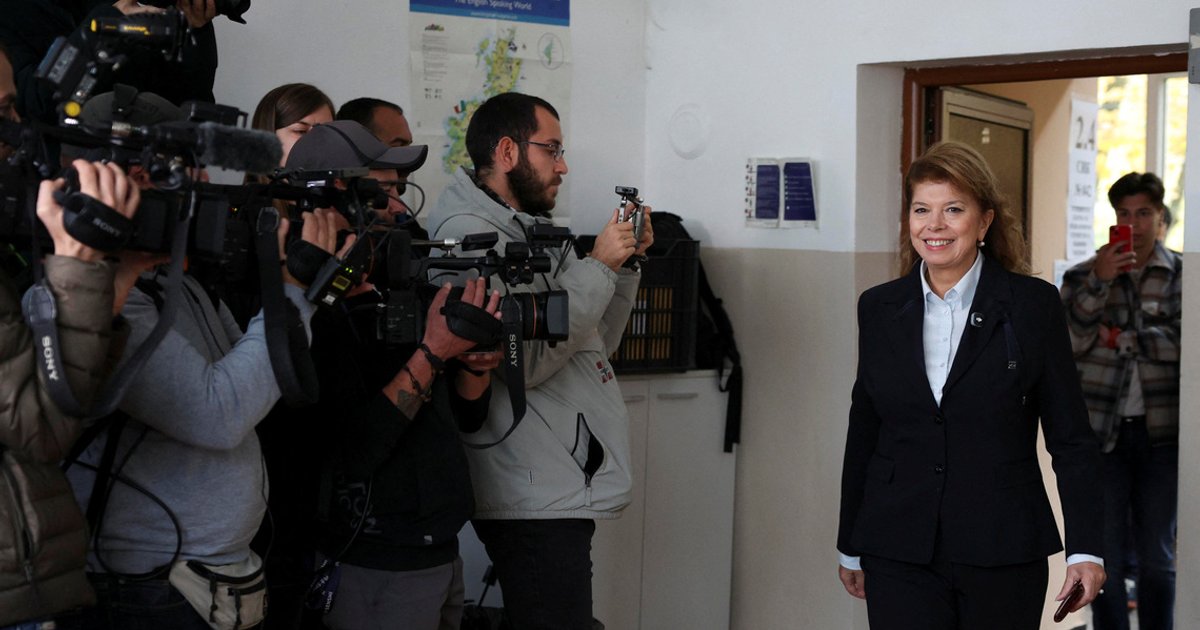
"We are choosing between war and peace," Bulgarian Prime Minister Rumen Radev told voters ahead of Sunday's presidential election runoff between incumbent President Iliana Yotova, who opposes military aid to Ukraine and favors dialogue with Russia, and former caretaker Prime Minister Andrey Gyurov, who is regarded as staunchly pro-European and pro-Ukrainian.
asserted
who → choose → Russia
With these words, it was clear that Sunday's runoff had turned into a kind of referendum on the country's foreign policy and stance on the war in Ukraine.
asserted
runoff → turn → Ukraine
Now that the official results are in and it is clear that Iliana Yotova won the election decisively by 57.6% to Gyurov's 39.5%, Radev claims that Bulgarians have chosen peace.
But is it really as simple as all that?
uncertain
it → win → that
When the presidential election campaign began in Bulgaria on September 25, there did not seem to be any doubt about the outcome: Iliana Yotova was well ahead in the polls on 44.5%.
asserted
Yotova → begin → %
Gyurov, her main rival, trailed far behind on 26.1%.
asserted
Gyurov → trail → %
Yotova was backed by both the prime minister and his ruling Progressive Bulgaria party, which won an absolute majority in the parliamentary election on April 19.
asserted
which → back → April
But the first round turned out to be much tighter than anticipated.
asserted
round → turn → ?
While Yotova got 34.8% of the vote in the first round, Gyurov was close behind on 31.95%, which meant that a runoff between the two was necessary.
asserted
runoff → get → two
While Yotova won the runoff convincingly, both the campaign and the outcome showed that the Bulgarian electorate is divided.
asserted
electorate → win → runoff
This division is both generational and geographical, explains Dimitar Ganev, sociologist and political scientist at the Trend market and electoral research agency.
asserted
Ganev → explain → agency
"Younger voters — those aged between 18 and 40 — favor Gyurov.
asserted
voters → age → Gyurov
Those over 40 tend to prefer Yotova," Ganev told DW.
asserted
Ganev → tend → DW
"It also appears that Gyurov dominates in the capital, Sofia.
asserted
Gyurov → appear → capital
In smaller regional cities, other towns and villages, Yotova dominates decisively," he said.
asserted
he → dominate → cities
While Andrey Gyurov relied mainly on social media for his campaign, Yotova chose to speak mostly to supporters of Progressive Bulgaria in closed venues.
asserted
Yotova → rely → venues
At such events, the war in Ukraine was always high on the agenda.
"As long as I am president, and if you place your trust in me, not a single Bulgarian soldier will go to Ukraine," Yotova declared at an election rally on October 6 — even though according to the Bulgarian Constitution, only parliament (not the president) has the authority to send troops abroad or declare war.
uncertain
parliament → place → war
Throughout the campaign, she referred to her opponents as "warmongers" and described herself as the "president of peace.
asserted
she → refer → peace
"
"We won because we talked to people about income and about peace," Yotova said after the election.
asserted
Yotova → win → election
When it comes to Ukraine, Radev regularly speaks of the need for peace and avoids calling Russia an "aggressor."
asserted
Radev → come → Russia
Both Radev and Yotova oppose military aid to Ukraine and criticize European leaders for not making sufficient efforts to engage with Russian President Vladimir Putin.
asserted
Radev → oppose → Putin
Gyurov, on the other hand, has sharply criticized Russian aggression in Ukraine.
asserted
Gyurov → criticize → Ukraine
Appointed caretaker prime minister by Yotova in February, Gyurov in March signed a security cooperation agreement with Ukraine, provoking the disapproval of both Yotova and Radev.
asserted
Gyurov → appoint → Yotova
The impact of drone attacks in the Black Sea
In the weeks leading up to the election, several ships in the Black Sea were hit by drones off the Bulgarian coast.
asserted
ships → lead → coast
The European Council criticized Russia for the escalation, and the European Parliament called on the EU and its member states "to consider deploying an EU naval operation" there.
asserted
Parliament → criticize → operation
Prime Minister Radev, however, was not as equivocal, going no further than summoning the Russian ambassador and stating that "logic suggests that the outcome" of the attacks in the Black Sea "is to the advantage of the Russian Federation."
uncertain
outcome → go → Federation
Just days before the runoff, he noted that "two ships were struck and sunk in Romanian territorial waters" after Romania had held Russia responsible for the attacks in the Black Sea.
asserted
Russia → note → Sea
"Many people think that once the aggressor is identified, the attacks will stop," he said, downplaying the Kremlin's responsibility.
asserted
he → think → responsibility
His remarks drew criticism from politicians and the media in Romania.
asserted
remarks → draw → Romania
Yotova also did not name Russia as the perpetrator, instead saying during her campaign that she did not want to see "foreign flags in Bulgaria" — a clear reference to the Ukrainian flag, which has been displayed outside several institutions in Bulgaria as a sign of solidarity with the war-torn country.
asserted
which → name → country
How other voters voted
Most opposition parties, including the right-wing conservative GERB led by former long-serving Prime Minister Boyko Borisov, refused to field a candidate for the presidency, which is one reason why turnout on Sunday was less than 30%.
asserted
turnout → vote → Sunday
In the first round, the pro-Russian candidate Kostadin Kostadinov from the nationalist Vazrazhdane (Revival) party came third with 12.5% of the vote.
asserted
candidate → come → vote
According to Dimitar Ganev, around 70% of Vazrazhdane voters backed Yotova in the runoff.
uncertain
% → accord → runoff
To secure their support, Yotova targeted pro-Russian voters.
asserted
Yotova → secure → voters
"Russia is by no means an enemy of Bulgaria," she said in a podcast interview just two days before the runoff, adding "Russia is part of our history, and I very much hope that it will be a key factor in the future security architecture across Europe, including for us."
In the days leading up to the vote, some of her supporters began claiming that the opposition was preparing a "Maidan," a reference to the Ukrainian revolution of 2014 that culminated in the ousting of President Viktor Yanukkovych, who had close ties to Moscow.
asserted
who → say → Moscow
"All of Gyurov's lackeys are speaking openly about inevitable protests.
asserted
All → speak → protests
They're using prime time to stir up a Maidan.
asserted
They → use → Maidan
Every single one of them," Sonya Momchilova, who was appointed to the media regulator by Radev, wrote on Facebook on Sunday.
asserted
who → appoint → Sunday
Similar claims were made by both former Hungarian Prime Minister Viktor Orban and former Serbian President Aleksandar Vucic ahead of this year's elections in their countries.
Bulgaria in the EU and NATO
"This claim that Ms. Yotova will be a president of peace is directly linked to the incitement of a fear of war," said former Defense Minister Todor Tagarev, who was part of the committee that nominated Andrey Gyurov for president.
uncertain
that → make → president
"Bulgaria will be in a much worse position within Europe and NATO under her leadership," he said during a TV interview.
asserted
he → say → interview
Dimitar Ganev, on the other hand, sees no threat to Bulgaria's commitment to the EU and NATO.
asserted
Ganev → see → EU
…and 4 more, not listed.
 The Aporia